Selling on Poshmark vs eBay for Clothing
Poshmark wins on fees for budget items, but eBay pays more as prices climb.
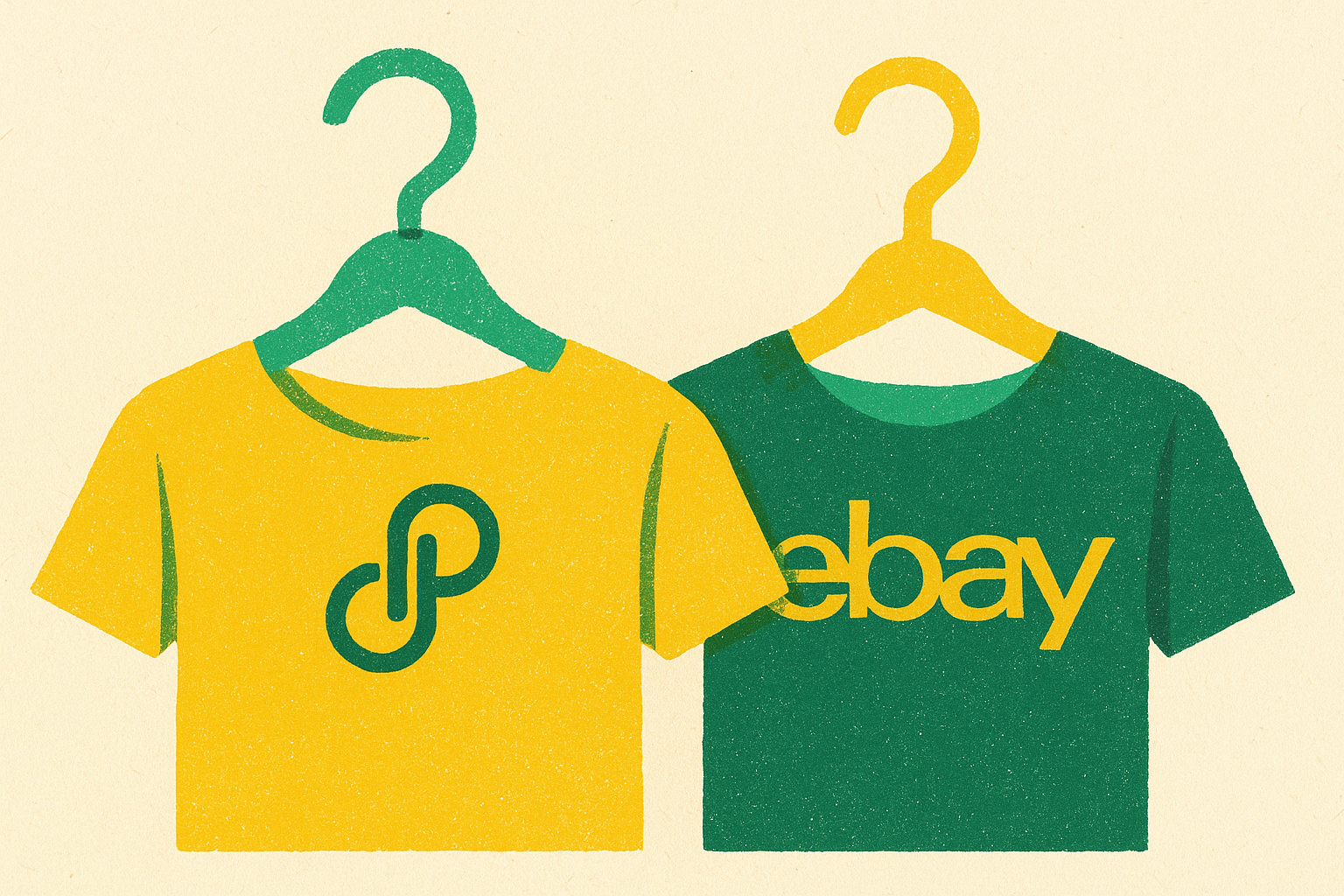
Secondhand clothing hit a record last year. 58% of U.S. shoppers bought used apparel in 2024, according to ThredUp's 2025 Resale Report, and online resale grew 23%, its second straight year of speeding up. So the real question for anyone with a closet full of clothes is where to sell online, not whether to. Poshmark and eBay are the two names everyone already knows, but knowing the name isn't the same as knowing which one actually fits what you're selling. Below is what separates them: who's buying, what fees eat into your check, how shipping works, and how much daily babysitting each platform expects from you.
What each platform actually is and who shops there
Poshmark started in 2011 as a clothing app and never wandered from that lane. Naver bought it in 2023 for $1.2 billion, and it now claims 130 million registered users across the U.S. and Canada. eBay is the older sibling by a couple decades, born in 1995 as an auction site, and now runs fixed-price and auction sales in more than 190 countries. Clothing is one aisle in a very large store.
Here's the part that actually matters: Poshmark buyers browse. They scroll a feed of outfits the way you'd scroll Instagram, half shopping and half just looking. eBay buyers search. They type "women's Levi's 501 size 28" into a box and buy whichever listing looks trustworthy first. Same clothes, two totally different shoppers, and that gap decides how you title something and how long it sits before it sells.
Poshmark says roughly 80 million of its users are there specifically for fashion, and the platform leans hard toward women's clothing and accessories. eBay's 130 million active buyers worldwide are shopping for everything from car parts to Pokémon cards, so clothing has to fight for eyeballs there. But eBay's size cuts both ways. Men's items and odd, niche categories often move faster on eBay simply because it attracts buyers who never set foot in a fashion feed to begin with.
How the fee structures actually compare across price points
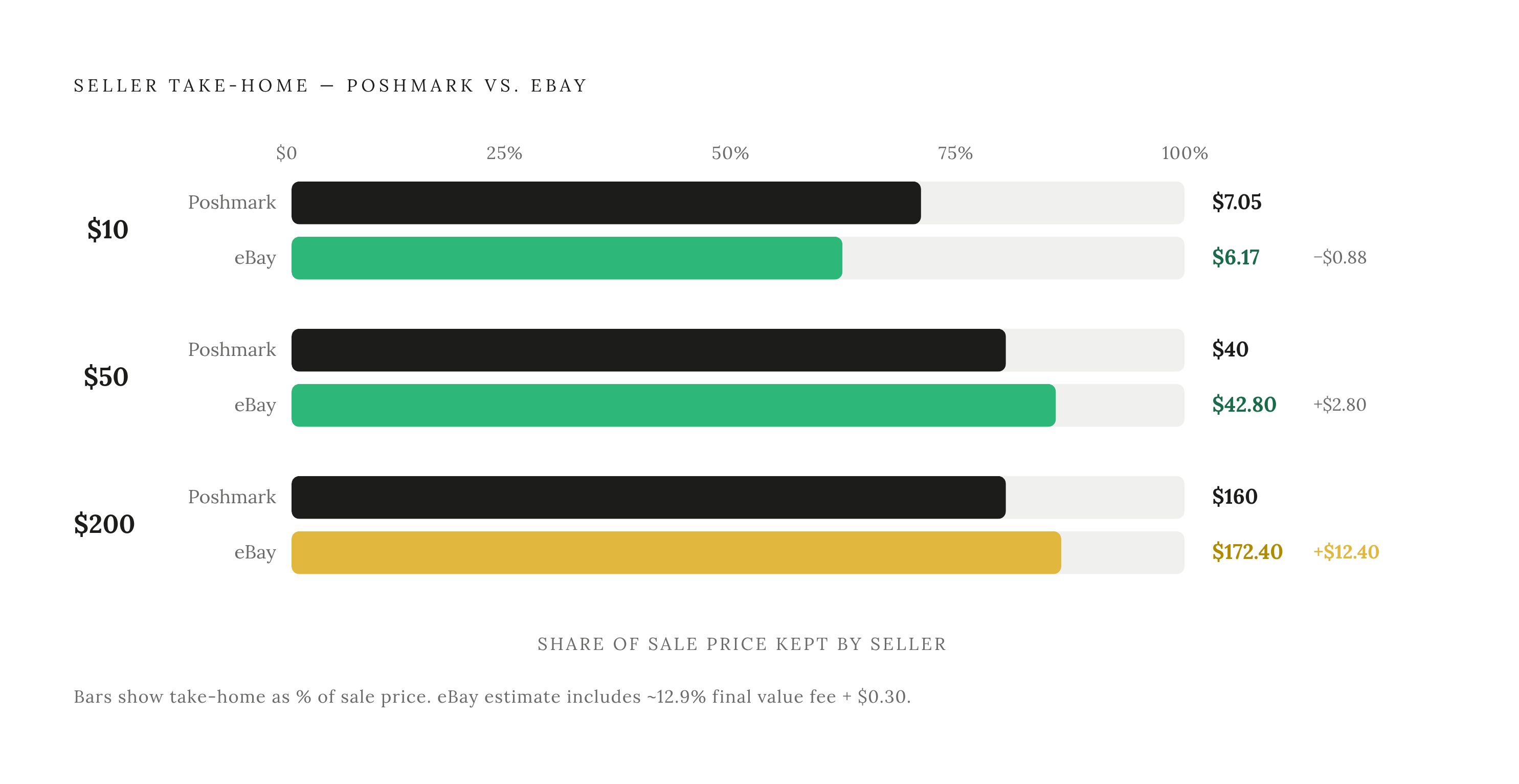
Poshmark keeps it simple: a flat $2.95 fee on anything under $15, then 20% on everything at $15 or above. No listing fees, no processing charge tacked on, no monthly bill. eBay's structure has more moving parts: it charges a 13.6% final value fee plus a small per-order fee on most clothing, gives you 250 free listings a month, and lets you pay extra for promoted-listing visibility if you want it.
Run real numbers and the gap stops being abstract. Sell a $10 item, and Poshmark pays you $7.05 while eBay pays $6.17, so Poshmark wins, barely, though honestly both numbers sting a little for a $10 shirt. Sell a $50 item, and Poshmark keeps $10 in fees versus roughly $7.20 on eBay, a $2.80 gap. Sell a $200 coat, and Poshmark takes $40 while eBay takes about $27.60. Above $15, eBay wins nearly every time, and the higher the price tag climbs, the wider that gap gets.
Poshmark's simplicity still counts for something, though. One fee. No menu of add-ons. No surprise at payout. There's a trap worth flagging: seasoned Poshmark sellers avoid pricing anything under $15, because that flat $2.95 fee works out to an effective rate of 29.5%, worse than the standard 20% on pricier stuff. And one more thing worth knowing: Poshmark briefly rolled out a new buyer-facing fee structure in 2024. Sales dropped fast as buyers bailed mid-checkout, and Poshmark reversed course within weeks. What's live today, since October 24, 2024, is the original structure, restored, no harm done except to whoever approved that meeting.
Shipping: what sellers pay, what buyers pay, and how much friction each model creates
Poshmark hands you a prepaid label. The buyer pays a flat shipping rate, you pay nothing, and you never touch a shipping calculator in your life. As of late 2025, orders ship via USPS Ground Advantage instead of Priority Mail, and if you use Priority Mail packaging anyway, Poshmark tacks on an extra $5. Stick to the free Ground boxes and you're fine.
eBay's setup works differently. You set shipping, free, flat-rate, or calculated by weight and distance, and you get discounted rates through USPS, UPS, and FedEx. That flexibility is real: you can fold shipping into the item price, offer free shipping to rank higher in search, or charge buyers the exact label cost, penny for penny.
It comes down to how much you want to think about boxes. Poshmark removes the decision entirely; shipping is the buyer's flat fee and never your problem. eBay hands you control, but control means choices, and a first-time seller who underprices shipping or scares off buyers with a steep flat rate is taking on real risk without realizing it. Clearing out a closet on a lazy Sunday? Poshmark's hands-off model saves you a headache. Shipping something heavy, or courting buyers who obsess over shipping costs? eBay's control is worth the extra five minutes of math.
What each platform's return and protection policies mean for sellers in practice
Poshmark sales are close to final. Buyers get three days after delivery to flag a problem, and once that window closes, your money releases automatically. Returns outside those three days are rare. eBay runs on a much longer leash: its Money Back Guarantee gives buyers up to 30 days to request a return, and eBay's dispute process leans toward the buyer even when the seller has a decent case.
That's a real exposure gap, not a small one. A Poshmark seller knows their money is safe after three days. An eBay seller sits with a month of uncertainty hanging over every sale, and that uncertainty gets heavier the higher the price tag climbs. Return fraud isn't hypothetical, either. Buyers occasionally send back a different item, or a damaged one, and eBay's judgment calls in ambiguous cases tend to land in the buyer's favor.
Poshmark has an answer for higher-value pieces: Posh Authenticate, a free authentication service for anything sold over $500, which adds legitimacy and shields sellers from "not as described" disputes. Worth knowing if you sell luxury goods: some sellers list counterfeits just under that threshold, specifically to dodge authentication. It's a known scam, which means buyers of genuine luxury pieces sometimes show up wary, through no fault of yours. Poshmark's final-sale model is lower risk day to day. eBay's longer window is the toll you pay for reaching a much bigger buyer pool.
The effort each platform actually requires to make a sale
Listing on Poshmark is fast. Snap photos, add a title, description, size, brand, price, done, mostly from your phone in the time it takes to microwave leftovers. But listing isn't selling. Poshmark's algorithm rewards sellers who stay active: sharing your own listings, sharing other people's listings, following people, showing up at "Posh Parties" (themed selling events inside the app), tossing discounts at people who've liked your stuff. None of that is optional flair. It's how the algorithm decides you still exist.
eBay's workload runs the opposite direction. The listing form up front is longer and less forgiving, asking for condition, measurements, brand, and a pile of item specifics you can't skip past. But once it's live, eBay mostly leaves you alone. A strong, search-optimized title does the heavy lifting, and you don't need to log in daily just to stay visible.
So Poshmark is quick to list but wants daily attention, and eBay asks more of you upfront, then goes quiet. A one-time closet purge probably costs fewer total hours on eBay's list-it-and-walk-away model. But if you like the social side, sharing, following, chatting with buyers, Poshmark's constant engagement feels less like a chore and more like actually belonging to something.
Which clothing categories tend to perform better on each platform
Poshmark's home turf is women's fashion: contemporary brands, fast fashion, shoes, accessories, anything that photographs well in a scroll feed. That tracks with the broader market, too. Women's wear holds roughly 52% of the global secondhand apparel market as of 2025, according to Persistence Market Research, and Poshmark's audience mirrors that split closely.
Tops and T-shirts make up the single biggest product category worldwide, around 35% of the secondhand market, but they're usually cheap, and Poshmark's fee structure eats a bigger bite out of small sales. eBay tends to serve high-volume, low-dollar pieces better for exactly that reason.
Men's clothing skews toward eBay, largely because Poshmark's audience leans heavily female and fashion-first, while men shopping secondhand tend to search rather than scroll. Vintage and collectible pieces lean eBay too. With reach into 190-plus countries, a buyer hunting one specific rare jacket on the other side of the planet can actually find it, something Poshmark's mostly U.S.-and-Canada footprint just can't match. Higher-end luxury items are genuinely split: eBay's lower fees pull one way, Poshmark's authentication program pulls the other, and which one wins depends on whether you'd rather have the extra cash or the extra credibility. Plain basics, unbranded tees, generic jeans, don't do great anywhere. Price the time it takes to photograph and list them honestly before you bother.
How to make the listing itself do more of the selling work on either platform
On eBay, the title is basically the whole game. Buyers search by keyword, so brand, size, color, style, and condition need to sit right there in the title, not buried three lines down in a description the search engine never reads. On Poshmark, that job falls to your cover photo instead. It has to stop someone's thumb mid-scroll, so lighting, styling, and a clean background matter more there than anywhere on eBay.
Condition notes matter on both, for different reasons. eBay's structured condition fields (New With Tags, Pre-owned, and so on) protect you during that 30-day return window. Poshmark has no safety net once the three days pass, so a buyer's trust in your written description is doing a lot of quiet, invisible work.
Price using sold data, never gut feeling. Both platforms let you filter for completed or sold listings instead of active ones, and that's the only number that tells the truth. Active listings show what people hope to get; sold listings show what buyers actually paid, cash on the table, no wishful thinking involved.
Here's the actual bottleneck for most casual sellers, and it has nothing to do with which platform you pick: writing a title, description, and condition note for every single item is exhausting, and it's the reason half of closets never make it online at all. That grind is a real, separate problem from the platform question, worth solving on its own. Some sellers now photograph the item and let an AI tool draft the brand, condition, and category details for them, which cuts the per-item time cost that turns a weekend project into an unpaid second job. Whatever tool you use, the goal is the same: stop rewriting the same listing by hand for every app.
A direct decision guide for sellers choosing between the two platforms
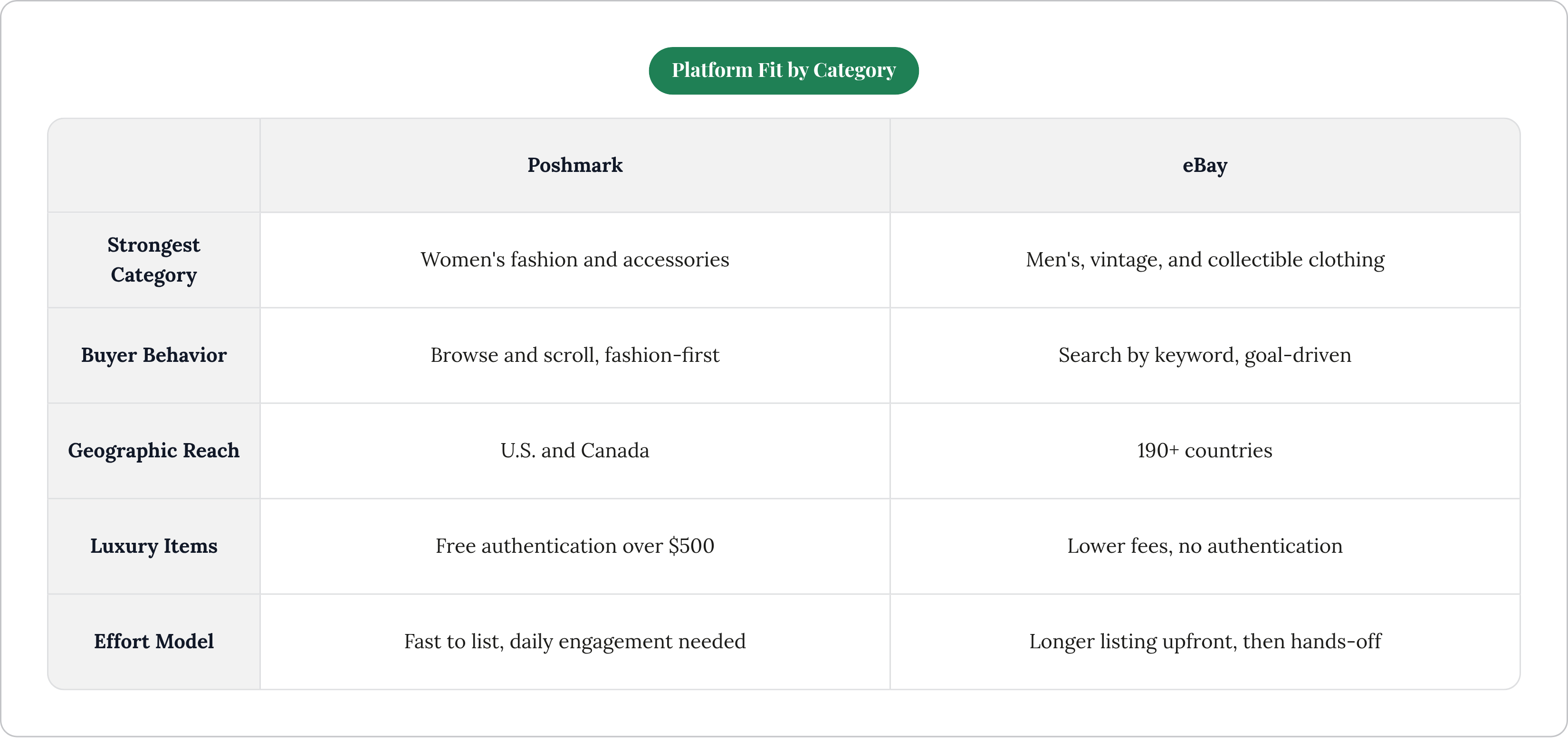
Poshmark makes sense if you're selling women's fashion, contemporary brands, shoes, or accessories, especially in the moderate price range where the 20% fee buys you a built-in fashion crowd. It also makes sense if you never want to think about shipping again (prepaid label, buyer pays, done) and you don't mind sharing listings daily to stay visible. A fast three-day payout with final-sale protection is the reward for that upkeep.
eBay makes more sense for men's clothing, vintage finds, or pricier pieces, where the fee gap actually changes your take-home pay ($27.60 versus $40 on a $200 coat adds up fast across a whole closet). It's the better call if you want buyers outside the U.S. and Canada, since 190-country reach turns a rare or niche item into something the whole world can bid on. And it suits sellers who'd rather write one strong listing and let search traffic do the rest, instead of logging in daily to share and chat.
Got a mixed closet? Some contemporary women's pieces, some vintage menswear, a couple things worth real money? Nobody's making you pick one. Plenty of sellers run both accounts and just send each item to whichever platform its buyer actually shops on.