OfferUp vs Facebook Marketplace for Furniture
Facebook's larger audience closes furniture deals twice as fast as OfferUp for most pieces.

Furniture doesn't fit in a padded envelope, and that single fact shapes everything about selling it online: where you list it, how you price it, whether the deal falls apart at the curb because nobody thought about the stairwell. The U.S. second-hand furniture market hit $13.25 billion in 2025 and is headed toward $20 billion by 2031, with real money moving through folding tables and curbside pickups. Whether you're set up to catch your share of it is the only real question.
A used iPhone ships in a box. A used sectional does not. Furniture is heavy, it's awkward to move, and shipping it usually costs more than the piece is worth, so almost every sale happens locally, with a stranger showing up at your door and squinting at your couch like it owes them money. Buyers need to see the thing in person; a photo can flatter a couch in ways it can't flatter a phone case. And because you're now coordinating pickup times, parking, elevators, and sometimes a second set of hands to get a dresser down a stairwell, there's friction baked into this category that doesn't exist when you drop a padded envelope in a mailbox. Most household pieces land in the $50 to $300 range too, which is enough to interest someone but nowhere near enough to survive shipping costs if you try to get cute about it.
Picking the right platform isn't a minor detail here. Get it wrong, and you're stuck waiting three weeks for a single bite, or watching a buyer ghost you five minutes before pickup with a "sorry, car trouble" text that both of you know is a lie.
How Facebook Marketplace and OfferUp are actually different from each other
Facebook Marketplace rides on the back of the social graph. You don't download a new app or set up an account; the listing just appears to people nearby who are already scrolling Facebook for reasons that have nothing to do with furniture. It's discovery by accident, and that accident happens constantly, which is sort of the whole point.
OfferUp took the opposite route. It was built mobile-first from day one, and it turned into a serious local resale player after absorbing Letgo in 2020, a merger that folded a huge slice of competing listings into one app.
Trust is where the two really part ways. OfferUp leaned hard into formal trust features early on: buyer and seller ratings, in-app messaging, an identity check called TruYou. It even suggests meet-up spots in police station parking lots, which sounds almost quaint until you're the one handing a stranger $400 in cash for a dresser. Facebook Marketplace runs on social profiles instead, and that works fine when the buyer's profile has eight years of vacation photos and three mutual friends. But it works a lot less fine when the account was created last Tuesday and the name sounds like it was generated by a bot naming contest.
Local, in-person sales cost nothing on either app; cash and pickup means you keep every dollar. That matters more here than in almost any other resale category, since local is basically the only mode furniture moves in. OfferUp also lets sellers pay for a Boost to push a listing higher in search, and Facebook has no clean equivalent. On raw audience size, Facebook wins easily, simply because it's riding on Facebook's enormous user base. OfferUp's crowd is smaller, but it tends to show up already intending to buy something rather than idly scrolling between ads.
Where Facebook Marketplace pulls ahead for furniture sellers
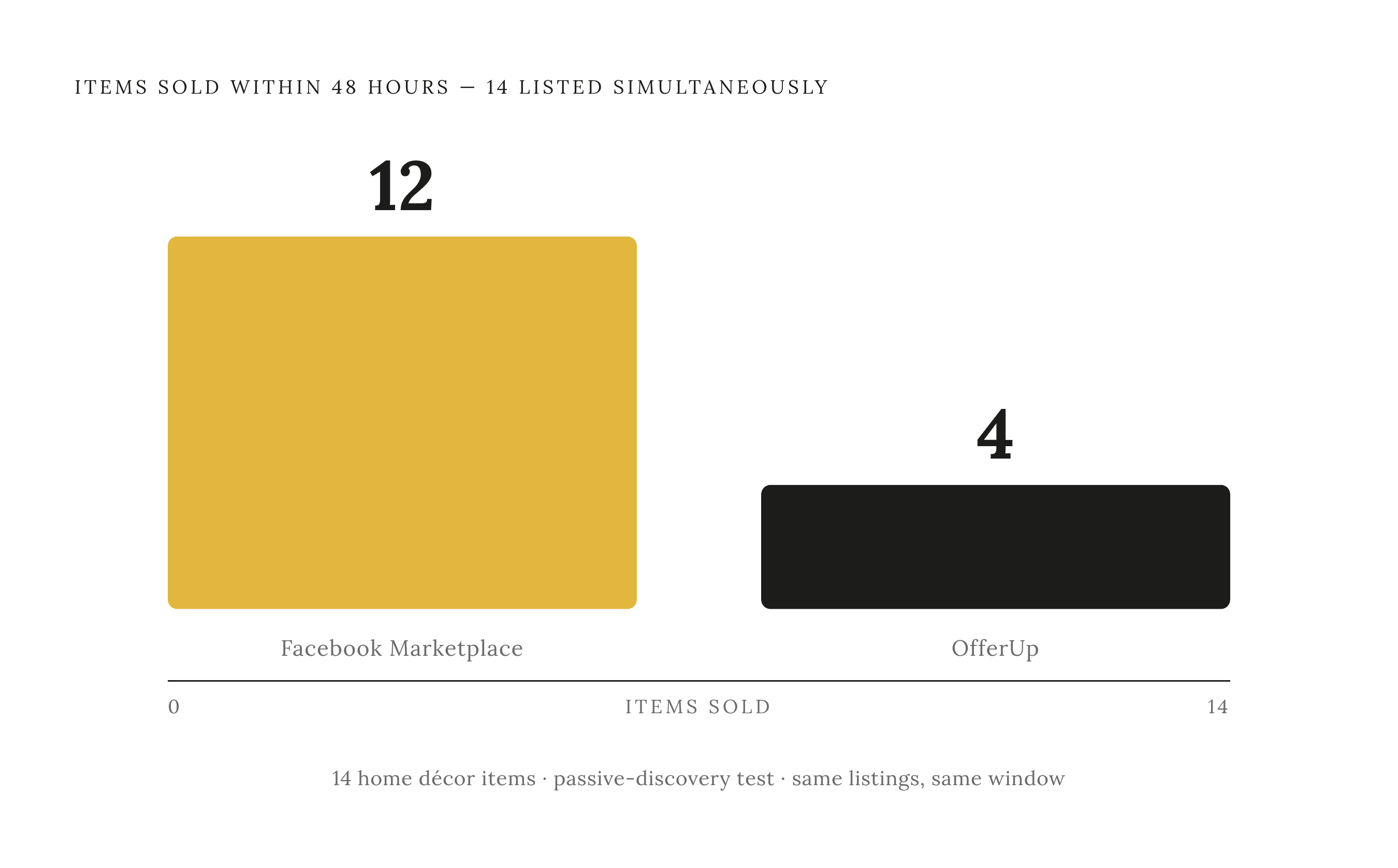
Size wins on speed. Facebook Marketplace's audience moves faster on household furniture under $300, and it's not close: in one seller test covering 14 home décor items (mirrors, baskets, lamps, that sort of thing), 12 sold locally on Facebook Marketplace within 48 hours. OfferUp moved 4 in that same window.
Furniture shoppers browse casually and buy on proximity, which is a fancy way of saying nobody wakes up planning to buy a couch. They see one two miles away while scrolling for something unrelated, and suddenly they're measuring their living room with a tape measure they didn't own an hour ago. Facebook's algorithm is built for exactly that kind of passive discovery, surfacing listings to people who never searched for them. OfferUp doesn't replicate that at the same scale, not yet anyway.
Common furniture doesn't need a trust-building campaign either. A bookshelf isn't a luxury handbag; nobody's checking for authenticity papers. Clear photos and a fair price close most deals on their own, and for well-priced listings, conversions on local furniture typically land somewhere in the 48 to 72 hour window. Something's probably wrong with the price if your listing's been up longer than that with no bites.
There's a quieter benefit too, buried in the social layer: buyers can often see mutual friends on a seller's profile, which takes some of the edge off inviting a stranger into your apartment. It's a small thing, but it adds up when you're trying to get someone to actually show up instead of flaking.
If you're moving an Ikea bookshelf, a sectional, or a dining set, start on Facebook Marketplace. Everything else is a distant second.
Where OfferUp earns its place in a furniture seller's toolkit
Fewer eyeballs isn't automatically a bad thing. OfferUp's smaller crowd tends to mean fewer no-shows and fewer "is this available" messages that vanish into the void the second you say yes, and the buyers who do show up tend to actually mean it.
That makes OfferUp the better call for higher-value pieces, a vintage credenza, a solid-wood dining table, anything where you'd rather wait a week for the right buyer than rush the first curious stranger through the door. It's also the stronger option when safety is genuinely on your mind. TruYou verification and those police-station meet-up spots add a layer of accountability a random Facebook profile just doesn't offer. Handing over a $600 sideboard feels different when the buyer has a rating history attached to their name instead of a profile picture from a wedding you clearly weren't invited to.
OfferUp also works as a solid second pass. If a piece has sat on Facebook Marketplace for a week with nothing, cross-posting to OfferUp taps a partially different local audience, one that might have exactly the buyer Facebook's algorithm missed entirely. The Boost feature gives you a way to force visibility on a stalled listing without immediately slashing your price, which is worth trying before you start negotiating against yourself out of impatience.
List common pieces on Facebook first. If a week passes with nothing, cross-post to OfferUp before you touch the price.
The fee structure and what it actually costs to sell furniture on each platform
For local pickup, the fee conversation is over before it starts: both platforms charge zero, and you keep everything.
Fees only enter the picture when a piece is small enough to ship, a side table, a lamp, a set of dining chairs. Facebook Marketplace charges 10% on shipped items (up from 5% before April 2024), and it stopped offering prepaid shipping labels to most sellers in February 2025, which adds an extra logistics headache nobody asked for. OfferUp charges 12.9% on shipped sales with a $1.99 minimum, and that minimum stings on cheap items where the fee eats a disproportionate bite of the sale.
Shipping a dresser or a bookshelf usually costs more than whatever fee difference you'd save by switching platforms anyway, so this comparison is real but rarely decisive. Local sale is the only sane option for most furniture. What actually decides the sale is audience and trust, not a percentage point or two.
How to price a used furniture piece so it actually sells
Asking prices are wishes, and sold prices are facts. Price off what other sellers hope to get, and you're pricing off fiction, and fiction doesn't sell couches.
The most reliable method: search your item on eBay, filter to "Sold items," and read the actual green completed-sale numbers. This works even for furniture you're planning to sell locally, because it tells you what buyers really paid, not what some optimist listed it for last March. Pull 5 to 10 comps in similar condition, land somewhere in the middle of that range, and move on.
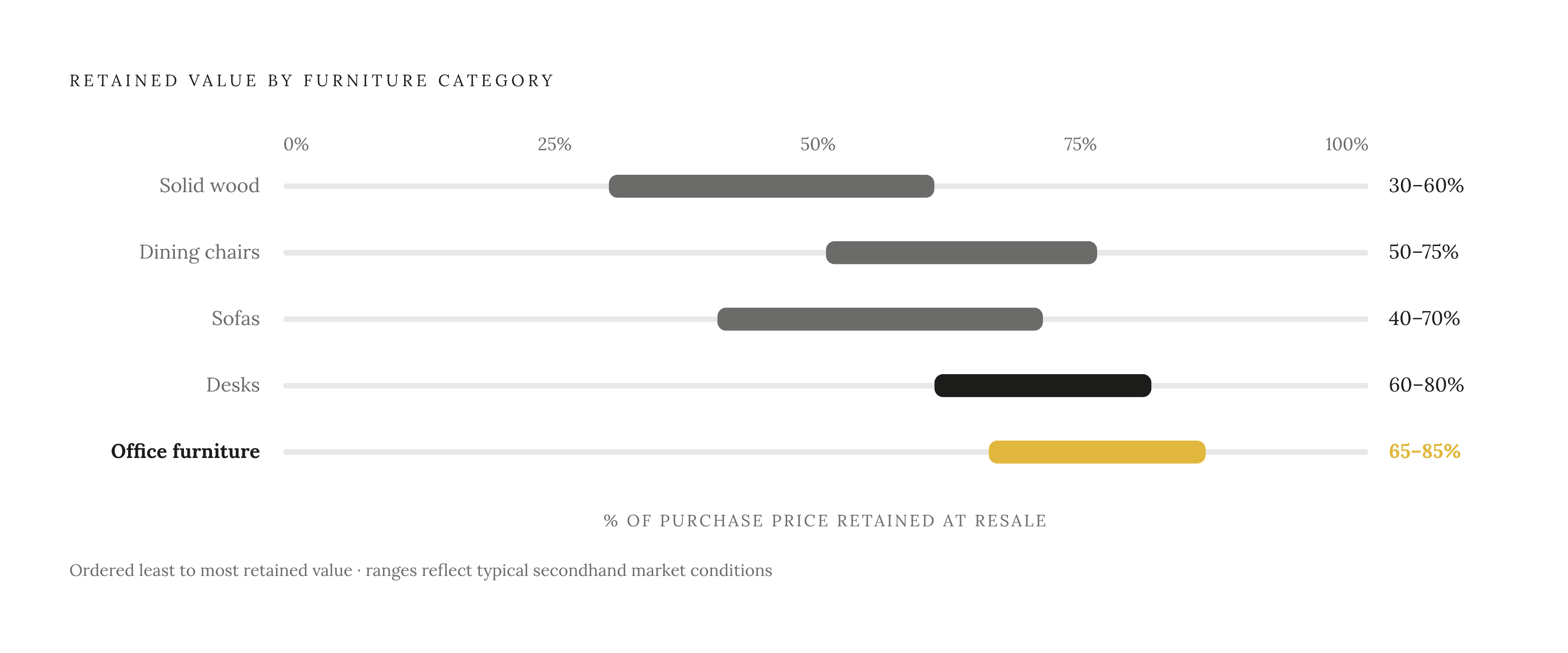
Depreciation varies by category. Sofas typically shed 30 to 60% of original retail depending on brand and local demand. Solid wood holds up better, dropping 40 to 70% but staying desirable longer than flat-pack pieces do. Dining chairs run 25 to 50% down, and selling the full set nets more total money than piecing them out one at a time. Desks lose 20 to 40%, with solid wood and standing desks aging better than particleboard. Office furniture, task chairs and filing cabinets, tends to land in the 15 to 35% range.
As a rough rule, most furniture loses 20 to 30% of its value in year one, and second-hand pieces tend to hold onto 20 to 50% of original value a few years out from there. Whatever number you land on, add a negotiation buffer: list somewhat above what you'd actually accept. Buyers on both platforms expect to haggle, and a listing with zero room to move often just stalls instead of selling, because everyone likes to feel like they won something.
Condition honesty isn't optional here. A stain or scratch that shows up in photos but never gets mentioned in the description doesn't just annoy people; it generates no-shows and disputes the second the buyer sees it up close. Describe it, or price around it, but don't just hope nobody notices, because they will.
If digging through comps by hand sounds like a chore you'd rather skip, an app like Reclaim can shortcut it: snap a photo, and it spits out a condition grade and a market-informed price without an evening lost to eBay's sold listings.
Writing a listing that gets the furniture sold, not just seen
A good listing does two jobs simultaneously: it filters out the tire-kickers and gives a real buyer everything they need to say yes without a single follow-up question.
Photos matter more here than in almost any other resale category. Shoot in natural light, from multiple angles, front, side, close-up on any wear. If there's damage, photograph it; hiding it just guarantees a no-show once the buyer sees it in person and feels lied to. Show some sense of scale too, since a chair floating alone in an empty room is genuinely hard to judge on a five-inch phone screen.
Titles should lead with the words people actually search: brand name if it's recognizable, material (solid oak, velvet, leather), the type of piece, the color. "Couch for sale" tells a buyer nothing, while "West Elm Andes sofa, gray fabric, excellent condition" tells them everything in one line, and that's the difference between a click and a scroll-past.
Descriptions need dimensions. That part isn't optional for furniture, since nobody wants to discover their doorway is two inches too narrow after they've already driven across town. Include the original retail price if the piece was expensive, since it anchors the buyer's sense of value, plus honest condition notes and pickup logistics. Ground floor versus third-floor walk-up genuinely changes whether someone bothers showing up at all.
On Facebook Marketplace, respond fast. The algorithm rewards active listings and buries slow ones, so a delayed reply doesn't just cost you that one buyer, it dings your visibility with the next ten. On OfferUp, fill out your profile completely and build a ratings history; it visibly shifts how much a buyer trusts you before you've even sent a reply.
Honestly, the listing itself is what stops most people from posting at all, and a blank description box is more intimidating than it has any right to be. Tools like Reclaim can generate that description and a price straight from a photo, which clears the blank-page problem and gets the piece out of your garage instead of sitting there through another six months of good intentions.
Choosing between the two platforms based on what you're actually selling
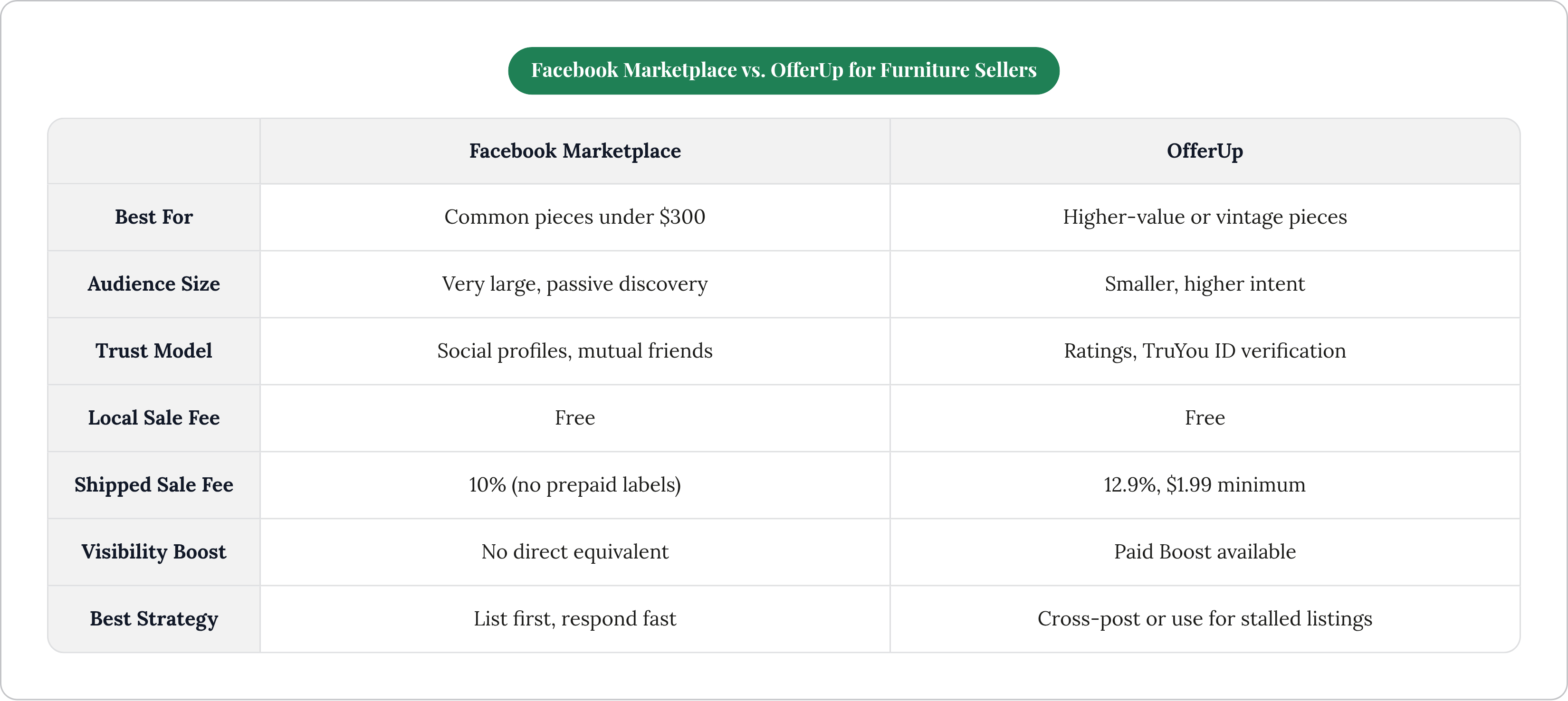
For most furniture, Facebook Marketplace is the default: bigger audience, faster sell-through, zero fees on local deals, and social profiles that make both sides feel a bit safer meeting a stranger in person.
OfferUp earns its spot when the piece is worth more, when you want a buyer with a verified identity and a rating history behind them, or when something's already stalled on Facebook and needs a different set of eyes on it. None of that is an edge case; it shows up constantly once you're selling furniture with any regularity.
For anything priced above a couple hundred dollars, there's no real reason not to list on both. It costs nothing extra, it doubles your exposure, and the only downside is remembering to mark the item sold on both apps once it's gone, so you're not fielding messages about a couch that left your apartment three days ago.
Anything common and under a modest threshold in decent shape doesn't need this whole debate. Facebook Marketplace, priced at a sold comp, clean photos, done, and then let the platform's own volume do the heavy lifting from there.
Platform choice is a lever. Pricing and photos are the engine, and getting those two right is what gets the couch out the door on either app.