Best Marketplace for Selling Used Electronics
The used electronics market moved $222 billion globally in 2026, and US e-commerce electronics sales alone cleared $74 billion in 2024. Electronics is eBay's single biggest category, 16.4% of everything listed on the site. The average American household has roughly $3,100 in unused gear sitting around, and most of it is phones and laptops collecting dust in a drawer somewhere.
Here's the part nobody tells you before you list your old iPhone: the same phone, in the same condition, sells for different money depending on where you post it. That's not because the phone changes, but because the crowd looking at it does. So "what's the best marketplace" is the wrong question. Ask what you're selling first, then figure out where it should go.
The core tradeoff every seller faces before choosing a platform
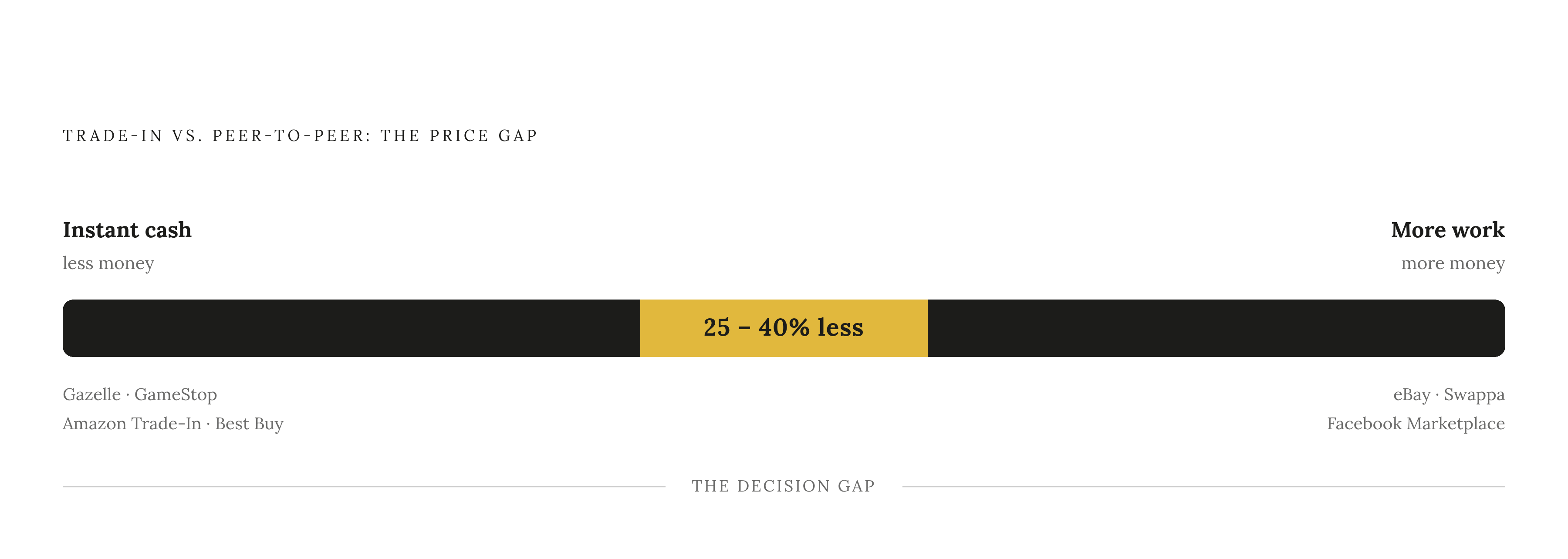
Every sale sits somewhere on a line between two ends. On one end: instant-quote and trade-in services like Gazelle, GameStop, Amazon Trade-In, and Best Buy, where you get a number in seconds and cash in a few days. On the other end: peer-to-peer marketplaces like eBay, Swappa, and Facebook Marketplace, where you do more work and walk away with more money.
That gap isn't small change. Instant-quote services usually pay 25 to 40% less than what the same device would fetch on a marketplace, and you're trading real dollars for convenience, full stop.
I think about it this way: figure out the dollar gap between the quick quote and what you'd realistically get listing it yourself. If that gap is small, take the quote and move on with your life. If it's large, the extra hour of listing and photographing pays for itself many times over, and somewhere in the middle, it just depends on how busy your month is.
There's a second axis, separate from speed versus payout: local versus shipped. This matters most for anything heavy, since shipping a desktop tower or a 27-inch monitor eats your margin alive in box costs and freight. Local sale wins on bulky stuff even when it wouldn't win on a phone.
One housekeeping note: Decluttr shut down in June 2025, so if you've read older advice mentioning it, cross it out.
How to price any used electronic before you list it anywhere
Price off sold listings, never active listings, since active listings show you what hopeful sellers are asking while sold listings show you what buyers actually paid. Those two numbers are often nowhere close, and on eBay, the gap between asking price and final sale price runs 30 to 80%. Guess wrong and you either sink your own listing or leave money on the table.
Finding sold data on eBay isn't hard once you know where to click. On desktop, search your item, then check "Sold Items" under "Show only" in the left sidebar; on mobile, tap "Filter," then "Sold Items." Standard search only covers the last 90 days, which is fine for most electronics since they lose value fast anyway. For older or rarer devices, eBay's Terapeak tool inside Seller Hub goes back two to three years and shows actual Best Offer prices, not just the sticker number.
Pull at least eight or ten comparable sales before you settle on a price, since two or three isn't enough. You'll just anchor to whatever number happened to show up first, which is how sellers end up either overpricing or leaving cash behind.
Electronics lose value month to month, so weight recent sales heavier than old ones; a comp from three months back on a fast-moving phone model is basically ancient history by now. Match your comps carefully too: condition, storage size, color, carrier lock status. A locked phone and an unlocked one are different products with different price tags, even if they look identical in the photo.
If you'd rather skip the manual digging, pricing tools like Reclaim pull sold data automatically and spit out a number, which frees up the time you'd have spent hunting comps for actually writing the listing.
Smartphones: where Swappa's trust premium and Facebook's zero-fee local option split the decision
Phones are the most liquid category in used electronics: biggest buyer pool, deepest comp history, fastest turnaround.
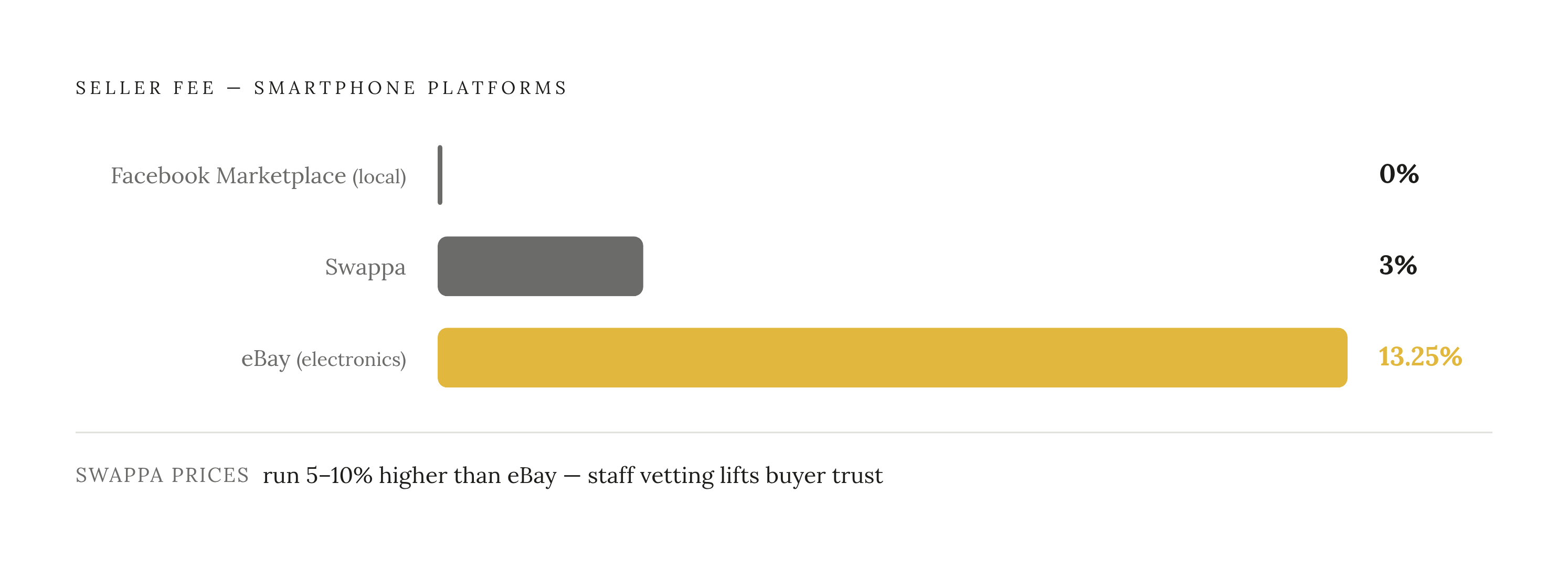
Swappa is the specialist, and it shows in the fee alone. Sellers pay a flat 3%, against eBay's 13.25% on electronics, which should make anyone pause before defaulting to eBay out of habit. Every listing gets staff-reviewed: the device has to work fully, carry a clean IMEI, and have no activation lock. Because of that vetting, Swappa prices for phones run 5 to 10% higher than eBay, since buyers pay more for something they trust. The tradeoff is a smaller audience, so an older or less popular model can sit for weeks.
eBay is still the fallback for sheer reach, since over 135 million users means even a beat-up five-year-old Android phone finds somebody eventually.
Facebook Marketplace, for local pickup, charges zero fees on in-person deals, the highest net payout you'll get if you're fine meeting a stranger in a parking lot. It works best for popular current-generation phones where local demand runs hot. One change worth flagging: as of February 2025, Facebook stopped offering prepaid shipping labels for most sellers, so a shipped sale now means buying your own label. And if you ship through Facebook, the commission is 10%, double what it was before April 2024.
Trade-in makes sense here mostly when the phone is old, cracked, or you genuinely have no bandwidth to field buyer texts for a month. Expect 25 to 40% less than peer-to-peer. Whatever platform you pick, unlock the phone from its carrier first, since a locked device sells for noticeably less no matter where you put it.
Laptops and MacBooks: eBay's depth vs. Swappa's vetting vs. local sale for heavy machines
Laptops flip the math slightly, mostly because they cost more and weigh more than phones. Higher value means a few points of fee difference adds up to real dollars fast, and heavier means shipping costs bite harder, so local sale starts looking better the bulkier the item gets.
Swappa covers MacBooks and laptops at the same 3% fee with the same vetting. It fits current-generation MacBooks and premium Windows laptops well, where buyers are patient enough to wait for verified stock instead of gambling on a random eBay listing.
eBay is the better call for older, cheaper, or oddball models, since that 135-million-plus user base means even a beat-up refurbished ThinkPad from six years ago finds a home. eBay moved over $12 billion in electronics last year alone, and that depth matters once you're outside the mainstream current-model lane.
For bulky machines, desktops, all-in-ones, monitors, Facebook Marketplace and OfferUp are the local-sale go-tos. Shipping a desktop PC rarely justifies the packing headache or the box cost, so local pickup skips both problems at once. OfferUp runs over 2,000 Community MeetUp Spots, mostly police stations and monitored retail locations, a solid option when you're handing off something pricey to someone you just met online.
Write down the specifics on laptops: battery cycle count, screen wear, keyboard condition. Buyers expect this, and listings that skip it just sit there.
Amazon Trade-In takes laptops but pays only in Amazon gift card credit, not cash. That's fine if you were already about to buy something from them anyway, but otherwise, it's worth skipping.
Gaming consoles and games: a category where GameStop promotions and Facebook local deals compete with eBay bundles
Consoles have a lively resale market, full of younger, price-conscious buyers who are perfectly comfortable buying used.
GameStop trade-in is the one spot in this whole piece where a physical retail chain competes seriously with online marketplaces. Cash payouts alone run 30 to 50% of market value, which is low, but GameStop periodically runs "extra trade credit" promotions timed around new game launches, and if you time your trade-in around one, the gap closes fast. Worth it mainly when the console is current-gen and a promo happens to be running, or when speed matters more than the extra cash would.
eBay shines for complete bundles: console, controllers, a stack of games thrown in. Buyers hunting for a bundle expect to pay a premium for the convenience of one purchase, and sellers capture that premium.
Facebook Marketplace works well locally, zero fees, and buyers often want to plug the thing in and test it before handing over cash, since a living room test-run is just the natural way consoles get sold.
Swappa covers consoles too, same low fee, same vetted-listing setup as phones and laptops, worth a quick check before assuming eBay is your only option.
For individual games: eBay for rare or retro titles that collectors track down, Facebook Marketplace for common current-gen discs where local demand runs high and mailing a single game case feels like overkill.
Tablets, smartwatches, and audio gear: matching niche devices to the right audience
Tablets split by brand. iPads do well on both eBay and Swappa: Swappa for newer models in clean shape, eBay for older generations or anything with damage. Android tablets lean toward eBay as the main venue, since Swappa's vetting doesn't buy you as much trust here (buyer confidence in non-Apple tablets runs lower to begin with, regardless of platform). Facebook Marketplace works nicely for local iPad sales, especially with parents shopping for a kids' tablet who'd rather watch it turn on before they pay.
Smartwatches follow a similar pattern. Apple Watch does well on both Swappa and eBay, but document the band and case condition more carefully than you would on a phone, since both move the price. Other smartwatch brands do better on eBay simply because the audience is bigger; niche models won't move much on Swappa's smaller crowd.
Audio gear splits into pieces. Swappa covers headphones, earbuds, and speakers, and fits premium brands (Sony, Bose, Apple AirPods) well, where buyers care a lot about verified condition. eBay handles everything else since the category is broad and its audience covers all of it. Bulky speakers and home audio setups go local, on Facebook Marketplace, for the same reason desktop PCs do, since shipping a subwoofer is a headache nobody wants, buyer or seller.
Cameras and lenses get their own lane. Swappa covers cameras too, and photography buyers are picky about sensor condition and shutter count, so vetted listings matter more here than almost anywhere else. eBay backs it up for less common brands or older bodies. And for sellers who shoot regularly and want a dedicated resale channel, MPB and KEH are specialist camera platforms, though they act more like trade-in services for casual sellers than open marketplaces.
When trade-in services actually make sense
Trade-ins earn their keep in a few specific situations, not as a default choice. If the device is damaged, cracked, or partly working, marketplace buyers will demand a steep discount anyway, so trade-in services essentially grade on the same curve you'd face regardless. If the device is several generations old and your comp research shows a low ceiling, listing it yourself probably isn't worth the afternoon, and if you're moving, clearing out a house, or working against a deadline, time is the scarce resource, not money.
Gazelle takes phones and laptops and pays via PayPal or check. Reviews run mixed, and a common complaint is that the final offer, after inspection, lands noticeably lower than the initial quote. Get the quote, then check it against eBay sold data before committing to anything.
Amazon Trade-In covers a wide range of devices, ships a free label, and inspects on arrival. The catch is the payout: gift card credit only, no cash. That's great if you already shop there regularly, but pointless otherwise.
Best Buy Trade-In handled over 777,000 trade-ins in fiscal year 2025, real scale behind the program, though the same limitation as Amazon applies: you get paid in store credit, not cash.
The math stays roughly the same across every category: small gap between quote and market value, take the quote; big gap, list it yourself; anything in between comes down to how much your time is worth this particular week.
Staying safe on local marketplace transactions
Local sales pay the most, dollar for dollar, and safety is the real reason a lot of sellers avoid them anyway and default to shipped platforms instead. Fair concern, but you can get the higher payout without much added risk if you're careful about it.
OfferUp built over 2,000 Community MeetUp Spots for exactly this reason, police stations and retail locations with round-the-clock video coverage, so if one's near you, use it.
A few habits go a long way: meet in public, well-lit places during the day (a coffee shop, a bank lobby, a MeetUp Spot), bring a friend for anything expensive, and test the device with the buyer standing right there before money changes hands. That last one alone kills most disputes before they even start. Take cash or a payment app that confirms instantly, Venmo, CashApp, Zelle, but never a check, and never accept an "accidental" overpayment.
Speaking of which, know the common scams on Facebook Marketplace before you stumble into one. The overpayment scam: a buyer sends too much "by mistake" and asks for a partial refund before their original payment even clears, which it never does. The fake screenshot: someone shows you a picture of a bank transfer that was never actually sent. And the shipping redirect: a buyer insists you ship somewhere other than their listed address, which is your cue to say no thanks and move on to the next buyer.