How to Write a Used Item Listing That Actually Sells
Clear product photos and honest condition details matter more than clever copy.
Most used item listings don't fail because nobody wants the item. They fail because the listing leaves buyers with questions, and on a platform with hundreds of similar options, an unanswered question is just a reason to keep scrolling. The resale market hit $186 billion in 2024. Buyers have options. Yours needs to remove every doubt before they find someone else's.
Every element of a good listing exists to eliminate one specific friction point. Fix them in order and a buyer reaches checkout without having to ask you a single thing.
Write what a buyer would type. That's it.
Words like "beautiful" or "rare" aren't search terms. They eat character space that could hold something a real person actually searched for. eBay gives you 80 characters. Use them.
The anatomy of a title that gets found:
- Brand + item type + key attribute (size, model, color) + condition
"Nike Air Max 270 Men's Size 10 Running Shoes Black/Red" matches a specific search. "Men's Sneakers" matches almost none. A few things to skip entirely: padding with synonyms, stacking the same keyword twice, and writing "vintage" when you mean "used from 2018." Algorithms flag the first two. Buyers clock the third immediately and it erodes trust before they've read a word of your description. Think of a weak title like a storefront with the lights off — technically open, but nobody's walking in.
What the Description Needs to Do in Under Eight Seconds
Eight seconds. That's the real benchmark. A buyer should understand the full listing in that time without reading every word, which means you lead with the most important fact and let bullets carry the rest. Walls of prose make buyers work. Bullets let them find what they need and move on.
Every description needs to answer:
- What exactly is it? Brand, model, year if relevant
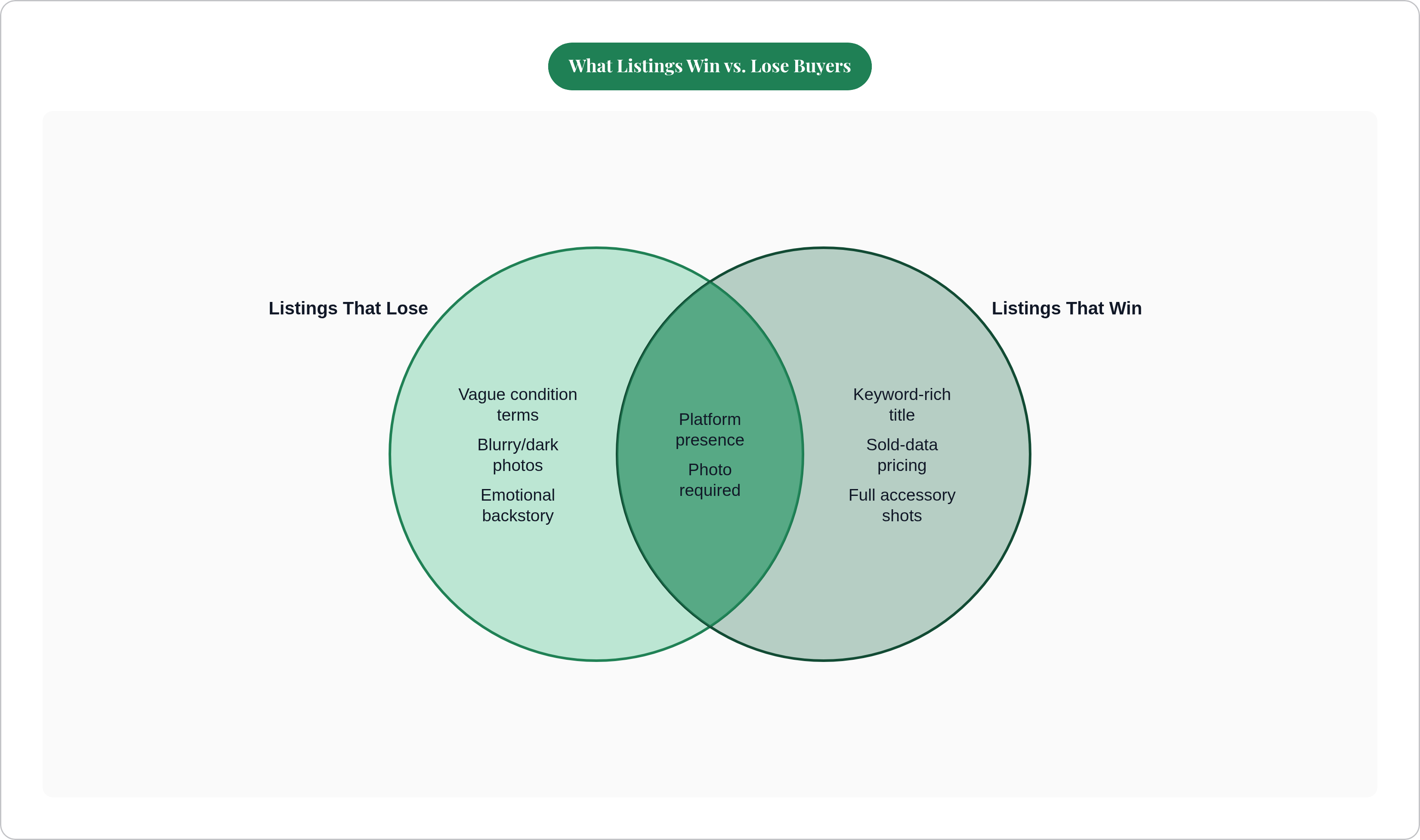
- What condition is it in? "Good condition" means nothing to anyone. Use anchors: new-with-tags, like-new, gently used, well-loved. Then name every actual flaw. A scratch, a stain, a missing button. Surprises generate returns, and returns are a headache you don't need.
- What's included? Charger, remote, original box, manual. Accessories can add 10 to 20% to what a buyer is willing to pay.
- For clothing and shoes: size, how it fits relative to standard sizing, and measurements if you can get them. Saves everyone a back-and-forth.
One thing worth doing every time: write "purchased new for $X, asking $Y." It frames the deal without you having to make a pitch. If the item is still sold at retail, a link to the original listing lets buyers verify the value on their own terms.
Listings that name every flaw upfront close faster than listings that hide them. Not because buyers love flaws. Because the ones who see the scratch and still inquire are actually going to buy. The others were going to find a reason to bail anyway. A missing detail in your description is like a hole in a boat — small at first, but it's still the reason the thing sinks.
Photos as the Primary Trust Signal Buyers Use Before They Read Anything
A blurry or dark photo in a feed means buyers never even reach your title. You've already lost them. The photo is the listing, in the first half-second, before anything else registers.
The setup is simpler than most people make it:
- Natural daylight, diffused. Flash flattens things and makes colors look wrong.
- Clean background so the item reads clearly against it.
- Bump brightness slightly so it pops in a thumbnail feed.
The shots that actually matter:
- One full-item establishing shot on a clean background
- Multiple angles. Back, bottom, inside. Things that are obvious to you are not obvious to someone who can't hold it.
- Close-ups of brand labels, model numbers, serial plates where relevant
- Close-ups of every flaw, no exceptions
- All accessories photographed together so buyers can verify completeness at a glance
That last point about flaws is counterintuitive. A photo of a scratch is more reassuring than a sentence about it. It shows you're not hiding anything, which matters more than whether the scratch is even that bad. Buyers who can see the flaw trust the listing. Buyers who read "minor wear" and have to wonder what that means often just move on.
eBay lets you upload up to 24 images. Use what the item actually warrants. Extra shots that add nothing new are just noise.
Pricing from Sold Data, Not from Gut or Other Listings
The most common pricing mistake is comparing to what other sellers are asking instead of what buyers have actually paid. Active listings show seller hopes. Sold listings show what the market decided. Those are two very different numbers, and confusing them is how you end up sitting on an item for six weeks convincing yourself it's unlucky when it's just overpriced.
The method:
- Find 3 to 5 completed sales for the same item or something close to it
- Note the condition spread across those comps and place your item honestly within it
- Price within the range those comps define. Lean toward the lower half if you want it gone fast.
- A rough baseline for most everyday used goods: 20 to 40% of original retail, adjusted for condition and demand
Build in a negotiation buffer, but size it to the platform (more on that in the next section).
A couple of other things worth knowing:
- Psychological pricing: just under $200 instead of exactly $200, just under $500 instead of exactly $500. Buyers filtering by price range are more likely to encounter your listing when it sits just under a round number. Costs nothing, worth doing.
- Reprice if it sits: Drop roughly 10% after two weeks without a sale. Repeat until it moves. An item that doesn't move is priced wrong.
Some tools pull sold-listing data automatically, which gives a first-time seller the same comp-based pricing intelligence a seasoned reseller would otherwise spend real time looking up manually.
How Platform Culture Changes What "the Right Price" Actually Means
The price you list is not always the price you expect to receive. Platform culture determines how much cushion to build in, and the same item warrants a genuinely different list price depending on where it's posted.
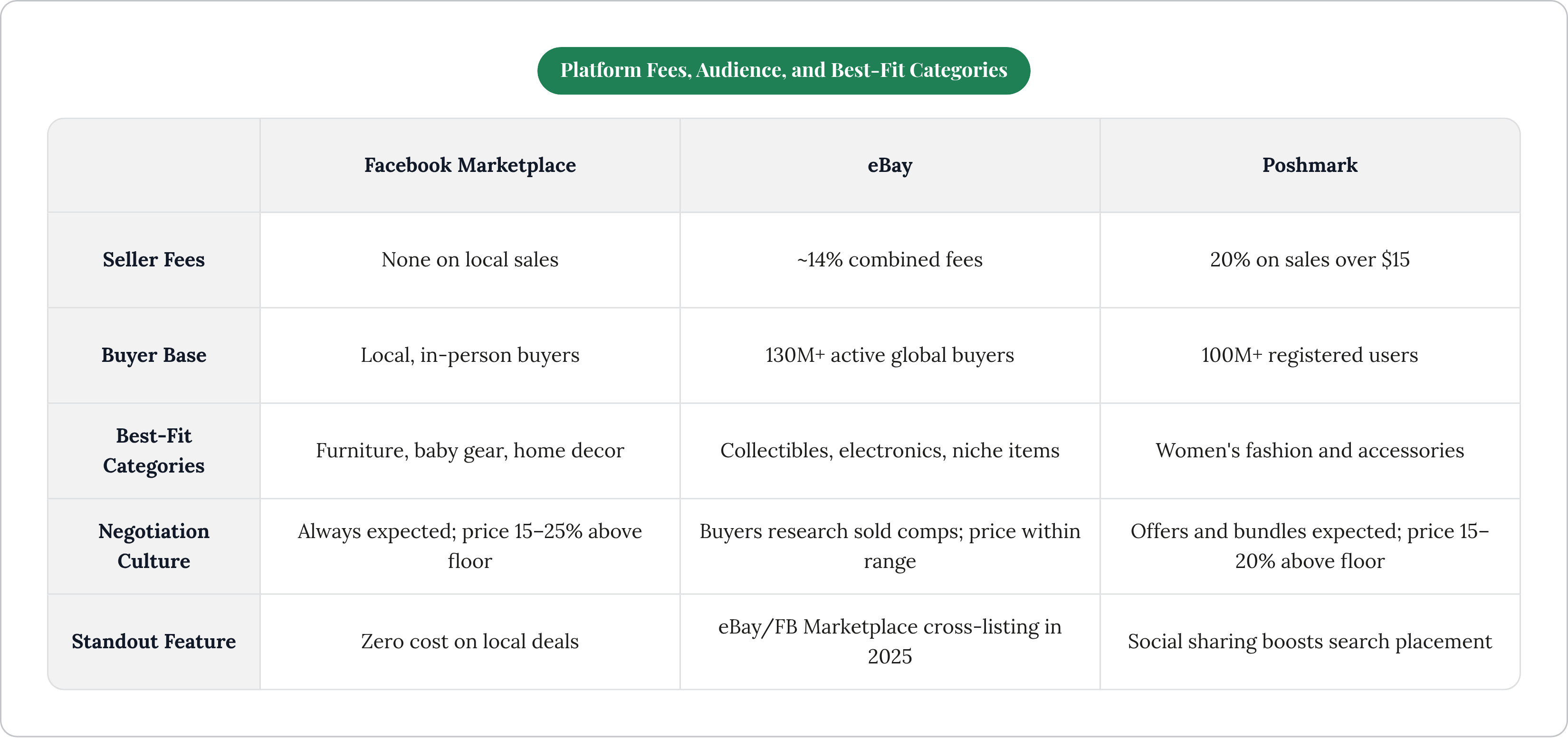
- Facebook Marketplace: Negotiation is assumed. Price 15 to 25% above your real floor so the "deal" a buyer feels they got still lands where you're comfortable. If you list at your minimum, you're negotiating yourself below it.
- Poshmark: Buyers expect to make offers and bundle items. Pricing 15 to 20% above your minimum leaves room for the Offer to Likers feature to actually close the sale.
- eBay: Buyers often pull completed listings before making an offer. They know what things sell for. Pricing within the demonstrated market range is critical. Price outside it and the listing gets ignored, not countered.
Sellers who miss this dynamic leave money on the table on platforms where they priced too low, and lose sales on platforms where they forgot to leave room to move. The item is the same. The pricing logic is not.
Choosing Where to List Based on What the Item Is, Not Where You Happen to Have an Account
Platform choice is a matching problem. Item type, buyer intent, and fee structure all point toward different answers. Defaulting to wherever you already have an account is how people end up trying to sell a couch on Poshmark.
Facebook Marketplace charges nothing on local sales. eBay takes roughly 14% combined fees on standard categories. A $75 vintage lamp nets $75 locally on Facebook Marketplace and about $64 on eBay after fees. For furniture, baby gear, home decor, and anything large or fragile where buyers want to see it in person first, Facebook Marketplace is the right call.
eBay reaches over 130 million active buyers globally. It's where niche items, collectibles, electronics, tools, men's clothing, and anything with a specific model number that has no local market actually get found. About 88% of eBay sales go through Buy It Now listings. Auction format moves things faster on average but typically at lower final prices. eBay's 2025 integration with Facebook Marketplace also means select eBay listings surface on Facebook Marketplace at no extra cost, which is a real visibility gain worth knowing about.
Poshmark has over 100 million registered users and social mechanics that reward active sellers. Sharing listings consistently lifts placement in search. But its 20% commission on sales over $15 is the highest of the major platforms by a noticeable margin. For women's fashion and accessories, where Poshmark's audience concentration is genuinely strong, it earns that fee. For other categories, run the math before you commit.
The multi-platform case is straightforward: listing the same item in more places reaches more buyers. Some tools generate a full listing from a single photo and push it across marketplaces, which is the practical alternative to logging into four different apps and retyping everything from scratch.
The Small Details That Separate Listings That Get Offers from Listings That Get Ignored
Timing is a real variable. Listings posted in the morning and on Fridays attract more saves and faster sales. The listing itself doesn't change. The audience size does.
Response speed reads as a trust signal. A listing with a day-old unanswered question feels riskier than one where the seller replied in an hour. Slow response signals that nobody's minding the store, and buyers move on.
Add any measurement detail that could prevent a deal from falling through: dimensions for furniture, weight for shipping estimates, battery health for electronics. Anything a buyer would need to know before committing. If they have to ask, there's a real chance they won't bother.
Things to cut before you publish:
- Emotional backstory ("this was my grandmother's") rarely accelerates a sale and often makes buyers feel like they're being asked to pay for sentiment
- "Firm on price" suppresses inquiries on platforms where negotiation is part of the process
- Spelling errors and inconsistent capitalization tank trust immediately. You're a stranger on the internet. The listing is the whole first impression.
Before you hit publish, read the listing as someone who knows absolutely nothing about the item. Whatever question still hasn't been answered is exactly what a buyer will message you about. Or use as a reason to click on the next listing instead. The buyer who doesn't have to ask anything is the buyer who actually checks out.