Local vs Online Selling for Large or Heavy Items
Shipping costs can erase your profit on bulky items—here's when to sell local instead.
A treadmill sold locally moved fast, cleanly, and at the asking price — the buyer handled everything. Then I tried to sell a vintage bar cart on the same platform for three weeks and got exactly one message, from someone asking if I'd "do $15 and you deliver." Same seller, same city, wildly different outcomes. The difference wasn't luck. It was that a treadmill and a bar cart are two completely different math problems wearing the same "furniture" costume, and most resale advice treats them like twins.
The second an item gets heavy, awkward to box, or too big for a trunk, the local-versus-online question stops being a vibe and starts being arithmetic: freight quotes, how many people actually want this thing, and whether you're quietly subsidizing a stranger's apartment upgrade. Get that math wrong and you'll swear "nobody wants this couch," when really you just put it in front of the wrong people. Here's the framework I actually use, and what to do once you've run the numbers.
The four factors that actually determine which channel wins
Four things drive this decision. Skip one and the whole calculation falls apart.
Item value comes first. A $40 end table can't survive a $90 freight bill, full stop. Expensive bulky items sometimes can eat that cost and still leave you with a real profit.
Shipping cost is the biggest lever by a mile, and you need to know the number before a buyer shows up asking "does this ship?" Not after.
Buyer pool size matters more than people think. A treadmill has buyers on every block. A commercial-grade rowing machine might have three people in the entire metro area who actually want it, which means you need Ohio and Texas and Oregon all looking at the same listing.
Then there's fraud and safety risk, and this one splits down the middle rather than favoring either channel. Cash-in-person deals mean a stranger at your door. Online deals mean payment scams. Neither side gets to claim the safety high ground here.
Line these four up and the pattern writes itself: a high-value item, cheap-ish shipping, and a thin scattered buyer base belongs online. A low-value item, expensive freight, and plenty of nearby buyers belongs local, every time, no exceptions worth mentioning.
How shipping costs destroy margin on bulky items — and when they don't
Once an item outgrows what UPS or FedEx will touch, you're in freight territory, technically called LTL (less-than-truckload), and that's where casual sellers get blindsided.
Here's what actually lands on that invoice: a residential delivery surcharge, a liftgate fee (because your buyer doesn't own a loading dock, they own an apartment), and pallet or crate prep that somebody has to pay for. String those together and a freight quote that looked reasonable on screen suddenly swallows a third of your sale price.
The math that kills deals is embarrassingly simple. If shipping eats most of what the buyer's paying, you're not selling a couch anymore, you're financing someone's move. Shipping still works when the item's valuable enough that freight is a rounding error, when it's rare enough that no local buyer exists at any price, or when you bake the entire freight cost, liftgate included, into the sticker price before you ever hit "list."
Get the freight quote before you list. Not after someone offers to buy it. Get the number wrong and the freight bill can erase your margin after you've already committed to a price. That's not a sale. That's a very expensive lesson in sequencing.
When local selling is the right answer for bulky goods
Local has one enormous advantage: the buyer deals with transport, so freight cost just vanishes. For anything heavy, that's not a nice-to-have, that's basically the whole ballgame.
Local wins, consistently, for sofas and upholstered furniture, washers and dryers, exercise equipment, patio sets, mirrors, anything glass, and bikes. Facebook Marketplace charges zero seller fees on local sales too, so whatever price you land on, that's what actually hits your pocket.
Speed helps here as well. A local buyer can show up same-day; a freight shipment might take a week or two to even schedule, and every day an item sits unsold is a day it's taking up space in your garage.
What sellers underestimate: someone mentally budgeting a truck rental and a favor from their cousin with a pickup is going to lowball you to cover that hassle before it even happens. Local selling removes the hassle entirely, which protects your number. Quick gut check: if the item's common and your area has enough population, waiting around for a buyer three states away just burns two weeks without adding real dollars to the sale.
Facebook Marketplace and Craigslist as the two local channels — what each is actually for
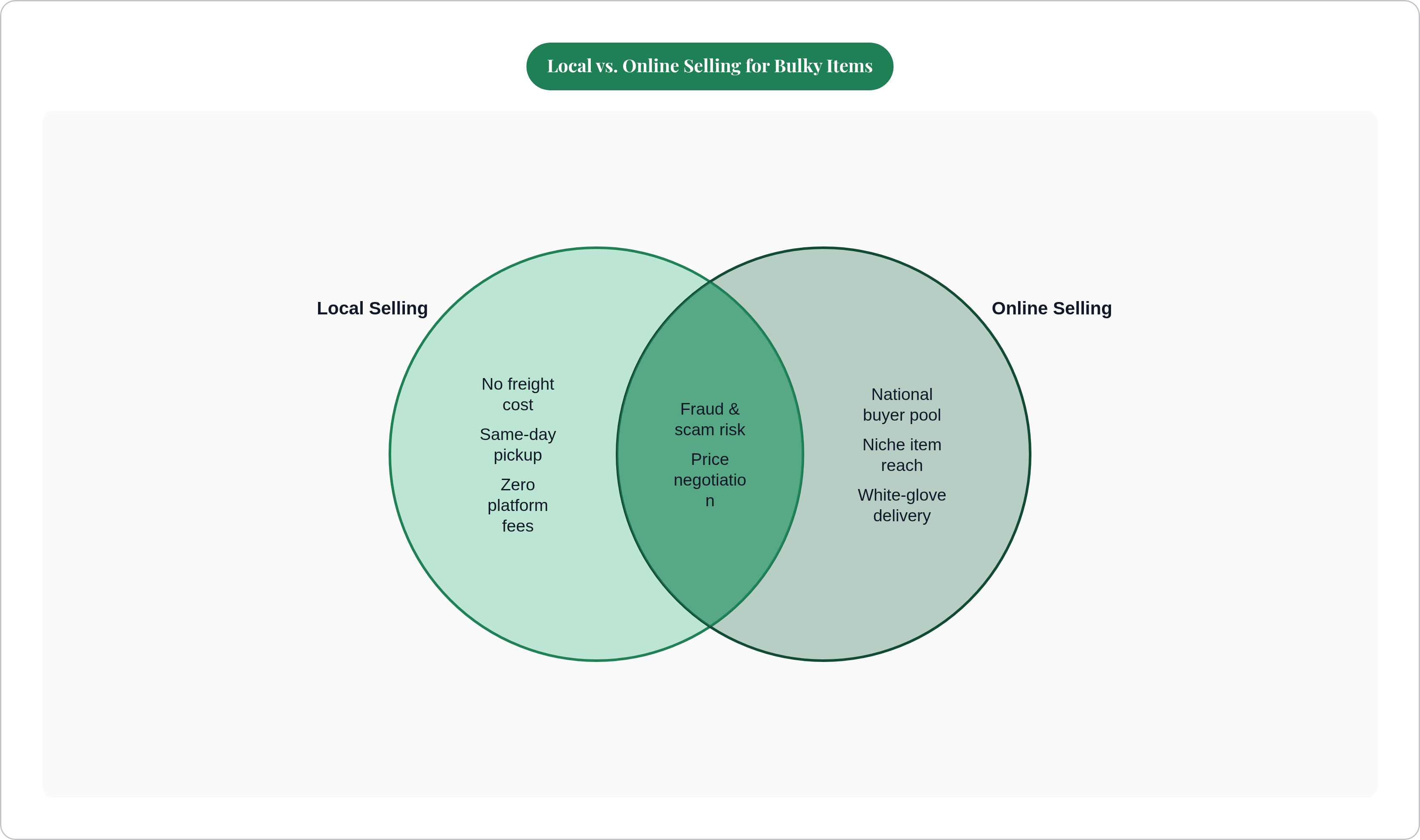
Facebook Marketplace runs the table for furniture and household goods. You can cross-post into local buy/sell groups by hand and multiply your exposure for free. Buyers are tied to real Facebook profiles too, which gives you a layer of accountability Craigslist never bothered building. It's the right call for everyday furniture and appliances with broad demand, and negotiation tends to stay reasonable rather than turning into a hostage situation.
Craigslist still has a job: heavy commercial gear, industrial equipment, oddball large items where a smaller, more targeted crowd is actually a feature. No verified identity, no ratings, which cuts both directions, more privacy for you, less accountability for them. Buyers here expect to haggle hard, so price with room to move. And for anything valuable, meet in public or bring a friend. Craigslist's anonymity means the usual safety habits matter double.
OfferUp is worth a mention for mid-size stuff, power tools, small appliances, since ID verification cuts down on scam attempts. They walked away from nationwide shipping a while back though, so it's local-only now.
My default order: Facebook Marketplace first, Craigslist as the backup net for whatever doesn't move.
When online platforms are worth the shipping complexity for large items
Online makes sense in two scenarios, and really only two: the item's valuable enough to absorb freight and still turn a real profit, or the local pool is genuinely thin (vintage furniture, rare appliances, specialty gym equipment that maybe a dozen people in your city actually want).
eBay's buyer base is big enough that niche items find a home even four states away. It supports flat-rate freight and freight rate tables, and its International Shipping Program lets you ship to a domestic hub while eBay handles customs on the other end, which means overseas buyers without you ever touching a customs form. Also worth knowing: some eBay listings now surface inside Facebook Marketplace, so you get local eyeballs without managing two separate listings.
Chairish and 1stDibs occupy a narrower lane, high-end vintage and designer furniture, where buyers expect white-glove delivery because that's just how that market operates.
None of this works without doing the math first, though. Sale price, minus platform fees, minus complete freight cost including residential delivery and liftgate. Skip that step and you'll discover, the hard way, that you sold a dresser for less than it cost to ship it. Ask me how I know.
The hybrid sequence most sellers should actually follow
Run local first for a week or two and go for the highest-margin outcome: no fees, no freight, no headache. Nothing serious comes in? Expand to a shipping platform with freight already baked into the price. A fast local sale is the best case; online is the fallback, not the opening move.
In practice: post to Facebook Marketplace with local pickup only, cross-post to Craigslist if the item's industrial or unusual, and after two weeks of silence, get a freight quote and relist on eBay with shipping folded in. High-end or vintage pieces skip straight to Chairish or 1stDibs.
One thing that actually moves the needle: write the listing copy the moment you take the photo, right then. That kills the procrastination that leaves items sitting in a closet for three weeks because writing the description felt like homework. And an unlisted item sells exactly nowhere, through exactly zero channels. If pickup logistics are the only friction left, Roadie or TaskRabbit can handle local delivery logistics on your behalf.
Pricing bulky items so the channel math works
Price off sold comps, never asking prices. Active listings show you what sellers are hoping for; sold listings show what buyers actually paid, and those two numbers frequently live in different zip codes. eBay lets you filter to sold listings for real transaction data. On Facebook, look for the "sold" or "pending" tag on comparable local results.
Local listings need negotiation room built in. Facebook and Craigslist buyers expect to haggle, so if you price at your actual walk-away number, you'll sell below it every time. Online freight listings need the full logistics cost baked in up front, not subtracted from profit after the sale's already closed.
Bulky items draw lowball offers because buyers are pre-taxing themselves for the hassle of moving the thing. A listing that kills that mental tax upfront, clear location, flexible pickup times, ground floor, no stairs, protects your asking price better than any negotiating tactic. And if two weeks pass with no real offers, a modest price cut beats holding firm and eating another month of garage storage.
Safety and scam risks that are specific to large-item transactions
Local cash deals mean a stranger's coming to your house, or you're meeting somewhere. That's a physical safety question shipping simply doesn't raise. For smaller valuable items, meet in public — a busy parking lot works well. For anything that has to happen at home, a sofa, a fridge, don't be alone. Stick to cash or a payment app without chargebacks and skip personal checks entirely; they're not worth the paper.
Online freight brings its own flavor of trouble. Overpayment scams cluster around high-value bulky items specifically: a "buyer" sends more than the asking price and asks for the difference back before their payment clears. Watch for the freight variant too, where a "buyer" insists their own shipper will reach out to you directly. Real freight buyers either arrange a verified carrier themselves or just accept the quote you already gave them.
Platform trust signals do real work here. eBay's buyer protections, Facebook's profile-linked identity, OfferUp's ID verification, all of it adds accountability that anonymous Craigslist contact never had. And the rule holds no matter the platform: overpayment, sudden urgency, reluctance to use the built-in payment system, treat all of it as a scam. Doesn't matter how convincing the story is.
Applying the framework: common bulky-item categories and where they land
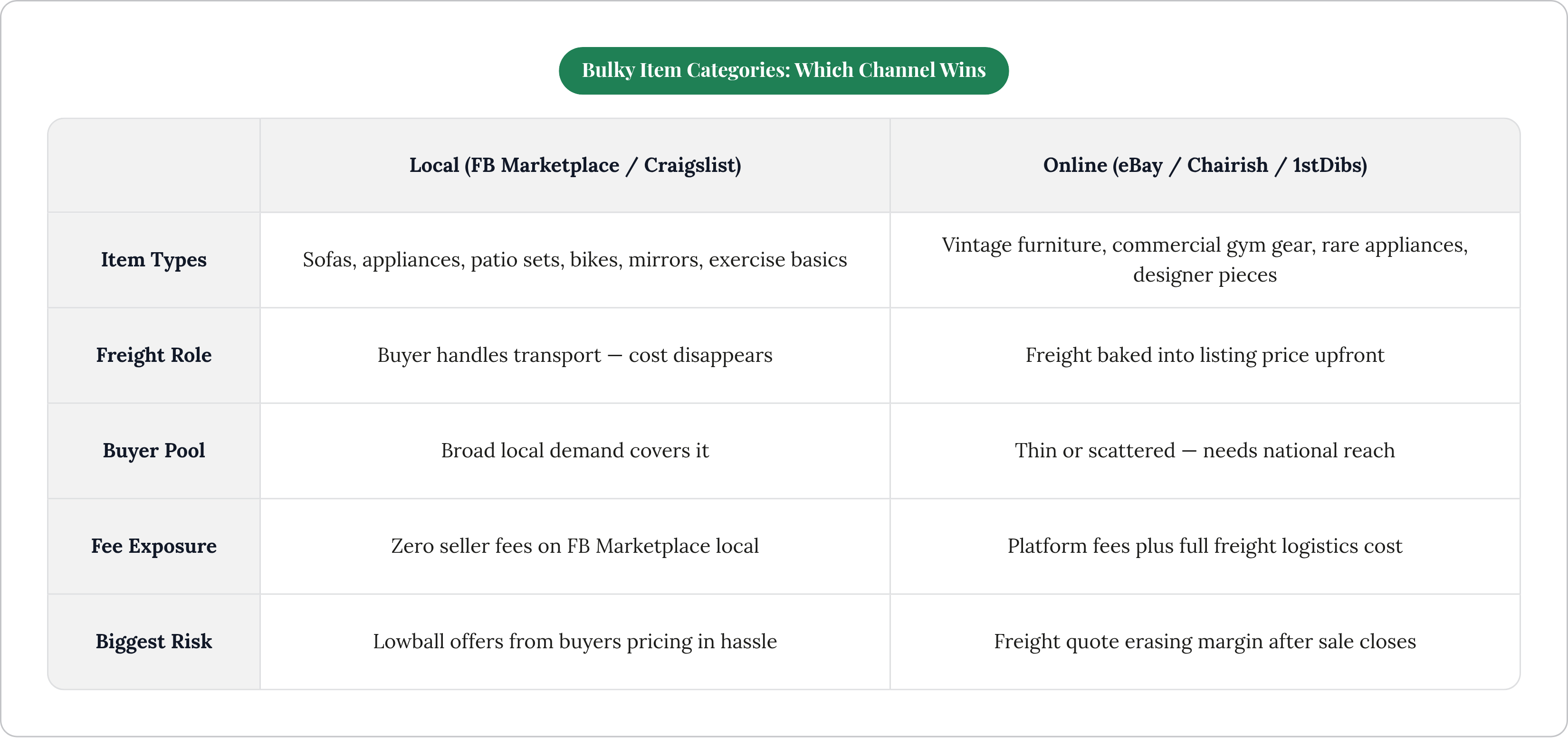
Sofas and upholstered furniture stay local, almost without exception. Freight's expensive, damage risk is real, and local demand usually covers it, so start on Facebook Marketplace and don't overthink it.
Large appliances default local too. eBay with freight only earns its keep for high-end or hard-to-find models where a buyer three states away will pay a real premium.
Exercise equipment splits down the middle: local for a standard treadmill, eBay with freight for commercial-grade machines where gym owners and collectors are the actual market.
Vintage or designer furniture often does better online. Chairish and 1stDibs put these pieces in front of buyers who expect to pay for provenance, and white-glove delivery is standard there, not an upsell.
Power tools go local via Facebook or Craigslist for the bulk of it, with eBay reserved for individual high-value or vintage pieces that have real collector demand behind them.
Patio sets are strongly local, seasonal, regional, and expensive to ship. List in early spring if you want any shot at a fast sale.
Pianos are the weird one. Freight is brutal, local demand is often thin, and free or nearly-free local listings can end up being the realistic outcome. Check comps before you list, or you'll waste a few weekends chasing a number that doesn't exist anymore.
Run the freight math first. Check sold comps second. Then pick a channel, not the other way around.