How to Determine the Resale Price of Any Used Item
Pulled from sold listings, adjusted for condition, and matched to the right platform.

eBay's sold listings filter is the most widely used starting point, and it earns that status. The platform's volume means comparable sales exist for almost anything you're trying to move. Apply the "Sold" filter and you're looking at completed transactions. What buyers actually paid. Not what sellers are hoping for.
Time window matters more than most people realize. The last several weeks of sales reflects current demand. Older data is a snapshot of a different market — which sounds obvious until you catch yourself using a six-month-old comp to justify your asking price, like navigating by a map drawn before the road was rerouted.
A few things worth knowing about where you're pulling data from:
- Fashion-focused platforms attract buyers willing to pay a premium for curation. Sold prices there run higher than eBay for the exact same item.
- General transaction platforms typically land somewhere in the middle.
- Specialty marketplaces for sneakers, vintage clothing, or collectibles reflect buyers who actually know what they're looking at. Their sold data is the most relevant for those categories. Full stop.
The comparison has to be narrow. Searching a generic product name gives you a price range so wide it's basically useless. Searching the specific model, colorway, storage capacity, size, or edition gives you a number you can actually work with.
And seasonality gets ignored constantly. A winter coat checked in April will show depressed sold prices because nobody was buying winter coats in April. Pull data from the relevant selling season, not whatever month it happens to be when you're listing.
How Condition Actually Moves the Price (and How to Grade Your Item Honestly)
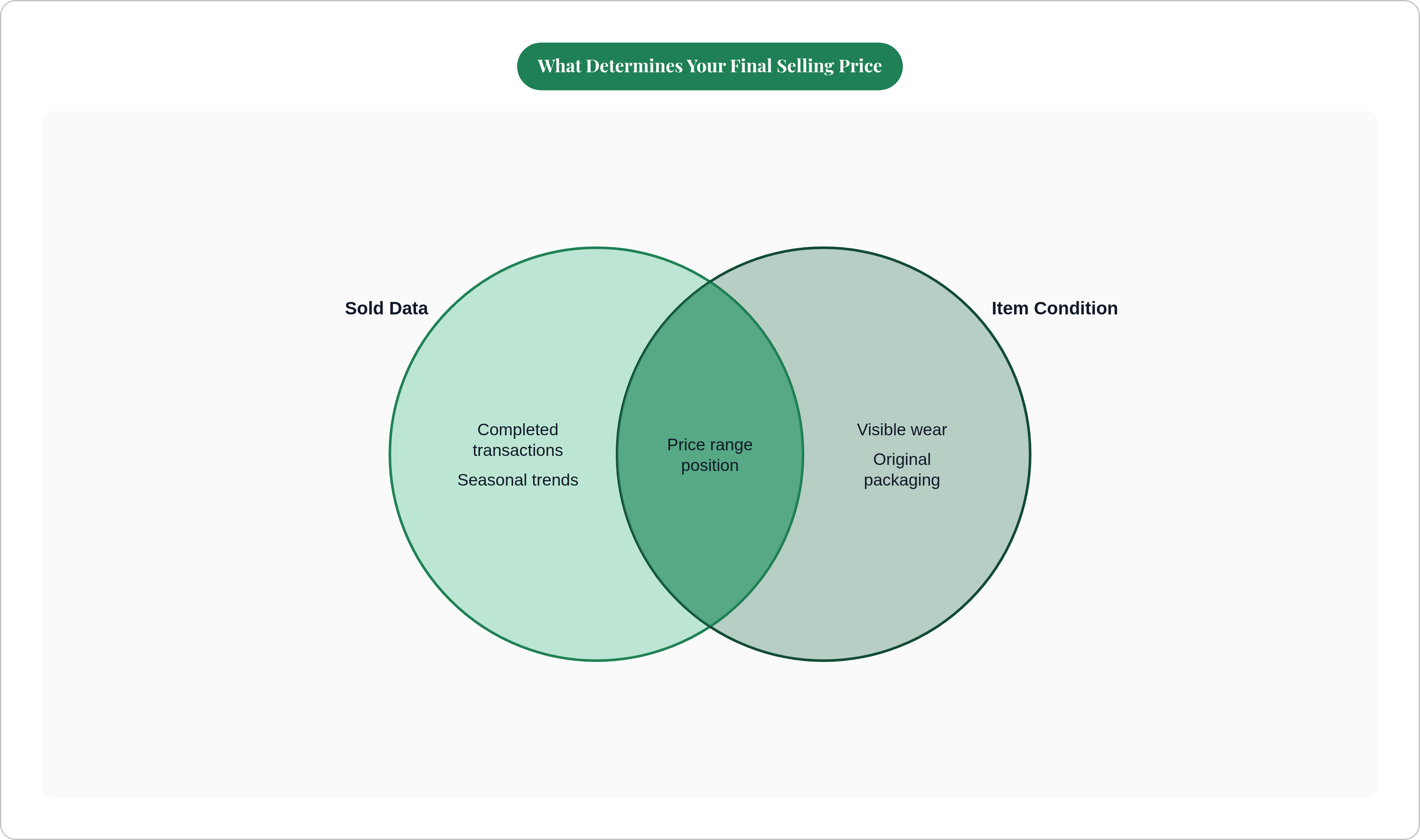
Sold data gives you a range. Condition tells you where in that range your item belongs.
Here's something that's just true: sellers systematically overestimate condition. What feels like "good" to you, after years of ownership, reads as "fair" to a buyer looking at photos with their own money on the line. You've made peace with every scratch. They haven't met those scratches yet.
There's an old joke buried in that dynamic: I told my resale listing it was in great condition. The buyer said, "That makes one of us."
When you're grading your item, be ruthless about:
- Visible wear. Scratches, stains, fading, missing parts. If you have to look closely to find it, a buyer will find it immediately and mention it in their first message.
- Functional completeness. Does it work fully, partially, or only as a parts donor?
- Original packaging and accessories. These add real, measurable value in electronics and collectibles. Don't overstate them, but don't ignore them either.
- Authenticity signals. For branded fashion, sneakers, and luxury goods, fakes in the market erode buyer confidence across the board. If your item is genuine, say so specifically and show your work.
If your item genuinely is in better shape than most comparable sold listings, pricing toward the top of the range is defensible. But your listing has to do the work of explaining why. The photos, the description, the specific details. Without that, a high price just looks like wishful thinking, and buyers have seen a lot of wishful thinking.
Items sold "for parts" or with disclosed defects mark the floor of the range. Know the floor. It anchors the full spread.
How Category Shapes Pricing Logic — Electronics, Clothing, Collectibles, and Home Goods Behave Differently
Not every category ages at the same rate. Pricing strategy that works in one category can be completely wrong in another. This trips people up constantly.
Electronics depreciate fast. A device priced reasonably today can lose value the moment a new model drops, sometimes overnight. The right move for electronics is price to move quickly rather than hold out for a peak. Waiting is expensive. The market doesn't wait with you.
Clothing resale is heavily brand-driven:
- Fast fashion depreciates quickly and typically sells at a fraction of retail.
- Mid-range brands with loyal followings hold value better and can reward some patience.
- Designer and luxury pieces require authentication and careful comp research. The ceiling is high, but buyer scrutiny is proportionally high too.
- Trend-sensitive categories like vintage streetwear or Y2K pieces can spike and fall fast enough that sold data from six months ago tells you almost nothing useful. Stick to the past month.
Collectibles and specialty items, sneakers, LEGO sets, retro gaming hardware, have dedicated buyer communities with strong price memory. Those buyers often know the market better than the sellers do. Sold data pulled from the right specialist marketplace is highly reliable. Pulled from a general platform, it's missing the context that actually sets price.
Home goods split into two different realities. Shippable items follow national sold prices. Furniture and large items are governed by local market conditions. What moves in one city will sit in another for months. Restored or refinished pieces can command a real premium over unimproved comparables, but only when the quality of the work is obvious and the listing communicates it clearly.
The common thread: sold data is the anchor. Category behavior tells you how fast that anchor drifts.
Adjusting for Platform (the Same Item Priced Identically Everywhere Is Almost Always Wrong)
Each platform attracts a different kind of buyer, with different price tolerance and different expectations. Pricing the same item identically across all of them ignores that reality entirely.
A fashion item on a curated, social-style platform sells at a meaningfully higher price than the same item on a general auction platform. The buyer there is partly paying for the experience and the curation, not just the object. High-volume, price-sensitive platforms reward competitive pricing. Niche platforms reward specificity and strong visuals. These are not the same buyer, and they're not the same market.
Local platforms like Facebook Marketplace operate under a different psychology entirely:
- Buyers expect to negotiate. They anchor to lower numbers than online buyers do, almost by reflex.
- Cash, speed, and no shipping are the real value exchange. Sellers give up some price; buyers give up selection.
- Items move fastest when priced well below retail, sometimes a third to two-thirds off, depending on condition and what's already floating around locally.
The practical solution is listing the same item on multiple platforms at once. Let the market show you which buyers value the item most, rather than guessing. Multi-platform listing tools reduce the friction that keeps most casual sellers stuck on a single platform by default, and that friction is why a lot of items just sit.
Starting Price, Negotiation Room, and Knowing When to Adjust
Sold data gives you the target. The starting price is a separate strategic decision you layer on top of it. Listing slightly above the average sold price leaves room for negotiation without pushing you below where you actually want to land. This is not complicated, but it requires you to actually know your floor before you list.
These signals mean your price is probably too high:
- Lots of views, very few inquiries
- Watchers accumulating with no offers
- Comparable items selling while yours sits
These signals mean your price is probably too low:
- Multiple inquiries within the first few hours
- Someone accepts your asking price immediately, which means demand was stronger than your number assumed
If an item hasn't moved in a week or two, reduce it. Incrementally. Don't slash it in a panic and see what happens. Then watch whether the activity actually changes. Holding out for the top of a range has a real cost: storage space, time, and the possibility that the market drifts down while you wait.
For electronics and trend-driven fashion especially, a faster sale at a slightly lower price is often the better financial outcome than a slow sale at the theoretical peak. The theoretical peak has a way of not actually arriving.
Tools That Make the Research Faster Without Replacing the Judgment Behind It
Visual identification tools like Google Lens solve the first problem a lot of sellers run into: not knowing what they actually have. Point at it, identify it, then go research sold data. The sequence matters more than people think.
Platform-native tools vary a lot in quality:
- eBay's extended research tool pulls genuine historical sold data and is one of the more reliable options out there.
- Built-in pricing suggestions on some platforms pull from active listings rather than sold data. That inflates the suggested price and misleads sellers who don't realize the difference. Worth knowing before you trust a number.
Amazon price-history tools like Keepa are useful for cutting through inflated "original retail" claims on items that also appear on Amazon. The chart shows what the item actually traded for over time, which is a lot more grounding than whatever a seller is currently asking.
AI valuation tools have gotten genuinely useful for common, well-documented items. For rare, obscure, or high-value items where authenticity heavily influences price, they're less reliable. Treat the AI output as a strong starting point, then confirm against two or three actual sold listings before committing to a price on anything valuable or unusual. The tool is a shortcut to the research, not a replacement for it.
Any tool doing this job well is pointing you toward the same outcome: sold data first, condition second, platform context third, and fast enough that you actually complete the process before you list. That last part is where most people fall apart, and no tool fixes it if you're not willing to do the work.