eBay vs Facebook Marketplace for Casual Sellers
Choose the platform based on whether your buyer lives nearby or across the country.

eBay wins when your item needs to find a buyer, no matter what zip code they're in. Facebook Marketplace wins when a buyer just needs to find your item, ten minutes down the road. Most casual sellers pick one and stick with it out of habit, which means they're leaving money on the table half the time and letting stuff sit unsold the other half.
The real question is which platform fits this item, this week. Here's how to actually make that call.
How the two platforms actually work and who buys on each
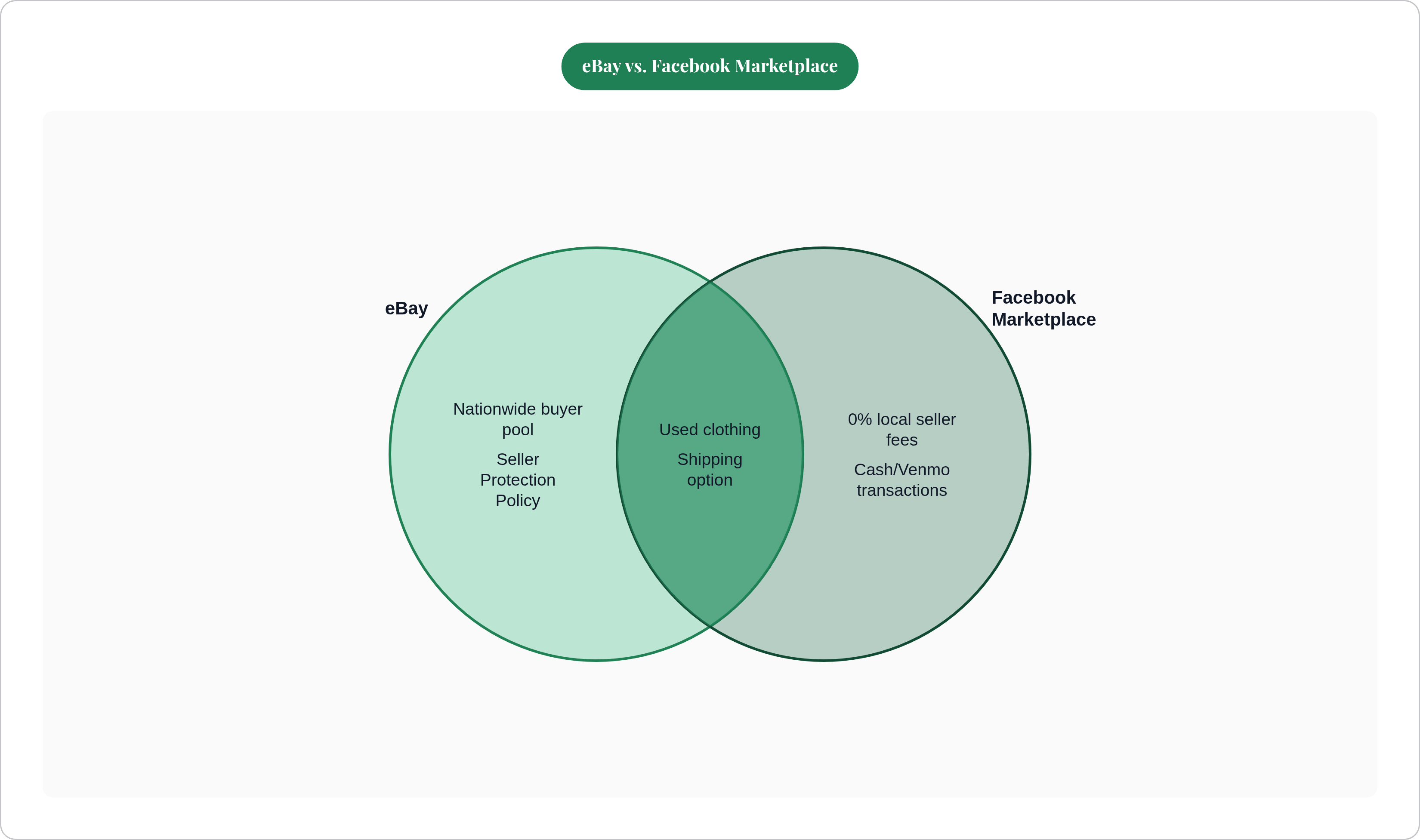
eBay started in 1995 as an auction site for collectibles, and that DNA never really left. It's grown into something much bigger, over 185 million active users worldwide, but the buyer mindset hasn't changed much. People show up already knowing what they want. They search, filter by condition and price, compare five listings before clicking buy. Your buyer might be in another state or another country, so eBay handles the payment, gives you shipping label integration, and steps in if something goes sideways. You also get real seller tools: bulk listing, inventory management, analytics, Promoted Listings.
Facebook Marketplace lives inside an app people open to check their cousin's vacation photos, not to hunt for a specific lamp. It reaches something like a billion monthly active users, and a chunk of them log in specifically for Marketplace. The intent is different, browsing instead of searching, and someone scrolls past your dresser the same way they'd scroll past a meme. The default transaction is local: buyer messages you on Messenger, you meet up or arrange pickup, no box, no tape, no trip to the post office. Shipping exists on Marketplace now, but the whole personality of the place is still "I'll swing by after work."
Seller tools on Marketplace are close to nonexistent. No bulk listing, no analytics dashboard, no way to pay for visibility. Whatever Facebook's algorithm decides to show people, that's your reach, and because a lot of these deals happen through cash or Venmo outside the app entirely, Facebook mostly stays out of disputes.
This difference in buyer psychology matters more than people think. eBay buyers comparison-shop and either accept your price or click away to the next listing. Facebook Marketplace buyers expect to haggle, and the opening message is almost always a lowball, sometimes an absurd one. Bake that into your pricing from the start.
One thing worth knowing going into 2026: eBay expanded a partnership that shows select eBay listings inside the Marketplace feed, tagged with a small partnership icon. The transaction still happens entirely on eBay's side, seller protections included. Facebook's just acting as a billboard there.
What you actually keep after fees — and when the gap matters
Here's the stark version: local Facebook Marketplace sales carry 0% seller fees in 2026. eBay's final value fee runs 13.6% in a lot of standard categories, plus a flat $0.40 per order on anything over $10.
Run the math on a $100 sale. Facebook Marketplace, shipped, charges you $11. eBay charges roughly $15.36. That's a $4.36 gap. Not huge on one item, but it adds up fast across a closet full of stuff you're trying to clear out. Sell that same $100 item locally on Facebook and you walk away with the full hundred. Sell it on eBay and you're closer to $84 or $85 once fees settle. I pulled one real example straight from eBay's own fee breakdown: a $210.50 transaction, shipping and tax included, generated a $29.03 fee and left a $170.97 payout.
Take a $75 vintage lamp as a cleaner illustration. Sell it locally on Facebook, you keep $75. Sell it on eBay, you're looking at roughly $64 after fees. On a modest-priced item like that, an $11 difference is real money for basically zero extra effort.
The rest of eBay's fee picture, for anyone keeping score: listing is free up to 250 items a month, then $0.35 per listing after that. Final value fees range from 2.5% to 15.3% depending on category, so check your specific subcategory before you list; it swings more than people expect. International sales tack on another 1.65%. Facebook Marketplace's shipped-order fee sits at 10%, with an $0.80 minimum, cheaper than eBay across most everyday categories.
So when does the fee gap stop mattering? Two cases. A rare collectible that simply won't find a buyer locally at any price is one; eBay's reach justifies the premium because there's no other buyer to be had. Anything bulky is the other, since shipping a high-value item might run well over $80 on its own, and at that point the fee difference is a rounding error next to the shipping bill.
Fees are only half of this, though. The other half is whether your item even has a buyer pool on each platform. That's the actual decision.
The item-routing framework: which platform wins for what
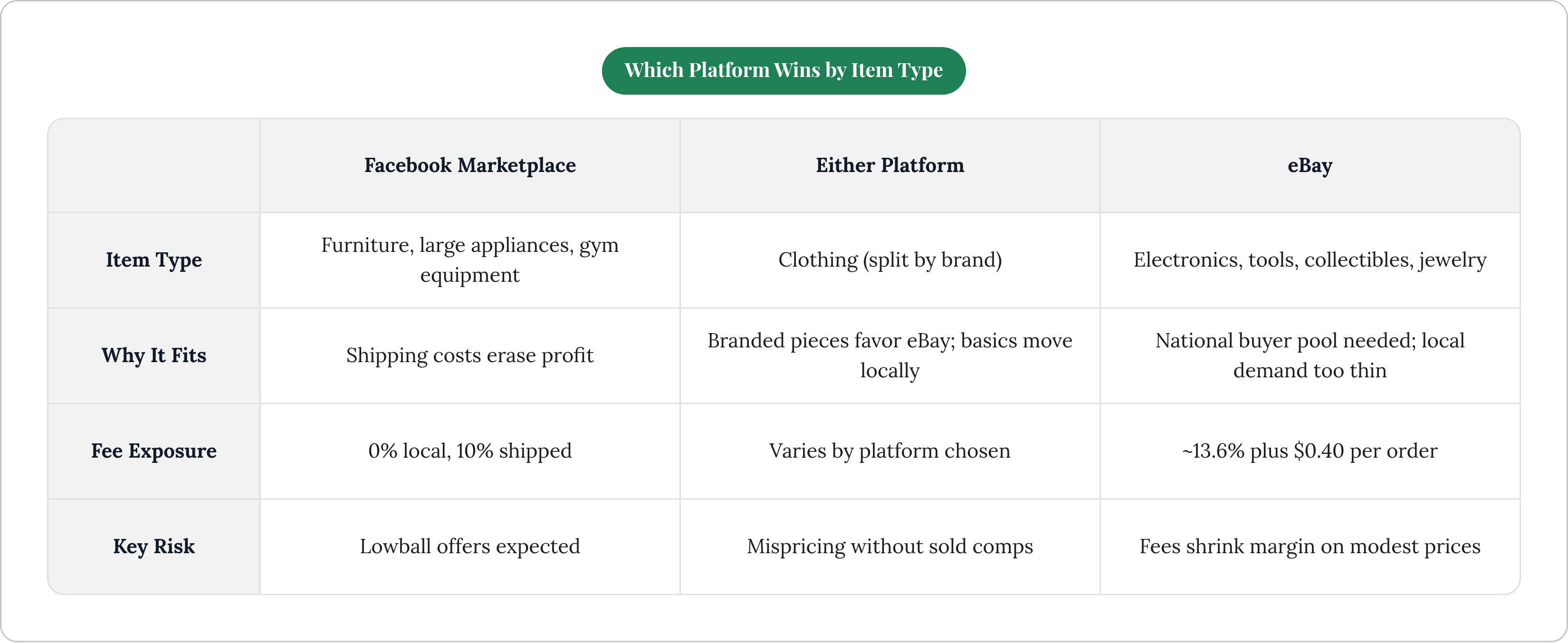
Default to Facebook Marketplace when the item is bulky, generic, or you just need it gone. Furniture, gym equipment, large appliances, anything where shipping would eat the entire sale price, belongs local. Same goes for stuff that's common and easily replaced: IKEA furniture, everyday home goods, kids' clothing, where the local buyer pool runs plenty deep. If speed and zero fees matter more to you than squeezing out the last dollar, Marketplace wins. Used furniture in particular moves faster there, since local buyers search by proximity and skip the shipping headache entirely.
Default to eBay when the item needs strangers from far away to find it. Niche electronics, rare collectibles, specialty parts, anything where the buyer pool in a five-mile radius is basically zero. Collector demand doesn't respect zip codes, and Marketplace will often undervalue that kind of item badly. eBay matters more, too, when buyer protection and structured payment carry weight for you; its Seller Protection Policy covers false "item not received" claims when tracking shows delivery, plus unauthorized purchases and chargebacks. Vintage or designer furniture can actually do well on eBay, collectors will pay for the right piece, but net out shipping costs before you get excited about a higher bid.
Getting more specific by category:
Electronics go to eBay. Phones like iPhones and Galaxy models are consistently strong resellers, especially in excellent condition with original packaging. Nintendo products led both revenue and units sold across tracked brands in 2025 resale data from Upright Labs, for what it's worth. Retro consoles, NES, Game Boy, early PlayStation, carry real nostalgia demand, and even unglamorous stuff like remotes, routers, and old digital cameras outperforms what you'd guess. Tariffs pushed new electronics prices up 8 to 15% in 2026, which only widens the margin on used gear.
Furniture and large home items go to Facebook Marketplace, almost without exception. Shipping a $200 dresser can run $80 to $150, wiping out the sale entirely. The one exception is vintage or mid-century pieces with real designer provenance; those can justify an eBay listing for the collector reach.
Clothing splits down the middle. Branded or collectible pieces do well on eBay, ordinary wardrobe clear-outs move faster on Marketplace. Clothing and accessories brought in close to $60 million across 2.5 million items sold in 2025 resale data (Upright Labs), with Coach, Nike, Michael Kors, Lululemon, and Kate Spade among the top performers. Reliable brands like Lululemon, Patagonia, and Carhartt sell fast at predictable prices on eBay. And with tariffs pushing new clothing prices up, more shoppers say they'd go secondhand instead, which is a tailwind for anyone selling used.
Toys, trading cards, and collectibles go to eBay. Pokémon, Magic cards, graded sports cards, these carry price swings a local buyer pool almost never matches. Popular toys around the holidays can carry serious markups too. The exception: Montessori-style toys and higher-end strollers do fine locally with sustainability-minded parents, so Marketplace works there.
Tools go to eBay, where DeWalt, Makita, and Milwaukee see steady national demand. Sellers report 40 to 100% profit margins when tools get sourced cheap at estate sales.
Home goods and appliances split by size. Small shippable stuff, air fryers, Instant Pots, Vitamix, Nespresso, does well on eBay because buyers are searching for that exact model. KitchenAid mixers hold value especially well in the sought-after colors, up to 70% of original retail in some cases, and eBay is where that color-specific demand actually shows up. Large appliances stay local. Full stop.
Jewelry and watches go to eBay. Tiffany & Co. led jewelry revenue in 2025 resale data at $1.26 million, with top-segment bracelets and earrings averaging $985 (Upright Labs). Seiko watches brought in $775,000 with average price per item up 17.8%. High-value pieces benefit from eBay's structured payment process and the protection that comes with it.
Pricing used items accurately on each platform
Price off sold listings, never active ones. Active listings show what sellers hope to get; sold listings show what buyers actually paid, and those two numbers are often nowhere near each other. On eBay, filter to "Sold items" to see real transaction history. On Facebook Marketplace, look for items marked sold or pending nearby, since there's no dedicated filter for that.
The single biggest mistake sellers make is pricing off emotion, what they paid, what they wish it were worth, instead of what the market actually paid recently. Pull three to five sold comps for the same or a similar item, look at the condition spread across those comps, then place your item honestly inside that range, not at the top just because you like it. Want a fast sale? Price toward the lower half. Can you wait for the right buyer? Lean upper half instead. Add 10 to 15% on top of your true walk-away number as negotiating room, especially on Facebook Marketplace, where the first offer is almost always under asking.
As a rough starting point, most everyday used goods land at 20 to 40% of original retail price. Adjust up for rare or collector demand, down if you need it gone fast or the wear is heavy. Original accessories, chargers, manuals, the box it came in, can bump what you're able to charge more than you'd think. For sealed collectibles, always cross-check eBay's sold data before listing on Marketplace, since local buyers frequently have no idea what something's actually worth.
One small trick that works on both platforms: price just under a round number, a few dollars under $200, so you land inside more buyers' filtered price ranges. If nothing happens after two weeks, drop the price about 10% and relist. Need it gone right now? Drop significantly below fair market value and let urgency do the rest. Keep the psychology gap in mind too: Marketplace buyers treat your listed price as an opening bid, while eBay buyers treat it as the actual price. Price each platform accordingly.
Practical listing and safety considerations that differ by platform
Listing on eBay takes more effort. Title, condition, category, shipping settings, it's a lot of fields to fill out, but the structure keeps things consistent, and bulk listing saves real time if you're moving multiple items. Facebook Marketplace is quicker: a photo, a description, a price, a location, done. The tradeoff is you've got zero promotional levers. Your visibility rides entirely on whatever Facebook's algorithm feels like showing that day. Friction, not laziness, is usually why casual sellers quit halfway through listing something, so pick whichever platform's process you'll actually finish.
Dispute protection differs sharply between the two. eBay's Seller Protection Policy covers false "item not received" claims when tracking confirms delivery, plus unauthorized purchases and chargebacks, and it runs on an evidence-based process. Facebook Marketplace mostly stays out of disputes altogether, since so many transactions happen through cash or Venmo outside the app. That means more risk sits on the seller's shoulders. For anything higher-value, that gap alone can justify eating eBay's fee.
For local Marketplace meetups, the basics still apply. Meet in a public place, bring a friend if the item's worth much, and trust your gut if a buyer's messages feel off.
None of this has to mean running two separate listing workflows and doubling your own work. Some cross-listing tools let you photograph an item once and list it to both eBay and Facebook Marketplace from that same set of photos, which makes it a lot easier to test where an item actually sells instead of guessing. Watch which platform moves similar items faster, then let that steer where you list the next batch. Match the item to wherever its buyer already is; everything else here is just detail.