Stores That Buy Used Furniture for Cash
Habitat and Goodwill take donations, but local dealers pay cash today without the consignment wait.
Habitat for Humanity ReStores will take furniture donations, and a handful of locations will actually cut you a check for the piece. Don't expect to get rich, though, since pricing runs mission-first at ReStore and the numbers stay modest. Pickup is often free, though, and free pickup matters a lot when you're trying to wrestle a dresser down three flights of stairs.
Goodwill is a different story. Most locations are donation-only, full stop, and no cash changes hands. I've watched people find that out the hard way after already loading a couch into a truck.
Both chains are picky about what lands on the sales floor. Heavily worn upholstery, particle-board with water stains, sectionals the size of a small apartment, anything that'll sit there for months, all of that gets waved off. Solid wood, mid-century shapes, storage pieces that are just plain useful, that's the stuff that sells itself and gets a yes.
This lane is for the person who wants the piece gone yesterday and isn't chasing a payout. Speed wins over money here, plain and simple.
One thing people mix up: Winmark franchise stores (Plato's Closet, Once Upon a Child) do pay cash on the spot, and the company says it's recycled over 2 billion items since 2010. But they don't touch furniture, and if you're clearing out a whole house and there's a pile of kids' clothes or old soccer gear next to the couch, that's a second errand, not the same stop.
How consignment furniture stores work and what sellers actually take home
Consignment runs on a completely different clock. The store puts your piece out, waits for a buyer, and you get paid once it actually sells, with nothing on day one.
The store usually keeps somewhere between 25% and 60% of the sale price. Sell a sofa for $300 and you might clear anywhere from $120 to $225, depending on their fee schedule and how much they wanted that piece in the first place. That's a big spread, so negotiate the split before you sign anything, not after.
Three questions worth asking before you agree to anything: how long the piece sits before the price drops or it gets pulled, what happens if it never sells (do you take it back, or does it get donated without asking), and exactly when and how you get paid.
These shops curate their floor the way a boutique curates a rack. Current styles, solid build, upholstery that doesn't need a story explaining the stain, that's the bar. Flat-pack pieces, anything with an odor, oversized furniture that eats up display space, dated styles, all of it gets a polite no. Furniture Consignment Gallery is a decent regional example of how tight these intake standards can be.
This route makes sense if you've got a genuinely good piece, some weeks (sometimes months) to spare, and you'd rather let someone else run the sale for a bigger check at the end.
Local used furniture dealers who pay cash on the spot and haul the piece away
This is the lane for people who want the thing gone and money in their hand today, no theatrics involved. A dealer shows up, eyeballs the piece, makes an offer, pays cash, and hauls it out the door, with no listing photos and no back-and-forth texting a stranger who ghosts you for two days.
A few real names to know: Consignment Furniture Emporium in Winston-Salem buys outright and brings the truck. Instant Offer Furniture, working out of Denver and Phoenix, skips consignment entirely and pays on the spot. Almost Perfect Furniture and Home Décor pays at pickup and usually clears the piece within days.
Here's the tradeoff: these dealers pay less than consignment could theoretically net you, since they're pricing in warehouse space, the labor to move your dresser twice, and the risk it doesn't resell fast. You're swapping upside for certainty, and depending on your week, that's a fine deal to make.
Every metro area has its own version of these outfits, they just don't buy Super Bowl ads. Search "your city used furniture buyer" and you'll turn up a handful of options before your coffee gets cold.
They want solid wood, recognizable brands, mid-century or farmhouse styles in shape that doesn't require an apology. What they pass on: giant formal dining sets, tired sectionals, anything that needs three grown adults to lift it. Have your basics ready before you call, original price, age, brand, dimensions, a couple of decent photos, and answer fast so the offer comes fast.
This one's built for the hard-deadline crowd: moving day, an estate to empty out, a renovation with a start date already circled on the calendar.
Antique and specialty dealers as a cash option for older or high-provenance pieces
Antique dealers care about a different scoreboard, and most will tell you so within the first ten seconds of the conversation. Age, rarity, craftsmanship, provenance, that's the list, and "vintage" isn't a mood to these folks. It's a set of criteria with actual teeth.
Anything you know about the backstory helps your case: the original maker, a rough date, past owners, even half a paper trail. That context moves the number more than most sellers expect.
What sinks the conversation fast: a reproduction dressed up as an original, a piece refinished so hard the original patina is gone (stripping that finish is a little like erasing the thing's résumé), or anything structurally shaky the dealer would have to sink money into before it's sellable.
Payout models differ dealer to dealer. Some buy outright on the spot, others run consignment the same way furniture shops do, so ask which one you're dealing with before you get attached to a number in your head. Solid wood tends to hold value well here, figure 40 to 70% of the original price for pieces in good shape, and a documented antique can clear that range without much effort.
Do a quick eBay sold-listings search before you walk in. Dealers respect a seller who shows up with a real number instead of a figure pulled from a story about Great-Grandma's cabinet.
This lane fits inherited furniture, estate finds, or anything pre-1980 with the joints still tight and the craftsmanship still visible.
Online and app-based buyers that pay cash without requiring a store visit
Facebook Marketplace is still the default for local cash sales. There's no fee on local deals, the buyer drives to you, and cash lands in your hand at pickup. It's basically the outright-purchase model, minus the dealer, since you're doing that job yourself, but the audience dwarfs anything a local shop could match. OfferUp's Recommerce Report found 93% of Americans bought something secondhand in 2025, so nobody's questioning whether the demand is real.
OfferUp itself claimed around 20 million monthly users as of 2024, skewed heavily city and suburban, which happens to line up nicely with furniture, since local buyers can actually handle the pickup without renting a truck.
AptDeco is furniture-specific and worth a look. It backs a sell-in-under-10-days guarantee and runs the logistics itself, so you're not the one juggling pickup times with someone who reschedules three times in a row. Buyers on the platform save up to 70% off retail, which is exactly why demand stays steady on their side.
eBay works best for the smaller stuff that can actually ship: chairs, lighting, accent tables, mid-century pieces with collectors scattered across the country. Skip it for a sectional the size of a small boat, but it's strong for anything compact with a bit of character.
The listing itself, more than the platform you pick, is usually what kills an online sale. Writing something honest about condition, with a price that isn't a fantasy, is the part almost everyone skips or rushes. Some tools are built to close that gap: you take a photo, the app identifies the item, grades the condition, and drafts the listing copy. Furniture that would've sat in the garage for six months winds up gone by Thursday instead, and certain tools will also push one listing across several marketplaces so you're not retyping the same paragraph five separate times.
This lane suits sellers fine with buyer pickup, anyone without a strong local dealer scene nearby, or pieces small enough to box up and ship.
What stores across every category won't buy — and why condition is the real gatekeeper
Furniture loses 20 to 30% of its value in year one alone, and that's before anyone's even inspected the actual piece. Condition is the gatekeeper no matter which buyer you're standing in front of: thrift store, consignment shop, dealer, online listing, it doesn't matter. Bad condition kills the deal everywhere, every time.
A short list of what gets rejected almost across the board: particle-board and flat-pack pieces (your IKEA Billy bookcase, for instance) that depreciate too fast to hold margin, upholstery with stains or pet odor or cushions that have given up, oversized formal furniture like a 12-person dining set where the buyer pool has basically evaporated, and anything structurally damaged that nobody's bothered to fix.
What moves everywhere: solid wood dressers, dining tables sold with their full set of chairs, sturdy bookshelves, standing desks, clean accent chairs. Simple and sturdy and useful, that's really the whole formula.
Here's a fix that costs almost nothing and matters more than it should: new drawer knobs and a scratch cover can pull a piece out of the reject pile entirely. It's a five-dollar fix that sometimes decides whether a store takes the piece at all or turns you around at the door.
Odor is the quiet dealbreaker across every single category, and every buyer type will pass on something that smells, no exceptions. Air it out and clean it properly before you call anyone, because no dealer is going to tell you your couch smells like a wet dog convention. They'll just say no thanks and move along to the next call.
Before you approach anybody, run a gut check on material quality, structural integrity, cleanliness, and whether the style still means something to today's buyers. Fail two or more of those, and it's time to adjust what you're expecting to get.
How to estimate what your piece is actually worth before you walk into any store
Start at 20 to 50% of the original retail price, then move down from there based on condition, age, and brand. A well-known brand in excellent shape sits near the top, while a worn, no-name piece slides closer to 10 to 20%.
A few benchmarks worth keeping in your head: solid wood runs 40 to 70% of original price in good shape. Sofas land around 30 to 60%, closer to 30% if it's worn or past six years old, closer to 60% under three years and still in great condition. Dining tables sit at 25 to 50%, and bundling in the chairs usually bumps the total. Desks run 20 to 40%, with solid wood and standing desks holding steadier than flat-pack. Office furniture generally sits at 15 to 35%, though brands like Herman Miller, Steelcase, and Knoll hang onto more value than most.
The method that actually works, and takes maybe five minutes: search eBay, filter down to "Sold" and "Used," type in the exact brand and model, and average out a handful of recent sold prices. That's real market data, since an active asking price only tells you what somebody's hoping for, not what anyone's actually paid.
Watch how fast comparable listings move, too. Something stuck at the same price for two months is priced wrong, while a similar piece marked sold after three days tells you exactly where the market's clearing right now.
Demand is local in a way national numbers can't capture. A dresser that sells in a day in Chicago might sit untouched for a month three hours outside the city. Treat eBay's sold data as your floor, then check local Facebook Marketplace listings for the ceiling in your specific area.
No comparable listing anywhere? Start 30 to 50% below MSRP based on condition, then adjust from there. And once you land on a number, hold it, since sellers who show up with research don't cave to the first lowball offer just because somebody said it confidently while wearing a polo shirt with a logo on it.
Matching the right buyer to the piece, the timeline, and the payout goal
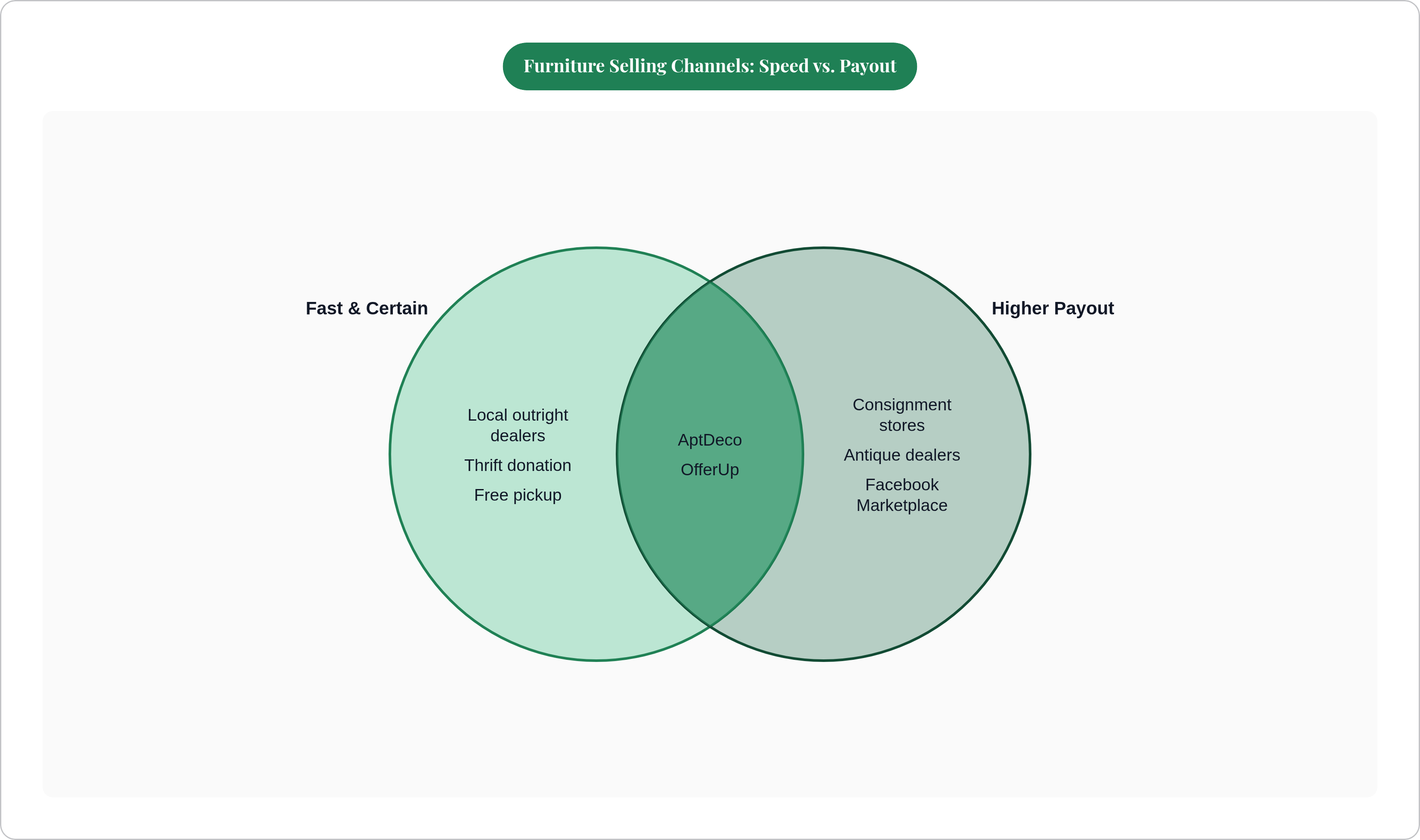
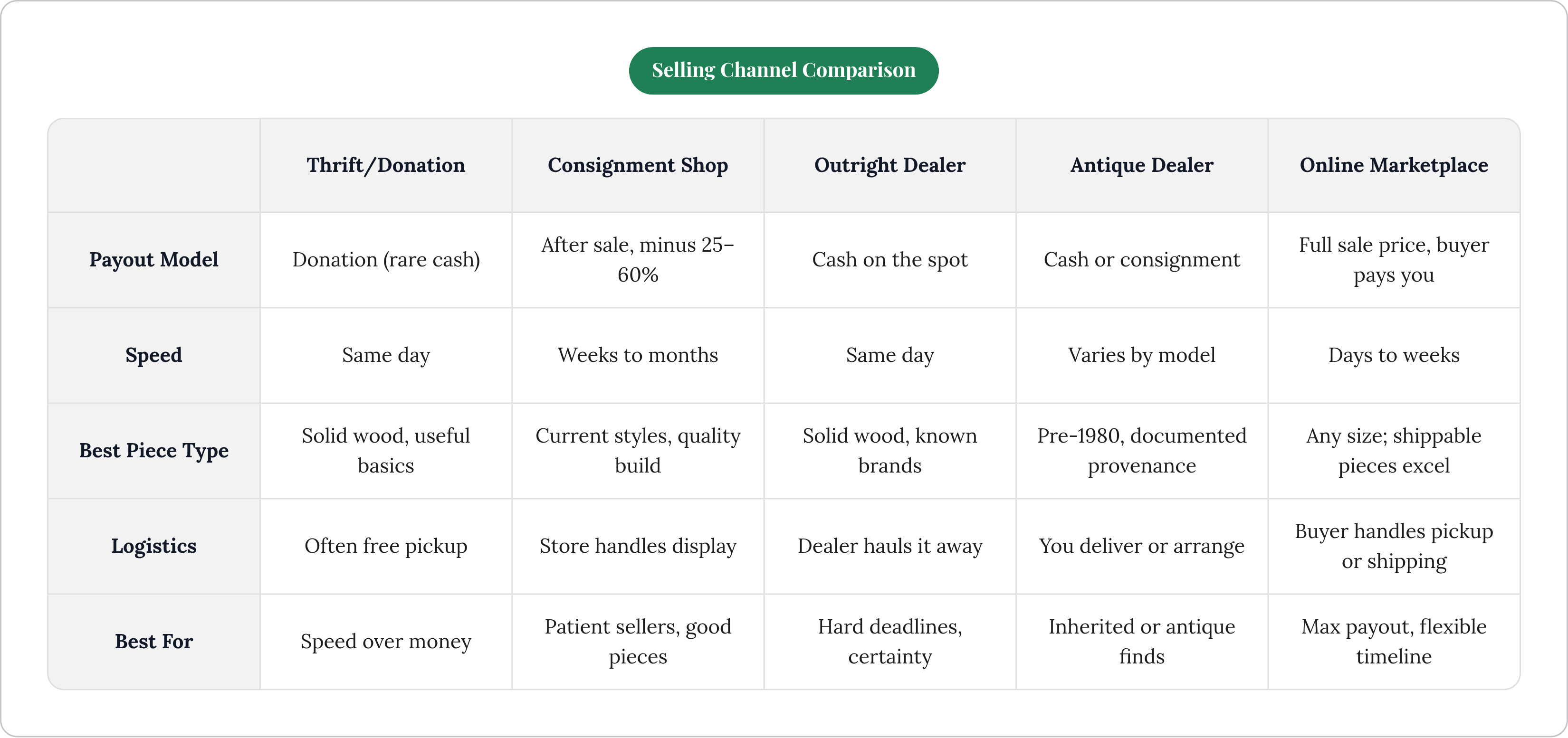
Three things decide the right channel: how fast you need it gone, how much the condition boxes you in, and how much the payout actually matters versus just wanting the thing out of your living room.
A rough map, if you need it gone this week and don't want to manage logistics yourself, call a local outright-purchase dealer. Got a solid piece and a few weeks of patience? Consignment, or AptDeco if the piece fits their model. Sitting on an antique or something with real history behind it? An antique dealer, with eBay sold data already in your pocket before you walk in. Fine with buyer pickup and chasing the biggest possible number? Facebook Marketplace or OfferUp, paired with a listing that doesn't read like it was written in a hurry. Want to list once and never think about it again? Some apps handle the description and condition grading, then push the listing out across the right marketplaces so you're not retyping the same thing five times.
Most people who say "I'll just post it online" never get around to it, and nine times out of ten, the listing itself is why. That gap between intention and action is the whole ballgame. Turning a five-minute chore into a thirty-second one is sometimes the entire difference between furniture that ends up donated out of sheer exhaustion and furniture that puts cash in your pocket.
One last thing worth knowing: you're not locked into picking a single channel and living with it forever. Start with whichever option pays the most, give yourself a deadline, and if the piece hasn't moved by then, step down to the next option on the list. That ladder beats freezing up over which choice is "right" and doing nothing at all while the dresser collects dust in the hallway.
The secondhand furniture market is worth $8.7 billion and it's still growing. The buyers are there, the platforms are there, and the tools that make listing painless are sitting right there on your phone. The only thing left standing between you and cash in hand is whether you actually pick up the camera and start.