How Condition Grade Affects Resale Price
Honest grading unlocks hidden value in your resale listings.

Condition grade is the one variable in resale pricing that's actually in a seller's hands. Everything else, the item's age, brand, model, original retail price, current demand, gets locked in before a seller ever takes a photo. Condition is different: it's something a seller can assess honestly, describe accurately, and in a lot of cases, improve before the listing goes live.
The stakes here are bigger than most casual sellers realize. Global resale was worth something like $200 billion in 2023, with forecasts putting it near $400 billion by 2027. A market that size doesn't run on guesswork. Buyers comparison-shop on condition the same way they'd comparison-shop on price, and two identical items listed side by side will sell for meaningfully different amounts depending on how well the condition is graded and described. That gap is what this piece is about, and by the end of it, the goal is simple: know what each grade means, know how much value moves between tiers, and know how to price anything sitting in a closet or a junk drawer without leaving money on the table.
How condition grading systems actually work and what each tier means
Professional resellers and luxury platforms tend to use a five-tier ladder: Pristine, Excellent, Very Good, Good, and Fair. Each one means something specific, not just "looks fine" versus "looks rough."
Pristine means no visible wear at all. Original tags or packaging are often still there, and the item reads as new in every sense that matters. Excellent allows for minimal use, maybe a light scratch on a hardware clasp or the faintest corner wear, but the item keeps its full shape and function. Very Good is where actual wear starts showing: leather softens, small scuffs appear, but the item still looks presentable and works the way it should. Good means wear you can spot without looking hard, surface scratches, some discoloration, edge wear, and this tier represents meaningful wear that many platforms scrutinize closely before accepting. Fair is the last stop before rejection: heavy scuffing, visible scratching or discoloration on hardware, sometimes internal stains. Items graded Fair either sell at a steep discount or don't get listed at all, depending on the platform.
Condition does three jobs at once. It sets the price the item can command, it signals how long a buyer should expect the thing to last, and it tells the buyer whether they can trust the listing. Grading, in other words, involves more than description. It's a pricing decision, a channel decision (some platforms won't take items of that grade), and a decision about how wide a buyer pool the listing reaches.
One more distinction worth locking in early: cosmetic condition and functional condition are not the same axis. A phone can look beat up and still work perfectly. A handbag can look spotless and still have a broken zipper. Grade both separately, because buyers will notice if the seller didn't.
Where wear shows up matters as much as how much wear there is
Sellers routinely misjudge their own items. "It's barely been used" is a common line, and it's usually sincere. Sellers look at the whole object, while graders and buyers zero in on specific spots that carry disproportionate weight.
For handbags and leather goods, four zones do most of the damage to a grade. The four corners of the base take the first hit, since they're the first thing to touch a table, a floor, a car seat. The handle drop darkens from skin oils over time, and that discoloration is close to impossible to reverse once it sets in. The interior lining picks up pen marks, makeup transfer, and general grime, and buyers check inside even when the outside looks untouched. Hardware, the clasps, feet, and zippers, scratches and dulls in a way that gives away age even on a bag that otherwise looks clean.
Electronics split even more sharply. Cosmetic damage and functional failure are graded on entirely separate tracks. A cracked screen or a dented corner typically costs a seller somewhere between $150 and $400 at trade-in compared to a clean device, even when the phone runs exactly as it should. Functional condition is the sneaky one: internal degradation can drag a price down even when the exterior looks flawless.
Inspect the specific high-impact zones for whatever category is being sold, rather than eyeballing the whole thing and calling it good. That's how sellers avoid both mistakes: grading too generously, which leads to returns and refund requests and a dented reputation that follows a seller into future sales, and grading too harshly, which quietly routes a perfectly good item into a lower price band where it sells for less than it should.
How much value actually shifts between condition tiers
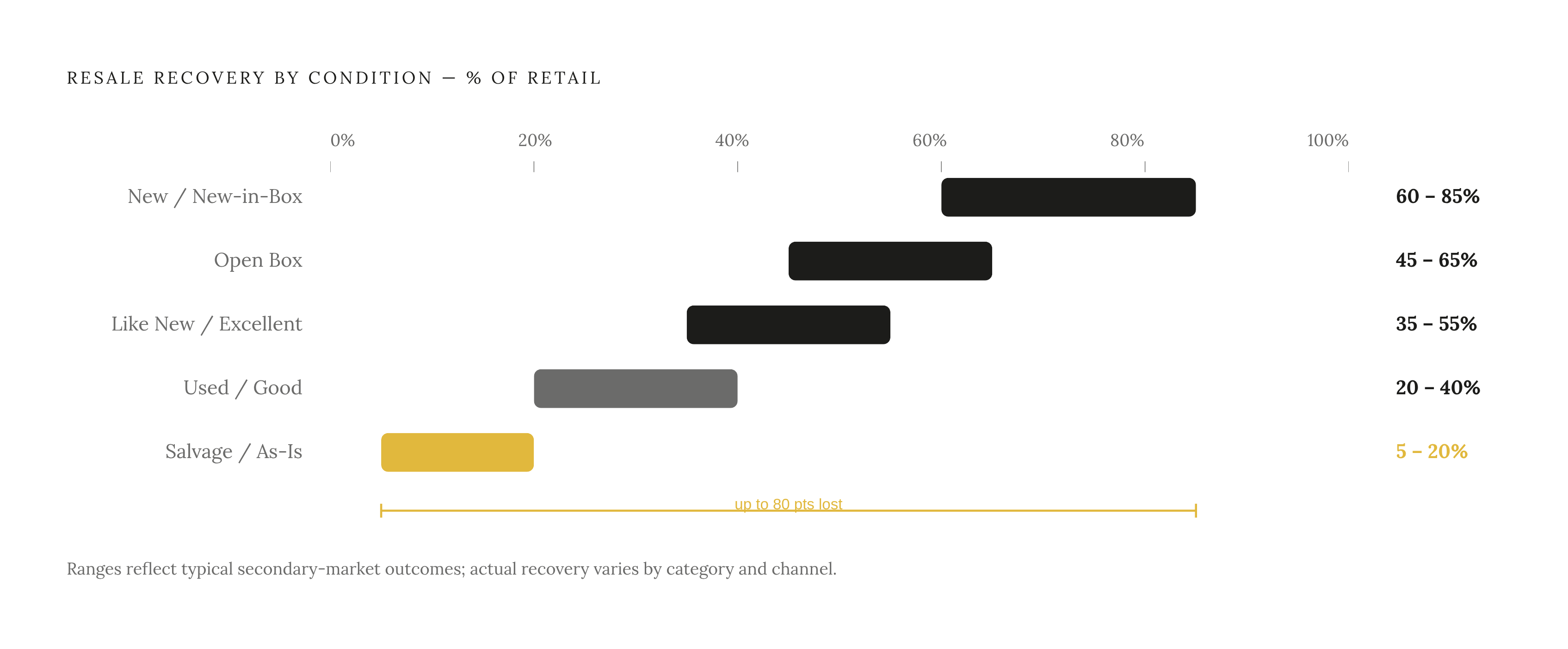
The liquidation recovery framework makes the stakes concrete. New or new-in-box items recover something like 60 to 85% of retail value. Open box items land around 45 to 65%. Like New or Excellent condition brings in 35 to 55%. Used or Good condition drops to 20 to 40%. Salvage or as-is items recover just 5 to 20%. Same item, five very different outcomes, depending entirely on grade.
For everyday used goods without a liquidation angle, a simpler rule of thumb works fine: gently used items generally price at 50 to 75% of original retail, while more worn or long-owned items fall to 20 to 50%.
Electronics show the steepest cliffs of any category. That $150 to $400 hit for a cracked screen or dented corner applies regardless of how well the phone otherwise performs. But non-working status isn't a discount at all, it's closer to a wipeout. Functionality and cosmetic condition together decide almost the entire price for electronics; there's not much else moving the number.
Luxury goods sit at the opposite extreme. A Hermès Birkin in pristine condition can sell above its original retail price. The same bag graded Good or Fair still holds real value, thanks to the brand, but sells for substantially less than its pristine counterpart. Brand puts a floor under the price. Condition decides where in the range above that floor the item actually lands.
There's a related idea worth naming directly: grade uplift. Moving an item from one tier into the next through cleaning or repair doesn't just make it look nicer in photos, it can shift the entire pricing band the item competes in. That's the reason accurate grading is worth real effort. The dollar swing between two adjacent tiers is usually bigger than sellers assume.
How category shapes the way condition affects value
Electronics run almost entirely on the combination of condition and functionality. A device that doesn't power on has close to zero resale value no matter how clean the shell looks. Carrier lock status compounds this: an unlocked phone reaches a broader pool of potential buyers than a carrier-locked device in equivalent or even better cosmetic condition. Internal functional wear can quietly reduce prices even when the outside looks new. And the platform matters more than people expect: MacBooks, especially the Apple Silicon M-series machines, hold resale value noticeably longer than comparable Windows laptops, which means condition grade carries more weight on a machine whose baseline value doesn't collapse right away. Budget Android phones and cheap Chromebooks depreciate so fast that condition grade barely registers. As GadgetSalvation has put it, some of these "become unsellable as soon as you take them out of the box."
Apparel works differently. Brand acts as a multiplier on top of condition, not a separate factor. Established brands in Very Good condition tend to land at the top of their category's price range. An unbranded item with the exact same wear won't get close. There's a hard floor for sellable apparel too: no rips or tears, no permanent stains, no broken zippers or missing buttons, no heavy pilling. Fall below that line and most resale platforms simply won't take the item. Among the categories where condition grade tends to earn notable premiums are sneakers and athletic shoes, athleisure and vintage pieces, and luxury designer handbags.
Luxury goods add a wrinkle: condition interacts with rarity in ways that split buyers into different camps. Some collectors actively seek out lightly worn pieces for the price break and the broken-in look. Others pay a premium specifically for pristine condition. Grade doesn't just move the price here, it aims the listing at a different buyer entirely. And the wear locations covered earlier, corners, handles, hardware, lining, matter more than a buyer's first glance, because serious buyers in this category study photos closely and know exactly where to look.
Across every category, one pattern holds. The higher an item's baseline value, the more dollars move per grade tier. Condition matters more on a $400 item than on a $40 one, if only because there's more room to lose.
Pricing to the grade using sold data, not guesswork
Sold listings show what buyers actually paid. Active listings show what sellers wish they'd get. Those two numbers are often nowhere near each other, and pricing off active listings is probably the single most common mistake casual sellers make. An item with a hundred active listings at $100 and a stack of sold listings at $40 is a $40 item. The asking price is a wish, not a market.
On eBay, pulling condition-matched sold comps follows a pretty simple process. Search the item, then apply the Sold Items filter. Match the condition, New, Used, or Refurbished, to the actual item before averaging anything. Default to a 90-day window, narrowing to 30 days for anything that moves fast and widening to 180 days or more for rare or slow items. Keep auction results separate from Buy It Now results, since they reflect different buyer behavior and shouldn't get blended together. And when a listing shows "Best Offer Accepted" with no visible price, assume the final sale landed roughly 15 to 25% below the listed price, and weight that comp a little lighter than the rest.
Terapeak, eBay's own research tool, adds a price trend chart across 30-, 60-, and 90-day windows. An upward slope means demand is climbing. A flat line means the market's stable. A downward slope is a signal to sell quickly rather than sit on inventory hoping the price recovers.
A few mistakes are worth naming outright. Pricing based on what an item originally cost, or on emotional attachment to it, ignores the fact that buyers don't care what the seller paid. Pricing off a single unusually high sale treats an outlier like a trend, when a 3x sale usually just means someone overpaid once. And using comps from the wrong condition grade to price a different-condition item defeats the entire purpose of grading in the first place; always filter to match the item actually being sold.
The rule-of-thumb ranges work fine for common household goods where sold data is thin or nonexistent. For anything with an active secondary market, comp-based research beats a rule of thumb every time.
Tools that apply condition assessment and sold-data pricing together
The manual process, search, filter, match condition, average the comps, works. It's just slow. For most casual sellers, the barrier isn't a lack of knowledge, it's friction: nobody wants to spend twenty minutes researching eBay comps to sell a used blender.
A few tools cut that friction down. Underpriced AI identifies an item from a photo, pulls real sold comps, and returns a price range along with a confidence score and market saturation data, handling the research step automatically. ItemValueChecker.com matches a photo against active eBay listings and returns a directional estimate, adjusted about 15% below the median asking price; it's free, requires no signup, and is meant as a rough guide rather than a precise number. Reclaim, the company behind this guide, uses AI to identify the item, grade its condition, and write the listing copy from a single photo, folding condition assessment, comp research, and listing creation into one step without requiring any prior grading expertise.
Whatever tool gets used, a few questions separate the useful ones from the noise. Does it pull from sold data, or just active listings? Does it let a seller filter or match by condition? Does it return a range instead of one flat number? A tool that just averages active listings is repeating the most common pricing mistake in the book, only faster.
The larger point for casual sellers: nobody needs to become an expert grader. What's needed is a system that applies consistent grading standards against real market data, which is exactly the gap these tools are built to close. Listing across multiple platforms, eBay and Facebook Marketplace, from a single session, then extends that accurate price to the widest possible buyer pool without doubling the work.
How to improve an item's condition grade before listing
Grade uplift is a commercial move, not a tidying-up exercise. Pushing an item from Good into Excellent doesn't just make it look nicer in a photo, it moves the item into a different pricing band entirely.
The specifics vary by category. Leather goods respond to gentle surface cleaning, conditioning, and stuffing to restore shape, with attention focused on the four high-impact zones from earlier: corners, handle, hardware, lining. Those are the spots graders and buyers check first, so that's where cleaning effort pays off fastest. Electronics benefit from a factory reset, which clears account locks and reassures buyers, plus removing any old screen protector to reveal the actual screen condition underneath, and a thorough clean of ports and the exterior. Including the original charger and any accessories matters too, since completeness affects grade independently of how clean the device looks. Apparel does well with washing or dry cleaning where it's safe, steaming out wrinkles, and a lint roller pass, though it's worth confirming there's no permanent staining before spending money on cleaning. Items with rips, permanent stains, or broken zippers rarely climb back to a sellable grade, and donating them is usually the better call than sinking time into a lost cause.
The math behind uplift is straightforward: it's only worth doing when the price gap between the current grade and the next one up beats the cost and time of the fix. Good condition recovers 20 to 40% of retail, Excellent recovers 35 to 55%; if the fix costs a fraction of that spread, it's worth doing. If it costs more, skip it.
Some wear doesn't come out, and that's worth admitting up front. Handle patina, deep scratches on hardware, screen burn-in, none of that reverses with a surface clean. Grading an item as Excellent after a quick wipe-down, when it's really still Good, invites returns and burns buyer trust, and that costs more in the long run than the grade difference would have earned. Accurate grading, priced against real sold data, is the whole loop. Condition is the one variable a seller actually controls, provided they know what to look for, what it's worth, and what's worth fixing before the listing goes live.