Used Electronics Resale Value by Brand and Model
Apple devices hold value far longer than the competition.
Used electronics don't lose value at some fixed, universal rate. A used iPhone and a used gaming laptop are playing two completely different games, and the brand on the lid matters almost as much as what's inside it. If you're selling anything but an iPhone or a MacBook, the calendar is working against you, and the sooner you list, the less it costs you. Here's the category-by-category breakdown of why, so you know roughly what to expect before you snap a photo and hit list.
The steepest drop happens in the first twelve months of ownership, across almost every device type. After that, the decline softens into something slower and steadier through years two and three. A handful of factors set the final number: condition, model tier, storage size, how many years of software updates are left, whether the device is carrier-locked, and how close the listing date sits to the next product announcement. Condition and model tier interact in ways that rarely break in the seller's favor.
The condition factors sellers most often underestimate
Cosmetic damage costs more than people think, and most sellers guess low. A cracked screen or a dented corner routinely knocks $150 to $400 off a trade-in offer compared to a clean unit, per depreciation research cited at reclaimstuff.com, even when the phone works exactly as it should. Buyers aren't paying for function alone. They're paying to avoid inheriting someone else's problem, and that fear has a price tag.
Battery health works the same way, just quieter about it. Graders commonly treat 80% battery health as the cutoff for top-tier payout, and dropping below it can shave $50 to $100 off an offer on its own. Replacing a worn-out iPhone battery through Apple runs about $89, so do that math before listing, not after getting lowballed. Laptops follow the same rule: a degraded battery drags down the price even when every other spec on the machine matches an identical, healthy unit.
What comes in the box matters more than sellers expect, too. The original box, charger, and cable tell a buyer the item was looked after, and research from multicalculators.com puts that signal at 10% to 20% of the achievable price. It sells faster. It sells for more. Simple as that.
Samsung's tablet lineup carries a quieter problem baked into the screen itself: OLED burn-in. The Galaxy Tab S10 Ultra and Tab S9 use AMOLED panels, and after 18 to 24 months of heavy use, persistent UI elements (navigation bars, keyboard outlines) can burn permanently into the display. Visible burn-in can meaningfully reduce resale value on these tablets. Pull up a plain grey background before listing one and check for ghosting under bright light. Most sellers skip this step. It shows up in the return request instead.
Running a device through diagnostic software before listing is sound practice, since undisclosed issues are one of the most common causes of returns and buyer disputes. Photograph every flaw honestly, because buyers price in uncertainty far harsher than they price in an honest scratch. Uncertainty is the thing they can't budget for.
Laptop RAM deserves its own line item, and it's the spec sellers shrug off most. Heading into 2026, 8GB is entry-level and priced like it. A 16GB configuration sells for $100 to $200 more than an otherwise identical 8GB model, and 32GB adds another $100 to $150 on top of that, especially in the MacBook and ThinkPad markets, where buyers know exactly what they're shopping for.
iPhones: why Apple holds the resale lead and by how much
Apple's resale lead is a measurable fact. It's a number, and a big one: iPhone 15 and 16 Pro models retain more than 70% of their original value after a full year, according to ecoatm's 2026 resale analysis. Nothing else in consumer electronics gets close, and nothing else is really trying to compete on this metric anymore.
Software support is the engine behind that number. Apple backs each iPhone with five or more years of iOS updates, and that runway keeps buyer demand alive well past the point where a competing device starts to feel stale. SellCell's tracker shows the iPhone 17 at 256GB depreciating 33.4% since its 2025 launch, in good condition, while the iPhone 16 at 128GB sits at 50.2% depreciation since its 2024 launch. That gap is basically a lesson in how hard the first year hits, and it hits every phone, not just Apple's.
Current prices, per phoneflipp.com's 2026 figures, put the 16 and 15 series in the $500 to $800 range. The iPhone 14 sits around $450, roughly 55% retention. The iPhone 13, which was the best-selling second-hand phone of 2025, still commands about $380. A three-year-old phone holding that kind of money says something about how differently Apple hardware ages.
Resale has become load-bearing in Apple's own upgrade cycle. Close to half of new iPhone buyers now fund the purchase by trading in or reselling their old device, which makes the secondary market a working part of Apple's business, not a side effect of it.
Timing the listing matters here as much as condition does. List two to four weeks before Apple's next announcement, not after. Once a new model gets announced, value on the outgoing generation drops fast, and waiting past that date is basically volunteering to take a haircut. Carrier lock status bites here too: an unlocked Galaxy S25 Ultra sells for $700 to $800 in 2026, while the same phone tied to a carrier lock or an unpaid installment balance sells for $400 to $500. Same math applies to iPhones. Unlock it before listing it. Every time.
Samsung Galaxy: a narrowing gap with a ceiling still in view
Samsung still depreciates faster than Apple, and pretending otherwise does sellers no favors. In its first several months on the market, the Galaxy S25 range depreciated somewhere between 47% and 66%, compared to roughly 27% to 33% for the iPhone 17 over the same stretch, per swappa.com's resale analysis. That's a real spread, not a rounding error, and anyone telling you Samsung and Apple resell the same is selling something else too.
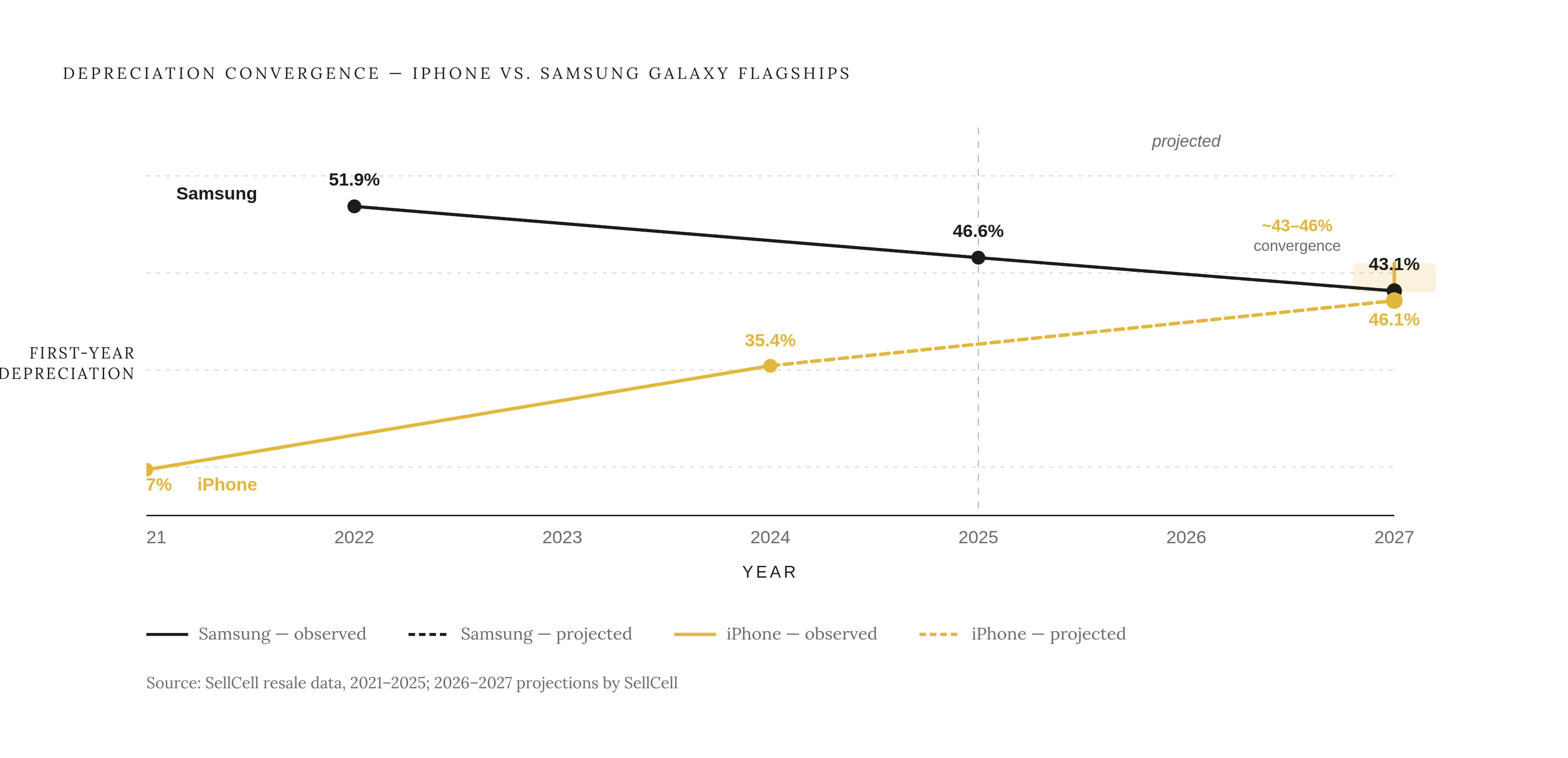
The trend line is the more interesting part, though. Samsung's Galaxy S depreciation improved by 5.3 percentage points, dropping from 51.9% in 2022 to 46.6% in 2025, according to SellCell's 2026 report. iPhone depreciation, meanwhile, rose 10.7 percentage points over a similar window, climbing from 24.7% in 2021 to 35.4% in 2024, likely a byproduct of Apple's own resale market getting more crowded. SellCell projects iPhone depreciation could reach 46.1% by 2027 while Samsung's improves to 43.1%. Not a bet to place money on yet, but the two lines are converging.
Samsung's improvement traces back to one decision: a seven-year software update commitment starting with the Galaxy S24 series, the exact playbook that made iOS longevity such a durable resale asset for Apple. Current prices for the S24 and S25 series sit at $400 to $650, per phoneflipp.com.
The OLED burn-in warning from earlier carries straight over to Samsung tablets: check the panel against a solid grey background before listing, since visible burn-in can meaningfully drag down the resale price. Samsung flagship hardware rewards a careful listing. Storage tier, exact spec, and carrier status matter here at least as much as they do on the iPhone side, maybe more, given how tight the margins are on Android resale.
Google Pixel, OnePlus, and Motorola: what mid-tier Android retention actually looks like
Pixel holds up better than its market share suggests. The Pixel 9 sits at $350 to $550 in 2026, per phoneflipp.com, and it earns that number on reputation: strong software support, and camera quality buyers actually seek out secondhand. Google has made a seven-year update promise for the Pixel line, a commitment that mirrors the kind of software longevity that tends to support resale demand.
OnePlus and Nothing sit in a different lane, retaining a more modest share of their value. A clean Android software experience and a genuinely dedicated enthusiast buyer base keep demand steady. Smaller crowd than Apple's or Samsung's, sure, but loyal buyers don't vanish the way trend-chasers do.
Motorola's budget lineup lands at a noticeably lower retention rate. Not nothing, but close, and sellers in this tier should price to move fast rather than hold out for an offer that probably isn't coming.
Here's the pattern across the whole middle tier: software support commitments and the size of a brand's enthusiast following matter more than raw spec sheets in keeping used demand alive. Unlocked status carries extra weight too, since the buyer pool for a locked mid-tier Android phone is thin to begin with. Locking a Motorola or a lesser-known OnePlus model to one carrier is basically shrinking an already small room down to a closet.
MacBooks: the laptop category where used prices stay high longest
MacBooks hold value the way iPhones do, only more so. They retain roughly 50% to 70% of purchase price after two years, compared to 20% to 40% for most Windows laptops, according to sellmylaptops.com's 2026 analysis. Widest brand gap in this entire piece. A used MacBook Pro can still fetch $1,500 or more in 2026, per the same source, a number that would sound made up if it weren't tracked so consistently.
The model-by-model spread tells the fuller story. Per itemvaluechecker.com and valuesnap.io, in mid-grade condition with charger included, M1, M2, and M3 MacBook Air models each command meaningfully different used prices, with each chip generation commanding a notable premium over the last. M1, M2, and M3 MacBook Air models each command meaningfully different used prices depending on configuration and battery health, with chip generation and RAM tier driving the largest spread. Move up to the M3 Pro 14-inch and prices sit at $1,200 to $1,500, with the 18GB/512GB configuration (originally $1,999) landing at $1,450 to $1,650. The base M4 Pro 14-inch commands a strong used price reflecting its position as the newest generation in the lineup. The M3 Max 16-inch tops out at $2,200 to $2,600.
Chip generation carries more weight on MacBooks than it does on iPhones. M4 machines sell for 50% to 80% more than equivalent M1 models, per buybackxstores.com, a bigger generational premium than anything in the phone market. RAM tier stacks on top of that: 16GB adds $100 to $200 over an identical 8GB configuration, and 32GB tacks on another $100 to $150. Spec out the listing to the exact gigabyte. Buyers in this category compare line by line, not vibe by vibe.
Timing matters just as much here, maybe more. Apple typically announces new MacBook Airs in March and new Pros in October, and prices on the outgoing generation drop 10% to 20% within days of the announcement. When the M4 Air launched in March 2025, M3 Air prices dropped almost immediately, per sellmylaptops.com. Sell before the announcement, not after, and remember: battery health applies here exactly as it does on phones. A worn battery drags the price down even when the rest of the spec sheet matches a healthier unit.
Business laptops that hold value: ThinkPad, Dell XPS, and HP EliteBook
MacBooks aren't the only laptops that age gracefully. Premium business laptops hold value two to three times better than budget consumer lines, according to valuesnap.io, and the gap inside the Windows laptop world is nearly as wide as the entire Mac-versus-Windows divide. valuesnap.io's own comparison makes the point bluntly: a 2018 MacBook Pro sells for $300 to $500 today, while a 2018 Acer Aspire from the same year sells for $60 to $120. Age alone doesn't explain that gap. Brand and build quality do, and no amount of gentle handling closes it.
Current 2026 prices from itemvaluechecker.com show the ThinkPad X1 Carbon Gen 12 at $900 to $1,500, the Dell XPS 14 and 16 at $800 to $1,500, and the Razer Blade 14 and 16 at $1,200 to $2,200. What keeps these numbers up is cold financial logic: corporate demand for hardware with a known reliability record, solid build reputations, and an entire resale ecosystem of IT resellers and refurbishers actively buying this exact gear.
Specs matter more in listings for this segment than almost anywhere else. Buyers shopping ThinkPads and XPS machines tend to be technically literate, and they filter hard on exact RAM and storage numbers. Skipping those details is one of the most common reasons a perfectly good laptop sits unsold for weeks, according to eBay's own listing guidance. Naming the exact processor generation in the title matters too, since buyers in this category search by chip generation first and model name second.
Gaming laptops and why they depreciate faster than any other laptop category
Gaming laptops lose value faster than any other laptop category on this list, and it has nothing to do with build quality. It comes down to GPUs. A new graphics card generation can make last year's flagship feel outdated overnight, even when it still runs every game fine. The hardware doesn't get worse. The comparison gets worse for it, which is a strange kind of obsolescence: nothing broke, the world just moved on without asking permission.
A gaming laptop typically sheds a large chunk of its value within two years, a curve noticeably steeper than what business or creative laptops of similar original price go through. Premium brands soften the blow somewhat: Razer's Blade 14 and 16 hold at $1,200 to $2,200 in 2026, per itemvaluechecker.com, beating what budget gaming brands manage. But no gaming laptop segment, premium or otherwise, comes close to matching MacBook or business ultrabook retention. Don't buy a gaming laptop expecting it to hold value like a ThinkPad. It won't, and no amount of colorful lighting changes that.
GPU model needs to sit front and center in any gaming laptop listing. Buyers cross-reference against current-generation benchmarks before they even message a seller, and a listing that leaves out the GPU tier underperforms no matter how clean the machine looks in photos. Sell sooner rather than later: the longer a seller waits after the next GPU generation launches, the steeper the price cliff gets. Bundling in accessories, a controller, a headset, can soften that drop, but only as a deliberate bundle, not something tossed into the listing photos as an afterthought.
Tablets, wearables, and gaming consoles: how resale logic differs by category
Tablets, wearables, and consoles don't follow the phone-and-laptop playbook exactly. Tablets track closer to phones, since software support windows and screen condition drive most of the value, with OLED burn-in risk on Samsung's AMOLED tablets acting as a category-specific wrinkle that phones mostly don't share.
Wearables depreciate on a shorter clock overall, tied more tightly to battery health and to how many fitness and health features still work without a subscription attached. Consoles behave differently again: value tends to hold steady through a generation's mid-life, then drops once a manufacturer confirms a successor, echoing the same announcement-driven pattern seen with phones and MacBooks.
Across every category here, the throughline stays the same. Condition, software support, and timing relative to the next announcement decide the price far more than brand loyalty or gut instinct ever will. Sellers who treat those three factors as the whole game, rather than an afterthought to a good photo, are the ones who get paid what the device is actually worth.