Best Platforms for Reselling Across Multiple Categories
Fee structure varies wildly—pick the wrong platform and lose 30 to 40 percent per sale.
Before anything else, know your net proceeds formula: Sale Price, minus platform fee, minus payment processing, minus shipping, minus packaging, minus return losses, minus what you paid for the item. That final number is what you actually keep. Every platform decision runs through it.
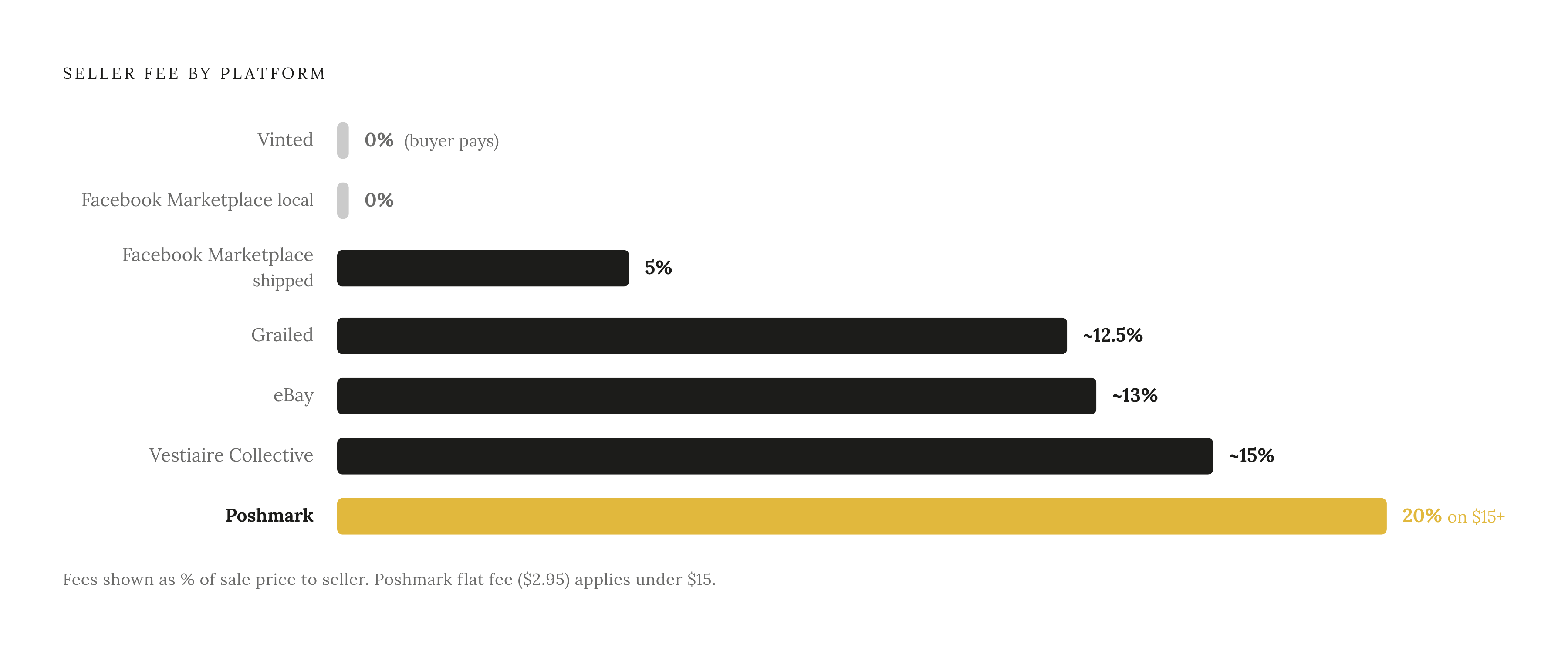
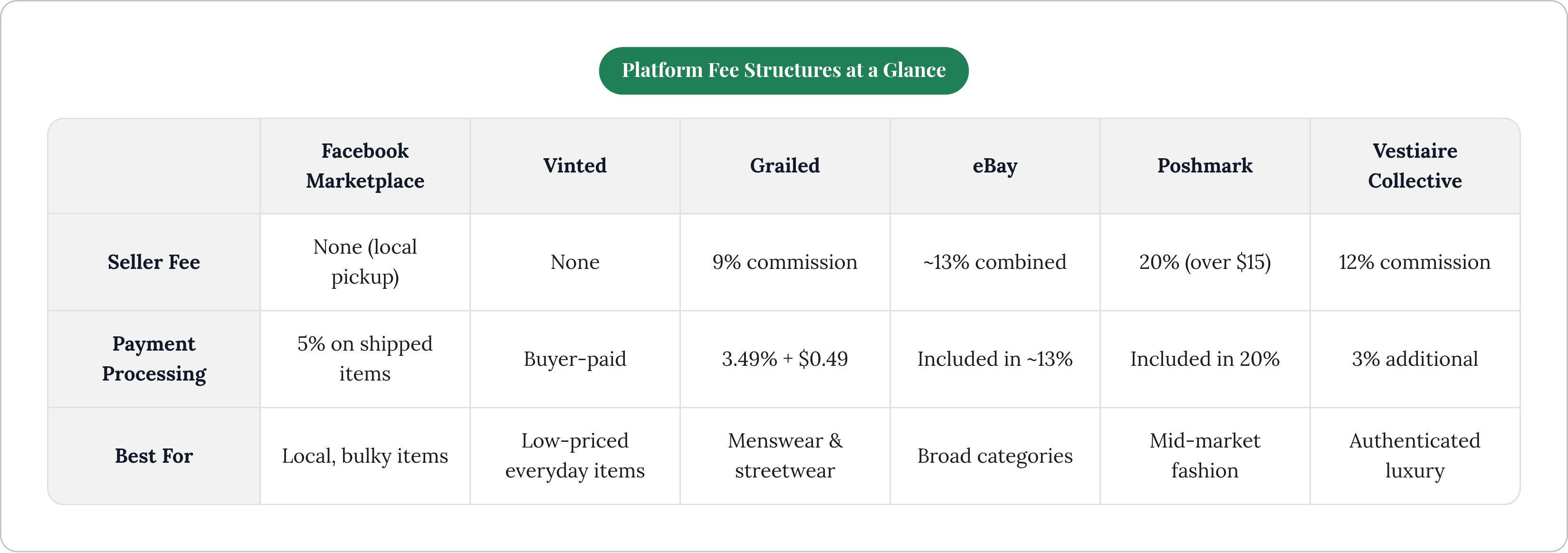
Here's how the major platforms shake out on fees:
- Facebook Marketplace: No fee on local (pickup) sales. Shipped items cost you 5%, with a 40-cent minimum.
- Vinted: No seller fee. The buyer pays a protection fee of roughly 5% plus 70 cents. Structurally, this is one of the most seller-friendly setups available.
- Grailed: 9% commission, plus 3.49% and $0.49 for payment processing on domestic sales.
- eBay: Around 13% total for most categories when you combine the final value fee and payment processing.
- Poshmark: $2.95 flat on sales under $15. For anything $15 and above, they take 20%. That's a meaningful cut, and it pushes sellers toward higher-priced items to make the math work.
- Vestiaire Collective: 12% commission on mid-range items, plus a 3% payment processing fee.
Picking the wrong platform on fee structure alone can cost you 30 to 40% of an item's value — like trying to fill a bucket that's already got a hole in it. But here's the part most sellers miss: the platform with the best fees for your category might still be the wrong choice if the audience isn't there. A $40 blazer listed on a platform where buyers expect $15 streetwear won't sell. No fee structure fixes an audience mismatch.
Shipping is also often the biggest swing factor, and it doesn't get talked about enough. A bulky item's shipping cost can erase margin that a fee difference would never explain. Keep that in mind as you read through the category breakdowns below.
Clothing and Fashion: Why Platform Culture Matters as Much as Traffic
Apparel is the largest resale category by a wide margin, representing roughly 45% of the global resale market. The buyer pool is large and growing. But fashion is also where audience mismatch does the most damage, because every platform has a distinct culture, and buyers shop within that culture. List outside it and you're invisible.
Here's how the major platforms break down:
- Poshmark has over 80 million active users and social-commerce mechanics like sharing listings and "Posh Parties" that reward consistent engagement. The 20% fee is steep. But the buyer base is genuinely there for everyday and mid-market fashion, so it can work if you price accordingly.
- Depop skews heavily toward Gen Z, vintage, and streetwear. eBay completed its acquisition of Depop in July 2026, so fee and policy changes are worth keeping an eye on. The audience is still there for the aesthetic it serves.
- Vinted charges sellers nothing. That makes it especially attractive for lower-priced everyday clothing where Poshmark's 20% cut would gut your margin entirely.
- Grailed has over 10 million users and is explicitly curated for menswear, streetwear, and designer. The 9% commission is lower than Poshmark for qualifying items, and the buyers there know what they're looking at.
- Vestiaire Collective earns its place for authenticated luxury. The fee structure and authentication credibility make sense when the item value justifies it.
- Etsy is viable only for true vintage, meaning items 20 or more years old. Buyers there expect unique, authentic pieces and will pay a premium for them. Just know that Etsy's fees stack: listing fee, transaction fee, payment processing, and potentially offsite ads at up to 15%. Price accordingly.
Gen Z and Millennials are expected to drive more than 70% of resale market growth through 2030. The platforms those buyers use, primarily Depop, Vinted, and Grailed, are genuinely different from the platforms where older buyers shop. Listing vintage streetwear on a platform skewing older is a mismatch that no amount of engagement fixes — you can't sell ice to someone shopping for fire.
Electronics: The Fastest-Growing Resale Category and the Platforms Built to Handle It
Electronics are the fastest-rising resale segment right now, and tariff pressure on new devices has a lot to do with it. When new retail prices climb 8 to 15%, the spread between what used items cost to source and what buyers will pay gets meaningfully wider. More buyers are shopping this category than ever before.
More buyers also means more sellers. Competition is real. Platform choice and listing quality matter more here, not less.
- eBay has the broadest audience for electronics resale. The search-first architecture rewards detailed, specific listings. Buyers search by model number, storage size, and condition. If your listing matches those search terms precisely, it gets found. The 13% total fee is the trade-off for that reach.
- Swappa is purpose-built for used phones and tech. Sellers price based on comparable listings and ship directly to buyers. The audience arrives already intending to buy a device, which is the platform's biggest structural advantage.
- Facebook Marketplace is effective for local pickup on larger electronics like TVs, monitors, and gaming setups where shipping cost would kill the deal entirely. No local-sale fee makes it the obvious move for anything too heavy or fragile to ship profitably.
One thing the growth numbers don't tell you: used-electronics buyers comparison-shop aggressively. Pricing against actual sold data, not asking prices, is the difference between a quick sale and a listing that just ages out. More on that below.
Furniture, Appliances, and Anything Too Bulky to Ship Profitably
Secondhand furniture represents roughly 7% of the global resale market. And almost universally, the shipping math points to local-first selling. Running this category through eBay with standard shipping rarely comes out ahead.
Facebook Marketplace is the default for large items. More than a billion users buy and sell goods on it each month, so local buyer density is high in most metro areas. No fee on local, cash-and-pickup transactions. That's the move.
Yes, lowball offers happen. Yes, no-shows are a documented reality of the platform. I once had a buyer message me three times to confirm a pickup window, then vanish without a word — not even the courtesy of a cancellation. The practical fixes aren't complicated:
- Set firm prices and hold them
- Be explicit about pickup logistics in the listing
- Don't hold an item for a buyer without a deposit commitment
For antique or high-value furniture where the item can justify freight shipping, eBay and freight shipping services are a real option. But that's the exception. For everyday furniture and appliances, local pickup is the rule.
Appliances follow the same logic. Condition transparency matters more here than in almost any other category, because returns are practically impossible. If the washer has a quirk, say so. Buyers who know what they're getting show up and complete the transaction. Buyers who feel surprised don't come back, and sometimes they escalate.
Collectibles, Sports Cards, and Hobby Items: Where Niche Platforms Command Higher Prices
The core argument here is structural. Niche platforms exist because general-platform buyers can't evaluate collectibles the way specialists can. That evaluation gap suppresses bids. A buyer who doesn't know what a graded rookie card is worth will bid conservatively, or not at all.
eBay remains relevant in this category. It has a long history with collectibles, and its auction format suits items with uncertain or sentimental value. The massive live listing count cuts both ways: more competition, but also more reach and more buyers who know exactly what they're searching for.
Whatnot is built differently. It's a live-stream auction format designed for sports cards, sneakers, and collectible toys. Real-time bidding with an engaged community can push prices above what a static listing achieves, and the energy of a live auction genuinely changes buyer behavior for certain items.
Authentication matters in this category more than any other. Buyer trust in condition grading directly affects what they'll pay. Platforms that offer or integrate authentication, whether that's eBay's programs for sneakers and watches or Whatnot's community standards, reduce buyer hesitation. Reduced hesitation means higher bids.
Here's the practical implication: an item that gets $40 on a general platform might get significantly more from a collector who actually recognizes it. But only if it's listed where collectors look.
Books, Toys, and Everyday Household Goods: Matching Item Value to Platform Overhead
Books represent about 5% of the global resale market. Toys and games are another 4%. Smaller shares, but these are often the first things people try to sell when they're clearing out a garage or a spare room. And they're also the category where sellers most reliably lose money to fees they didn't account for.
The core tension is fixed-cost overhead. Low-ticket items lose a disproportionate share to fees and shipping. That math matters more here than in any other category.
- Facebook Marketplace is usually the right answer for bundles. No fee, no shipping, buyer comes to you. A box of paperbacks or a bin of kids' toys sold as a single lot is faster and often more profitable than listing individually.
- eBay is viable for individual items with collector value. Vintage board games, first editions, discontinued toys. Common paperbacks or generic kids' toys rarely pencil out given the 13% fee and shipping costs.
- Vinted is increasingly used for toys and kids' clothing. The zero seller fee helps on lower-priced items where any fee structure becomes a margin problem.
A quick note on consignment platforms: some clothing consignment services accept kids' items, but payouts on low-priced goods are often a small fraction of the sale price. That's a convenience trade-off, not a profit strategy.
For a box of common paperbacks, bundling locally beats individual listings almost every time.
Using Sold Data to Confirm Your Platform Choice Before You List
Asking prices on platforms run 30 to 80% higher than what items actually sell for. If you're pricing against active listings, you're anchoring to wishful thinking. Sold listings tell you what buyers actually paid, which is the only number that matters.
How to check sold data on eBay: Search your item. On desktop, find "Sold Items" under "Show only" in the left sidebar. On mobile, tap Filter, then Sold Items. eBay shows the last 90 days of transaction data.
What to look for:
- The range of sold prices for comparable condition
- How recently items sold (recent sales are more relevant than older ones)
- How many active listings are competing against you right now
A category with hundreds of identical active listings and sparse recent sales is a saturated platform for that item. That's a signal to route it elsewhere before you've invested listing time.
Poshmark shows sold listings, which is useful. Facebook Marketplace doesn't show sold data, which is itself a reason to check eBay sold comps first, even when you plan to list locally.
If your sold comps on the first-choice platform show thin margins or slow movement, move the item to a different platform. Do this before listing, not after six weeks of silence wondering why nothing is moving.
Listing on More Than One Platform Without Doubling Your Work
Different platforms have different buyer pools, different price ceilings, and different urgency levels. A fashion item might sell faster on Poshmark but get a better price on Grailed. Listing on both hedges the outcome. Most casual sellers don't do this, and it's a real missed opportunity.
The reason they don't is time. Recreating descriptions, re-uploading photos, and managing separate inboxes across apps is genuinely tedious, and that friction is what stops people. The strategy itself is sound; the execution is what breaks down.
What a good multi-platform workflow actually looks like: one photo, one set of details, pushed to multiple listings without rebuilding each one from scratch. Two or three platforms per item category is usually enough to capture the meaningful buyer pools. Beyond that, the management overhead starts outweighing the benefit.
The delisting problem is real. Once an item sells on one platform, it needs to come down on others immediately. Failing to do this creates duplicate sales, unhappy buyers, and negative feedback that follows your account. Multi-listing tools exist specifically to handle this. If you're running any real volume, the friction of manual delisting will eventually cost you.
The platform decision is the first real choice you make as a seller, and it compounds. Get it right and the rest of the process gets easier. Get it wrong and you're not just waiting longer. You're also making less when the sale finally happens.