Garage Sale vs Selling Online Cash Comparison
Online selling nets more for quality items, but local sales beat fees for bulk clutter.
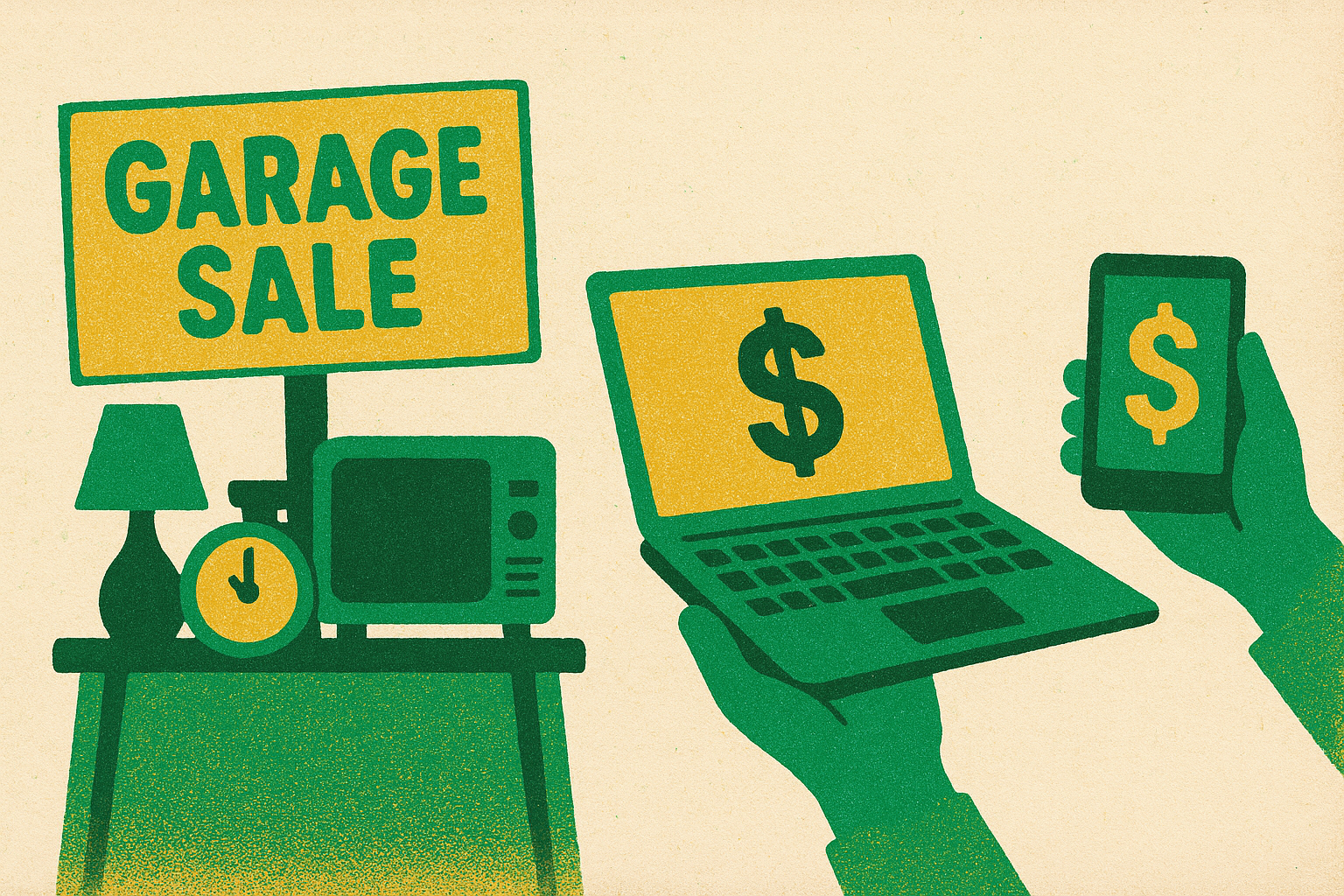
A garage sale hands you $500 to $700 in cash over a weekend. Sounds great, until you notice the average item only nets $100 to $200 of that, and half the stuff in your garage is worth way more somewhere else. This is about that gap: what a garage sale buyer pays you versus what an online buyer pays you, and when the difference is big enough to change what you do on Saturday morning.
Garage sale items tend to sell for about 20% of what they cost new, no matter what they are. Clothing makes up 42% of garage sale transactions, furniture drives around a quarter of total earnings, and that's not a random split. It's just what people are willing to drag out onto the driveway.
The case for the garage sale is real, so let's say it before anyone pokes holes in it. Cash in hand, no fees, no box, no tape, no trip to the post office. But resellers have known something for years that most weekend sellers haven't clocked yet: somebody buys a lamp off your driveway for three bucks, drives home, and lists it on eBay for forty. That's not luck, that's information they have and you don't. ThredUp ran the numbers in 2024 and found the average American home is sitting on $5,300 worth of unused stuff. Almost none of that value shows up on a garage sale price sticker.
What online selling actually costs — fees, friction, and where sellers net out
Every platform takes a bite, and the bites aren't the same size. eBay runs about 13.25% under its 2025-2026 fee schedule. Poshmark takes a flat 20%. Etsy charges 6.5% plus 20 cents a listing. Depop and Facebook Marketplace charge nothing for most listings, and Marketplace skips fees entirely if you do local pickup.
Cheap stuff gets hit the hardest, and this is the part nobody tells you going in. Poshmark's flat 20% works out closer to 29.5% of the sale price on anything under $15, once you look at how the math actually shakes out. Sell a $10 shirt there and the fee eats close to a third of it. You made a sale and somehow still feel like you lost.
Facebook Marketplace looks like the free lunch of online selling, and locally, it mostly is. But Facebook pulled prepaid shipping labels for most sellers back in February 2025, so "free to list" stops meaning "frictionless" the second you're shipping instead of handing something off in a parking lot. Now you're buying your own boxes and printing your own labels. It doesn't cost money, it costs time, which is its own kind of tax.
Some smaller platforms advertise lower fees than the major names, but low fees don't matter if no one's shopping — without the foot traffic of an eBay or Poshmark, a bargain fee rate rarely translates to a faster or higher sale.
Sell locally, whether that's a garage sale or a Marketplace pickup, and you can net 20% to 40% more per item than the same item shipped, simply because there's no fee and no box involved. Online selling doesn't come out cheaper on paper; it almost never does. The real question is whether the higher price you'd get online covers the fee with room left over, and that's not one answer for every item. That's a calculation, one item at a time.
How to find out what an item is actually worth before choosing where to sell it
Most pricing mistakes start the same way: a guess, or anchoring to whatever you paid for the thing back in 2019. Neither one tells you what somebody will actually hand you money for today.
eBay's completed listings are about as close to a real price tag as used goods get. Go to Advanced Search, check the box for "Completed listings," and look at what sold in the last 90 days, not what other sellers are hoping to get. Asking prices are wishes, and sold prices are receipts.
Facebook Marketplace does the same job for anything too big to ship. Filter by condition, location, price, and you've got local comps for the couch, the treadmill, whatever else nobody's mailing across state lines.
A few small moves shift the number once you've got a range. Keeping the original box, charger, remote, or manual can add 10% to 20% to the price. Pricing just under a round number, $195 instead of $200, keeps you inside the buyer search filters that cut off at even hundreds (a trick as old as price tags themselves). List seasonal stuff four to six weeks ahead, patio furniture in early spring, coats in early fall, and you can pull 25% to 35% more than listing it in the off-season. If a listing hasn't moved in a week, drop it 15% to 25% below fair market value instead of letting it fossilize in your closet.
Garage sales run on their own rule of thumb: half what you paid, or less. That's a decent floor, but it's not a ceiling, and you'll never know the difference unless you check sold data first, which almost nobody does.
For anyone who isn't going to sit there scrolling through eBay listings by hand, there are apps now that pull sold data automatically, or take a photo of an item and spit back a price range in a few seconds. That's the difference between someone actually pricing an item and someone shrugging and marking it "$2, or best offer."
Which items genuinely earn more at a garage sale versus online
Garage sales win on anything heavy. Furniture, gym equipment, the ancient microwave, shipping would cost more than the item's worth, so local just wins on math alone. They also win on cheap household stuff: kids' clothes, mismatched kitchenware, the stuff where the platform fee and twenty minutes of listing time cost more than any extra dollar you'd squeeze out online. Sometimes speed is worth more than the last five bucks. If you'd rather have cash and an empty garage by noon than spend two weeks answering "is this still available?" messages, that's a fair trade, not a mistake.
Online wins everywhere else. Electronics top the list, an iPhone, a MacBook, a PS5, a pair of AirPods, pull a national audience instead of whoever happened to be walking their dog past your house that morning. Vintage and collectible stuff works the same way: a garage sale only reaches whoever showed up Saturday, while eBay, after 29 years in the game, can connect you to the one specific person on Earth hunting for that exact item.
Branded fashion belongs online too. Take a Patagonia fleece: even after Poshmark takes its 20%, you'll still net more than any garage sale shopper would offer for it. If something has a model number, spend five minutes checking sold listings before you price it. That search alone tells you if you're holding a $5 garage sale item or a $50 eBay listing.
Honestly, the smart move for most people isn't picking a lane. Run the garage sale for volume, but pull the dozen best items out beforehand and list those online instead. Clothing proves the point in both directions: it's 42% of garage sale transactions, and branded or vintage pieces still pull multiples more online. Condition and brand decide the winner here, not the category.
How time and effort change the math — and when the convenience of a garage sale is an illusion
A garage sale isn't free time, it just feels that way because no money changes hands for the setup. Somebody has to price everything, tag it, haul it outside, sit there all day (sometimes all weekend), haggle with strangers over quarters, then haul back inside whatever didn't sell.
"Simple" garage sales aren't simple anymore, either. 78% of buyers now find sales through Facebook Marketplace or Craigslist, so even a driveway sale needs a digital push to pull a crowd. Meanwhile 80% of sellers still put up physical signs, meaning you're doing the cardboard-arrow-on-a-stick thing and the online posting thing. The old-school garage sale already lives half online, and nobody just wandered up anymore.
Listing items one by one online has its own drag, and it's worth naming honestly: photos, descriptions, answering "will you take $8 for it?" messages. That's exactly the part most casual sellers quit halfway through, which is why stuff sits in boxes for three years instead of ever getting listed. Reclaim, for instance, is a photo-to-listing app built specifically for that friction point, generating the description and price from a single snapshot. AI listing tools cut straight through that. Snap a photo, and you get a description, a condition grade, a price suggestion back. The friction that used to stop people from bothering just about disappears.
So the real comparison isn't garage sale versus online selling in the abstract. It's one full day of hauling and haggling that nets $500 to $700, against a few minutes per item that might net more per item, on your schedule, spread across a week instead of crammed into a Saturday. For a handful of good pieces, online wins on time and money at once. For a garage full of junk, one Saturday sale is still the efficient move, and pretending otherwise would be lying to you. Which answer's right just depends on how much stuff you've got and what it's actually worth.
A practical decision framework — choosing the right channel item by item
Sort first, and don't price yet. Pull anything with a model number, a recognizable brand, or collectible potential, and check sold listings on it before it ever touches the garage sale table.
Then run the fee test. Take the realistic online price, subtract the platform's cut (13.25% on eBay, 20% on Poshmark, 0% on Marketplace for local pickup), and stack that against what the same item gets on a folding table in your driveway. If online still comes out at least 30% ahead, list it.
Factor in shipping next. Anything bulky or breakable stays local by default, while small electronics and anything that folds flat ship cheap enough that the bigger online audience is worth chasing.
From there, match the item to the platform:
- Electronics, collectibles, and odd vintage finds do best on eBay, where 29 years of buyer trust and a global audience track down the one person who wants that exact thing.
- Branded fashion and streetwear fit Poshmark or Depop, where people are already shopping for exactly that.
- Furniture, gym gear, big appliances belong on Facebook Marketplace, local pickup, no fees, no shipping headache.
- CDs, DVDs, games, anything you've got a pile of, may not justify the per-item listing effort online — weigh whether the garage sale pile or a bulk lot is the faster path to clearing them out.
- Anything that fails both the fee test and the shipping test goes in the garage sale pile, or gets donated and forgotten.
Price off sold data, not off gut feeling or what you paid for it in 2015. eBay's 90-day completed listings and Marketplace's sold filters hand you a real number in a few minutes, and skipping that step is the single most common way people leave money on the table.
The hybrid approach ties the whole thing together: run the garage sale for the volume and the cash, but pull the ten or twenty best items out beforehand and list those online first. Those reach a bigger audience and probably sell for more, while the rest clears out locally in one morning instead of gathering dust for another year. Now that tools can identify an item, grade its condition, and write the listing for you, "sell the good stuff online" isn't just a reseller's trick anymore. That edge is available to anyone with a phone camera.