Baby and Kids Gear With the Highest Resale Value
Premium brands and complete condition determine what your used baby gear actually fetches.
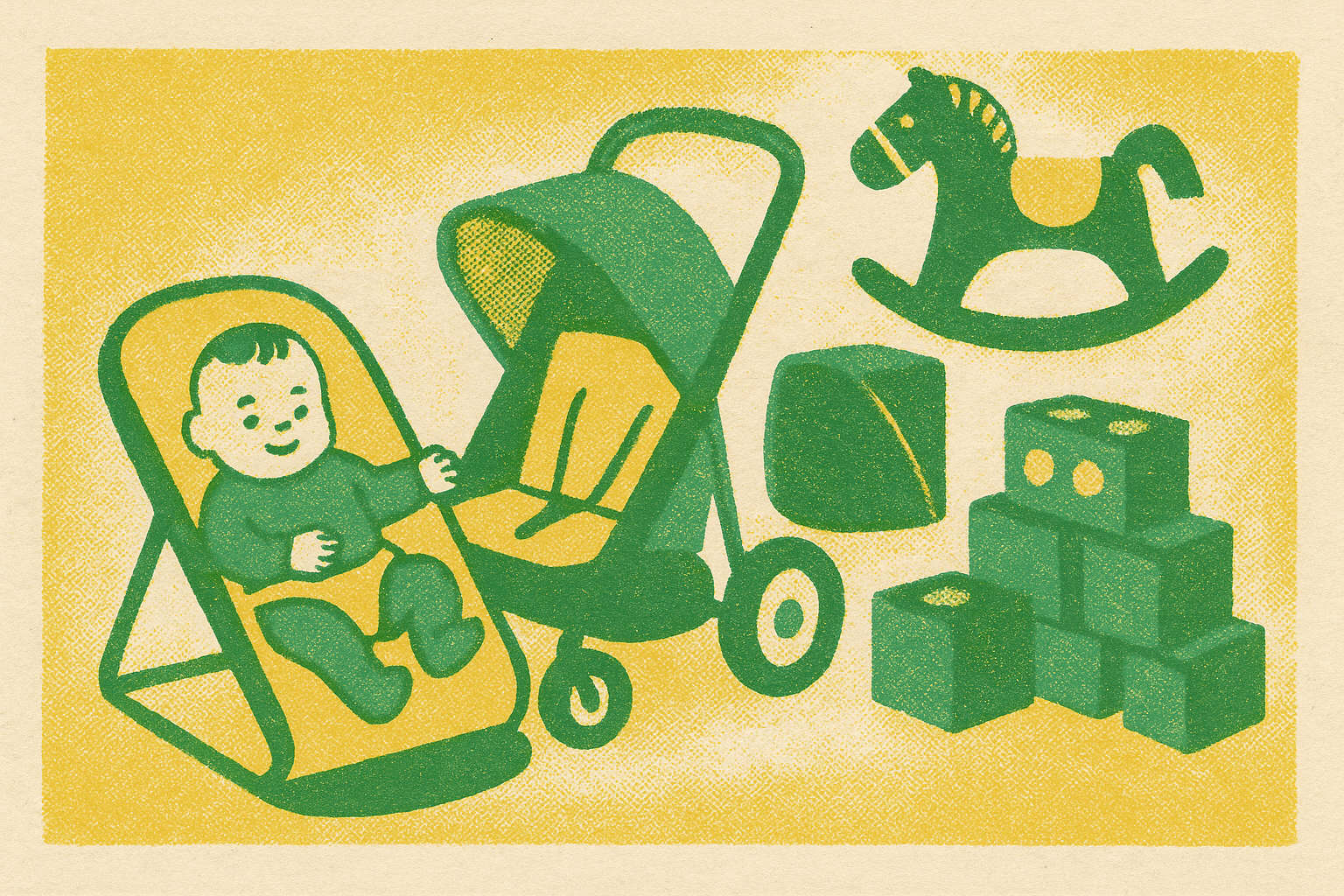
Baby gear depreciates weirdly, in a good way. Kids outgrow strollers, bassinets, and clothes long before those items show any real wear, so most of what leaves a household is basically still new. That gap between how long a kid actually uses something and how long the thing is built to last is the whole reason resale works here, for sellers and buyers both.
New tariffs in 2025 are poised to drive up the cost of baby gear by at least 20%, according to GoodBuy Gear's 2025 Resale Report, and that's nudging secondhand from backup plan to default choice for a lot of parents. The buyers are already out there, waiting for a better deal, but the only real question is whether sellers know what their stuff is actually worth. Most don't, and most people price by gut feeling or by what they paid.
What actually determines resale value in this category
Two things move the needle above everything else: the brand, and the shape it's in when you list it. Ignore either one and you'll underprice or overprice by a mile, and most sellers ignore both.
Brand matters because premium baby gear gets built to survive more than one kid, and buyers bid accordingly. Condition is the piece sellers still control at sale time. Keeping the original box, the manual, and every last part is worth roughly as much to the final price as having bought the fancy brand in the first place. That surprises people who assume brand does all the heavy lifting.
Gently used baby items typically sell for 30% to 50% of original retail. High-demand items in excellent shape reach 60% to 70%. Buyers judge condition fast, using two shortcuts: is everything actually there, and does it come with clean paperwork, meaning original packaging, no recalls, no crash history. Then one factor overrides everything else, since safety compliance beats brand, beats condition, beats all of it: an item under an active recall or past its safety window is worth zero dollars, no matter how mint it looks or how nice the name on it sounds. Car seats prove this point again, harder, further down.
Strollers consistently command the highest resale prices in the category
Strollers sit at the top of the resale food chain, pulling 60% to 75% of original retail depending on brand and condition, well above the baseline for nearly everything else in the nursery.
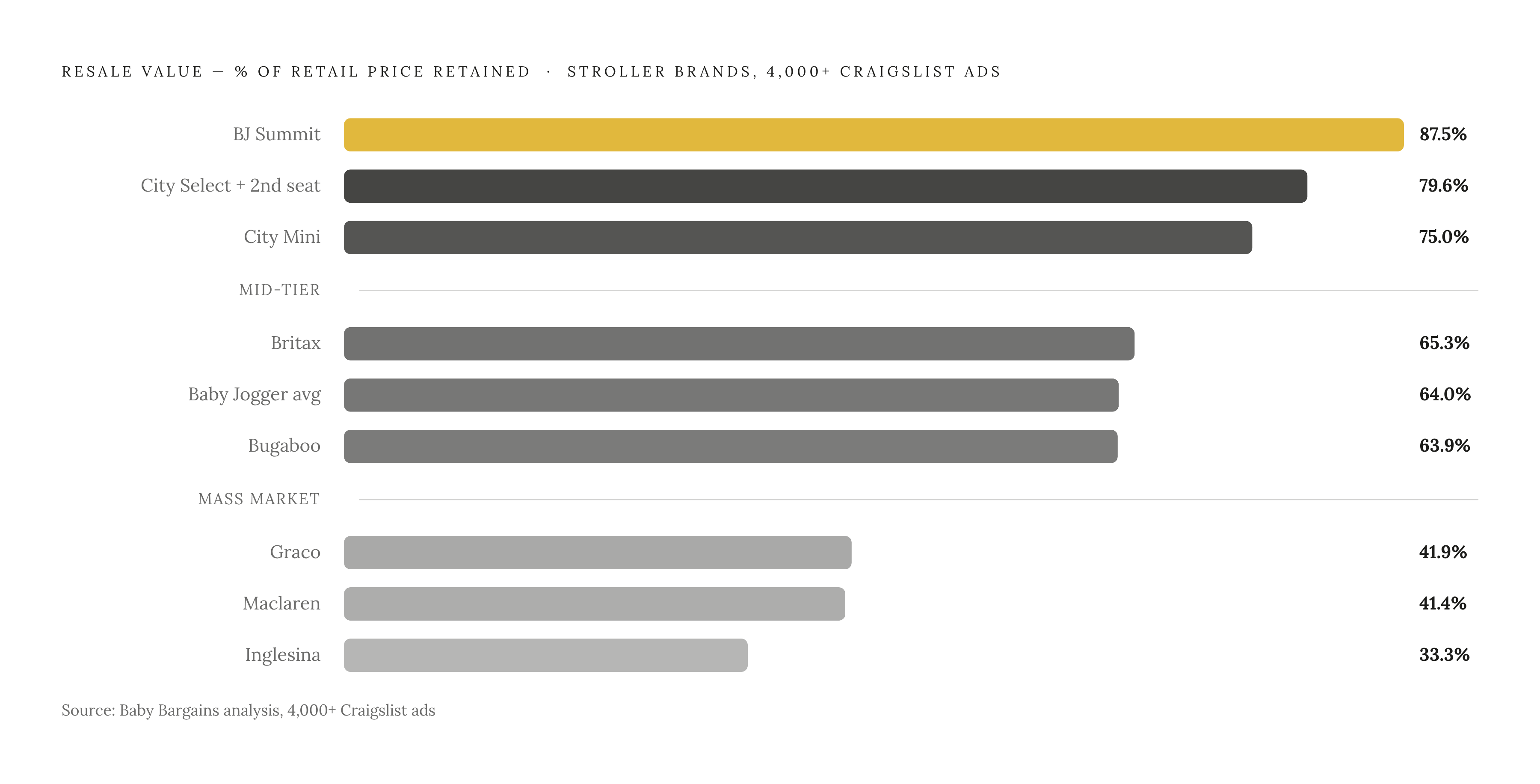
The brand gaps aren't subtle either. A Baby Bargains analysis of more than 4,000 Craigslist ads (data from 2014, so treat the exact figures as directional, not gospel) found Britax holding 65.26% of original retail, Baby Jogger at 63.98%, Bugaboo at 63.90%. Specific models did even better: the Baby Jogger Summit jogging stroller held 87.5% of its value, the City Select with a second seat held 79.55%, the City Mini held 75%. Double strollers beat singles across the board, probably because there just aren't many floating around secondhand, and scarcity does what scarcity always does to price.
Graco sat at 41.90%, Maclaren at 41.43%, Inglesina at 33.31%. Mass-market positioning that makes a stroller easy to sell new at Target tends to tank it on resale, because the secondhand buyer isn't paying for the badge, they're paying for the badge's résumé.
The old numbers are over a decade old, but the pecking order hasn't moved an inch. GoodBuy Gear's 2025 data still has UPPAbaby (the current Vista runs about $969.99 new) and Bugaboo selling fastest and highest, with the Wonderfold W4 Original Stroller Wagon noted for strong demand. If someone's wondering whether their stroller is a Britax or a Graco, that question is basically the whole ballgame, since listing a Graco like it's a Bugaboo won't fool anyone; buyers who know the category will know instantly.
Toys: open-ended play and collectibility drive the strongest returns
The toy brands with real resale value all share one trait: the play doesn't expire. A kid ages out of a rattle in about six weeks, but a kid does not age out of Magna-Tiles, LEGO, Playmobil, or a set of Hape or Grimm's wooden blocks, because the design lets a two-year-old and a seven-year-old use the same pieces for entirely different games.
Lovevery is the standout name here, and it's not a close call. Archive Resale puts its products at an average of 70% of resale value, an outrageous number for a toy. Lovevery clearly knows it too: in July 2025 the company launched its own resale marketplace, Lovevery Pre-Loved, betting on its own secondhand demand instead of fighting it. Toycycle's 2026 Toy Price Index shows how wide the brand spread gets. Among toy brands with at least ten used listings, resale value ranged from 59% (Lovevery) down to 37% (BabyBjörn). That 22-point gap comes down almost entirely to brand and design category, which is the part sellers keep getting wrong when they assume a clean toy is a valuable toy.
Packaging is its own lever here, more than in most other categories. Open-box, complete-in-packaging listings start near 70% of original retail on Toycycle's index. LEGO plays a different game entirely: retired or rare sets sometimes sell above original retail on eBay, where a genuine collector market sets the price, not a parent hunting for a deal. That's a ceiling, though, not what a random bin of loose bricks will fetch.
A Lovevery kit still in its box is a legitimately good listing, while a generic bag of plastic dinosaurs from the dollar aisle is a donation, full stop, and no amount of wiping them down changes that. Knowing which one is sitting in the closet saves a lot of wasted photography time.
Baby clothing resale works differently — bundles and brand niches beat individual pieces
Clothing resale runs on volume, not scarcity. ThredUp's 2025 Resale Report found 58% of buyers bought secondhand apparel in 2024. Demand is everywhere, but so is the competition, since every other parent has a bag of onesies to unload too.
Here's the part that catches people off guard: the premium doesn't always sit at the luxury end. Certain niche baby clothing categories have devoted followings with buyers willing to pay a premium in dedicated resale communities. Higher-end kids' clothing can hold value too, but only on the right stage. eBay and specialty resale apps suit them, while a local Facebook post undersells the brand every time, since the wrong venue and the wrong price ruin things no matter how nice the coat is.
For everything else, bundling wins outright, and selling piece by piece is the mistake most sellers make. Facebook Marketplace suits lots of same-size clothing well, because local buyers are often shopping for a whole wardrobe at once, not a single onesie. Pricing a 15-piece lot below the sum of its per-item prices moves it fast and spares the seller from photographing fifteen onesies one at a time, which is its own special kind of tedious.
Condition rules in clothing leave no wiggle room: clean, no stains, sorted by size, or it drops straight into donation-bin territory. Online platforms have seen strong growth in kids' clothing resale activity, particularly around the back-to-school season. That's a sign the online audience for kids' clothing resale is expanding fast, and getting younger while it does.
Nursery tech and baby monitors are emerging as a reliable secondhand segment
Nursery tech items like bassinets, baby monitors, and sound machines have become a reliable secondhand segment, and it tracks. These items get the same short-use, low-wear treatment as strollers: a baby outgrows a bassinet in months, not years, so it lands back on the market looking practically untouched.
The buyer's real worry here is function over looks. A monitor with a crisp video feed and a working display sells; one with spotty connectivity doesn't, no matter how clean the casing looks. That makes an honest, specific description, does the app pair reliably, does the night vision actually work, matter more here than almost anywhere else in the nursery. Vague descriptions ("works great!") read as a red flag.
Brand recognition carries weight too, and buyers type the brand straight into the search bar: a Snoo bassinet or a Nanit monitor gets searched by name, while a generic equivalent never gets that traffic at all.
Car seats are the one category where resale is legally and ethically complicated
Car seats break nearly every rule above, and for good reason: many general marketplaces restrict or discourage listings for them. Expiration dates, unknown crash history, and evolving safety regulations turn a secondhand car seat into a liability question first, and a resale question a distant second.
Before listing any baby item, check the CPSC recall list. For car seats, that step isn't optional, since skipping it is how sellers end up on the wrong end of a lawsuit rather than a sale.
One real exception is worth knowing. GoodBuy Gear launched a proprietary process for buying and selling gently used car seats, keeping quality-checked seats in circulation through a verified channel. That proves verified resale is possible, but only through a channel built specifically to check crash history and expiration dates, not through a general marketplace listing. A car seat sitting in the garage belongs with a manufacturer take-back program or a certified safety organization. Selling it solo on a general platform isn't worth the risk, and most platforms have already made that decision for you.
How to price what you have using sold data rather than guessing
Sold listings tell the truth, and this is the single rule that matters more than any other here. Active listings show what sellers are hoping for, while sold listings show what buyers actually handed over money for. Those are frequently two very different numbers, and mixing them up is the fastest way to price something wrong.
On eBay, the process is simple: go to Advanced Search, type in the item, check the box for "Completed Listings," and search. Filter down to sold results only, since unsold listings skew the picture upward and make everyone look richer than they are. Pull at least ten comps if possible, toss the highest and lowest as outliers, average what's left, then subtract the platform's selling fee and estimated shipping to land on what actually hits the bank account.
Recency counts too. Weight anything from the last 30 to 60 days more heavily than older sales, since baby gear turns over with new product generations and updated safety standards faster than most categories. Use the resale percentages above as a gut check: if a Britax stroller in excellent shape is pricing out well below expected value based on comps, something's off. Usually that means the comps are pulling from beat-up listings that don't match the item in hand, and the fix is adjusting upward, not accepting the low number.
Which items are worth cleaning up and listing versus donating
Some gear earns the fifteen minutes it takes to photograph and list, and some doesn't. Here's where the line actually sits, and the mistake most people make is listing the wrong pile.
List these without hesitation. Premium strollers (UPPAbaby, Bugaboo, Baby Jogger, Britax) clear the effort threshold even in average shape. Lovevery kits, Magna-Tiles, and retired LEGO sets do the same, especially with original packaging intact. Bamboo baby clothing and luxury kids' brands hold value well enough to justify the listing too. Fully functional nursery tech from a recognizable name, monitors, smart bassinets, rounds it out.
Bundle instead of listing solo. Mass-market stroller brands like Graco rarely justify individual listings, though tossing in the extra accessories helps close the sale. Generic plastic toys without a brand behind them are a hard sell on their own. Mixed clothing lots under 18 months move better bundled on Facebook Marketplace than listed piece by piece.
Skip the listing entirely for anything on the CPSC recall list, any car seat headed for a general marketplace instead of a certified channel, and anything missing a safety-critical part like a harness or buckle. None of that is worth the exposure, ethical or legal, and no markup covers that kind of liability.
The gap between a $40 Graco and a $300 UPPAbaby on the resale market isn't noise. It's engineering, brand trust, and buyer confidence that got built in on the day it was bought new. For anyone shopping for the next kid, that's the actual argument for buying resale-aware brands from the start: the money doesn't disappear, it just changes hands later, on better terms than most sellers expect.