Estate Sale Cleanout Selling Strategy
Selling an estate item by item beats dumping it—here's the proven system.
Most families sorting out an estate lose money before they realize there's money to lose. They see a garage full of stuff, a deadline from the closing date, and a dumpster rental that feels like the path of least resistance. That's the wrong call almost every time. The fix requires doing things in the right order: sort first, figure out what's sellable, price it off real sales data, match it to the right platform, and only then deal with what's left.
Here's the part nobody wants to hear: the junk hauler and the donation truck are where profit goes to die. A drawer of old remote controls looks like trash to a grieving family and looks like $20 to somebody on eBay. Multiply that gap across a house, and it's the difference between a cleanout that costs money and one that pays for itself.
How to sort an estate before a single item is priced or listed
Four boxes. Keep, Sell, Donate, Trash. Touch each item once, make the call, move on. Going back for a second look at every teacup is how a two-day sort turns into a two-month standoff, and nobody has two months.
Start where nobody's crying: the attic, the garage, the guest room, the storage unit. These rooms build momentum fast because no one gets attached to a broken space heater. Save the primary bedroom, the kitchen, and the living room for after the sorting muscle warms up. Save anything sentimental for dead last; photo albums and jewelry boxes eat hours if tackled early, and they'll stall every other room behind them.
The rule that cuts through most hesitation: if nobody used it in the past year, or nobody in the family even remembered it existed, it's not a Keep. Big items go first physically too. Clearing furniture and bulky gear out of a room creates visible progress and usually surfaces the best sell candidates early, before fatigue sets in and everything starts looking like Donate.
One warning worth repeating, because it gets skipped constantly: garages and sheds hide aerosol cans, paint thinner, and old chemicals. Deal with those before sorting anything else in that space. They can't ship, and no mover or estate company will touch them.
Set expectations now, because families donate far more than they sell, especially clothing without a recognizable brand on the tag. The Sell pile always ends up smaller than everyone hopes. Give the whole process six weeks before a property handoff, enough time to sort, price, list, sell, donate, and clear without rushing into bad calls. Don't price anything during the sort; that comes later, once there's data to work from instead of a guess.
Which categories actually have resale value and which don't
Most people assume the furniture is the money and the junk drawer is, well, junk. Flip that assumption and the math starts working.
Power tools from DeWalt, Makita, and Milwaukee sell fast, with profit margins running 40 to 100%. Electronics are underrated across the board, and not just the obvious stuff. Remotes, routers, calculators, old digital cameras: 20 to 50% margins, routinely. Apple Watches and Fitbits hold value well past their release date, long after the owner assumed they were worthless.
Collectibles and games get underestimated too. Pokémon cards, sports cards, and Magic: The Gathering decks can yield 10 to 1,000x returns on rare finds. Old consoles like the NES, SNES, Sega Genesis, and Game Boy still have buyers, and a rare Nintendo 64 or PlayStation title can fetch hundreds of dollars. Kids' gear counts here as well: high-end strollers like UPPAbaby and Montessori-style toys do well, since parents shop secondhand on purpose now, not out of necessity.
The volume hiding in small parts surprises most people. A single 30-day window on eBay showed more than 1,200 replacement remote controls and similar small parts sold, totaling over $24,000. Nobody expects a drawer of old remotes to be worth anything, yet the numbers say otherwise.
On the other side, and this list won't shock anyone: non-name-brand clothing, mismatched dishes, duplicate kitchen tools, expired pantry goods, generic furniture with no maker's mark, linens, toiletries. None of it is worth listing. Donate it or toss it and stop thinking about it.
An estate isn't a garage sale. The ceiling on the right items runs much higher, but only if someone pulls those items out before they get lumped in with everything else headed for the truck.
How to price what you've found using sold data, not guesswork
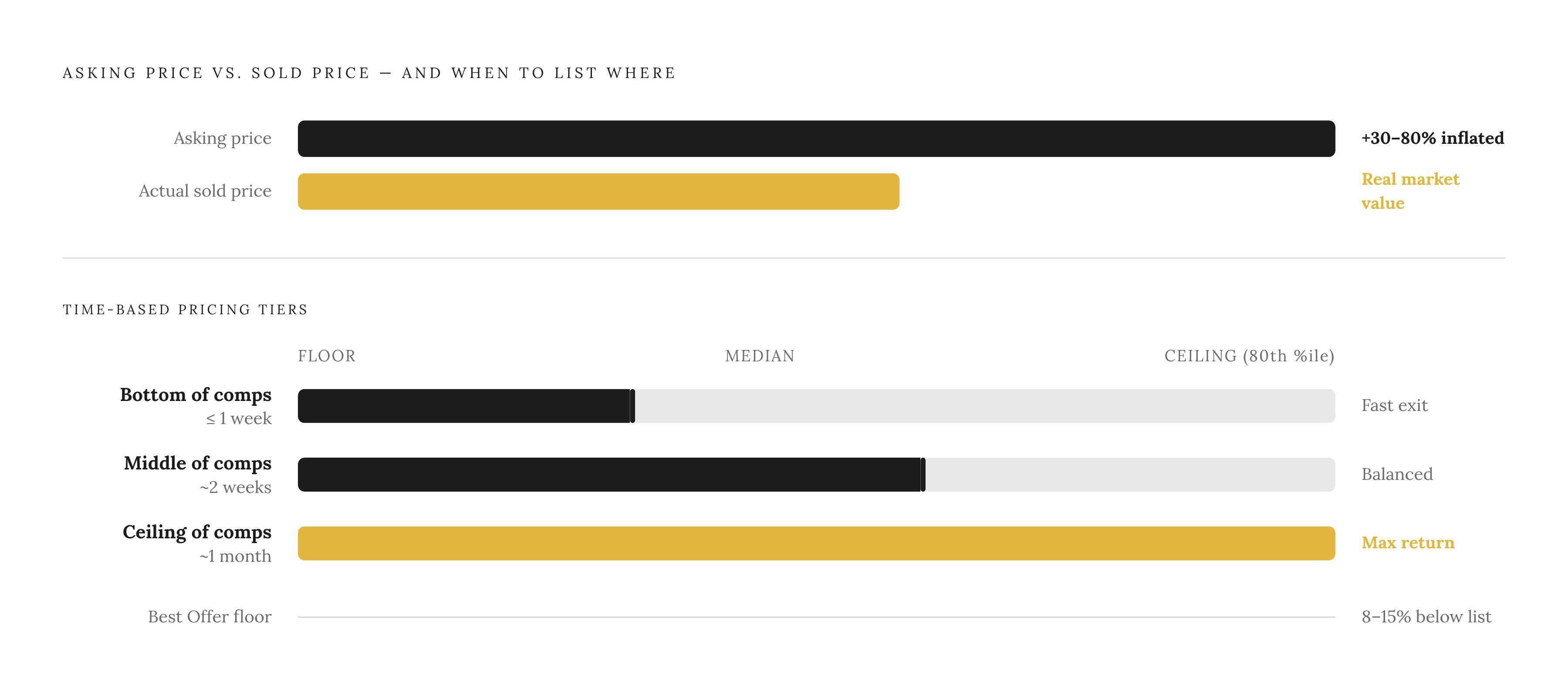
Nearly everyone makes the same mistake here: checking eBay, seeing what similar items are listed for, and pricing off that number. Bad idea. Asking prices run 30 to 80% higher than what things actually sell for, so pricing off active listings means pricing off wishful thinking, not the market.
Price from sold listings instead, always. In the eBay app, search the item, tap Filter, toggle on "Sold Items." That pulls real sales from the past 90 days. For a longer view, the Research tab inside Seller Hub (the tool that used to be called Terapeak) shows up to three years of sales history, including what buyers actually paid after Best Offer negotiations knocked the price down.
Build a comp set that means something. Match model, condition, and included accessories exactly; mixing a mint item with a beat-up one in the same average produces a number that's useless to anyone. Pull at least ten sold listings and throw out anything roughly 20% above or below the middle cluster. Then check speed: if comparable items are sitting two to three weeks without a sale, that's a demand signal, and it means the price comes down, not that it stays put on principle.
One method that works well: sort comps low to high and find the price where 80% of sales landed at or below it. That's a realistic ceiling. Price near the bottom for a sale within a week. Price in the middle for around two weeks. Price at the ceiling only with a month to spare.
On Best Offer, accept anything 8 to 15% below list; holding out for more rarely pays off in an estate situation, where the goal is clearing the property, not winning a negotiation. And if a listing gets zero views in 72 hours, treat that as a visibility problem rather than a pricing one. Use "Sell Similar" to generate a fresh listing ID, reset the algorithm, and adjust price on the relist.
Estates don't get the luxury of waiting for the perfect buyer. Price toward the middle, take reasonable offers, keep things moving.
Matching each category to the right selling channel
No platform wins for everything in the house. Each one trades off reach, friction, and fees differently, and picking wrong costs real money.
eBay is the right call for electronics, tools, and collectibles, anything with buyers scattered nationally or internationally. With 185 million active users worldwide, it's the widest net for niche or high-value items. Fees run about 13.6% plus $0.30 to $0.40 per transaction in most categories, with 250 free listings a month. That fee is worth paying the moment a national buyer pool pushes the price meaningfully higher than a local sale would.
Facebook Marketplace is built for furniture, gym equipment, and large appliances, the stuff nobody wants to ship. Local pickup sales carry zero fees, so the full sale price lands in the seller's pocket. Shipped items on Facebook run a 10% fee with an $0.80 minimum, which makes it a worse deal than eBay for anything that has to travel. For an estate, the real use case is local, full stop.
Fashion has its own lanes. Specialty resale platforms serve buyers hunting specifically for vintage clothing, streetwear, and luxury accessories. Auction-format platforms work for trading cards and collectibles, where competitive bidding can push prices higher than a flat price tag ever could. Other local-sale platforms can serve as a backup for items that didn't move on Facebook.
The goal is putting each item in the one place where its buyer is already looking, and skipping the rest.
Whether to hold an estate sale, hire a company, or sell everything yourself
Sequence beats almost every other decision here. Run the estate sale, or self-list the high-value pieces, before scheduling any cleanout. Get that order backwards and whatever's left standing when the junk haulers show up is money that just left with the truck.
A professional estate sale company earns its cut in specific situations, not as a default. Large volumes spread across many categories with no time to sort piece by piece, antiques or fine art that need real appraisal and buyer networks, a family that's remote and can't be on-site: these are the cases. Companies handle pricing, advertising, and the transactions themselves, but they take a real percentage. Families are trading revenue for convenience, and that's a fine trade to make consciously. It's a bad one to fall into by default because sorting felt like too much work.
Selling everything independently makes more sense when the inventory leans toward electronics, tools, collectibles, or designer goods, categories where eBay or a specialty platform will beat a single weekend sale on the front lawn every time. That only works with six weeks or more of lead time to sort, price, and list properly. Without that runway, don't attempt it solo.
A hybrid usually threads the needle best in practice. Pull the shippable, high-value items for online listing, run or hire out an estate sale for the furniture and housewares that need a local buyer, then clean out whatever's left afterward. Time, geography, and what's actually sitting in the house decide the right mix, not a formula that works the same for every family.
Moving unsold items out without losing more money on disposal
Donation belongs early in the sequence, not as the last resort after everything else failed. Doing it backwards, donating before the sell channels get a shot, is the single costliest mistake in the whole process, because it hands away value a short listing window would have turned into cash.
Many donation organizations accept general household goods, furniture, clothing, and linens, and some will arrange pickup for large loads, which cuts hauling cost outright. Keep an itemized list before dropping anything off as a record of what was donated and when.
For items with a little residual value that never sold, bundling works on Facebook Marketplace. A listing like "box of kitchen items, $20 takes all" clears volume in one transaction instead of ten small, tedious ones.
True junk, meaning anything hazardous, isn't a donation center's problem to solve. Aerosols, paint, chemicals: those need a junk removal service, since movers and haulers won't touch them no matter how clean the rest of the sort went. Full-property cleanout services fill the gap after the sale wraps, handling whatever remains for families who can't manage the physical labor.
The finish line is a broom-clean property, free of boxes marked "maybe I'll sell this." Those are the same boxes that delayed the sale in the first place, and they'll delay the closing too if nobody puts a deadline on them.