Room-by-Room Declutter Plan That Generates Cash
Declutter room by room to avoid decision fatigue and sell each category to its best-paying buyer.

The trick to decluttering a whole house is that you can't do it as one project. You have to do it as five or six small ones, since every room hides its own kind of stuff, its own buyer, and its own price logic, and if you treat the garage like you'd treat the closet, you'll bomb both.
I've watched people dump everything into one giant pile in the living room, thinking that'll speed things up. It doesn't, and here's why: decision fatigue shows up around item forty, categories start blending together, and the whole pile just... sits there. Nothing gets listed, nothing gets sold, and eventually the pile becomes furniture itself. Going room by room works better because each space already sorts itself for you. The garage hands you tools, the closet hands you clothes, and the kids' room hands you toys, and each of those has a different buyer waiting on a different platform, whether you plan for that or not.
A couple of sequencing tricks make the job less miserable. Start with the big stuff first, in every room, since hauling out a busted treadmill or a couch nobody's sat on since 2019 makes the room feel lighter almost instantly, and that momentum (plus the cash, because furniture sells fast) carries you through the slow, tedious parts, like pricing out a drawer full of tangled cables one at a time. If a room feels too big to face, chop it into zones and finish one before touching the next. That's how you avoid the classic trap: everything ends up in a pile on the bed, and the bed becomes unusable, and now you have a new problem you didn't have this morning. Anything you're unsure about, just set aside until the whole room is visible, and you'll often find two more of the same thing hiding in the back of the closet.
Run the "just in case" test on anything you're on the fence about. Haven't touched it in a year, or forgot you even owned it? That's the test failing in real time. Save the sentimental stuff, the photo boxes, the kid's old drawings, for dead last, since that kind of sorting drains you emotionally, and if you start there, you'll stall out before you've made a dent anywhere else.
The payoff is bigger than most people assume going in. The secondhand market worldwide sits at $393 billion, and online resale grew 23% in 2024 alone. Somewhere out there, right now, someone is actually searching for the exact stand mixer collecting dust in your cabinet.
The living room: decor, media, and furniture that sell faster than people expect
Start with anything that doesn't match your taste anymore: extra picture frames, accent pieces you never loved, media collections gathering dust, and the furniture you've spent years just walking around without really seeing.
Furniture is usually the biggest single payout in this room, and it's the easiest to sell fast. Skip shipping entirely and post it on Facebook Marketplace for local pickup. Bulky pieces move quicker there than on eBay, since local buyers search by proximity. Your couch shows up for someone three miles away before it ever shows up for someone three states away, and nobody's driving a U-Haul across state lines for a loveseat.
DVDs, CDs, and old media stacks can go straight to a buyback service like Decluttr. You'll get less than top dollar, sure, but you get a cash offer without writing a single listing. That's a fine trade when you've got forty DVDs and zero desire to photograph each one. Check what the service actually accepts before you box everything up.
Decor and accent pieces need decent photos and pricing based on what similar items actually sold for, not what's currently sitting unsold in someone else's listing. Condition and style era matter more than brand name here. Electronics in the living room, old routers, spare remotes, gaming peripherals, depreciate fast and belong in the electronics logic covered later on. Collectibles are the exception; those can actually gain value with time, which is a strange thing to say about a beanie baby but here we are.
The decision for almost everything in this room comes down to one split: local pickup for the bulky stuff, shipped listing for the small stuff.
The kitchen: small appliances and cookware that have a surprisingly active resale market
Stand mixers, blenders, coffee makers, bread machines, the duplicate cookware set from a wedding registry nobody asked for twice, the gadget used exactly once and never again. Kitchens hoard this stuff, and a lot of it still has real value sitting untouched.
Brand matters more than condition tier here, full stop. A scuffed-up KitchenAid mixer still sells well, while an off-brand mixer in mint condition barely moves at all. Buyers already know the names they trust, and they search for them by name, not by adjective.
Worth flagging: tariffs on new imported goods have pushed retail prices up somewhere in the 8 to 15% range, which makes a used name-brand appliance look a lot better next to its brand-new equivalent at the store. That's a shift working in your favor, not against you.
Dig up the original box, the extra attachments, the manual, if you kept any of it. Those accessories can tack on another 10 to 20% to your final price. eBay is the better home for named-brand kitchen gear since it pulls from a national buyer pool, and people search by model number when they already know exactly what they're after. Generic gadgets with no brand name, anything missing parts, anything beat up: just donate those. Listing them wastes more time than they'll ever earn back.
The bedroom and closet: where clothing value is almost entirely brand and condition
Clothing is the biggest resale category in the house, and it's not close. The U.S. secondhand apparel market is projected to hit $78.8 billion by 2030, growing around 7.3% a year, which tells you this isn't some fringe hobby anymore.
What sells: branded sneakers, designer handbags, quality outerwear, athletic wear from names people already recognize on sight. Sneakers from Nike, Adidas, Jordan, or New Balance can carry margins from 40% up to 200%, but authentication isn't optional anymore. Counterfeits have gotten good enough to fool a careless buyer, and a bad reputation from selling a fake (even accidentally) follows you around this hobby longer than you'd like. Luxury handbags from Louis Vuitton, Chanel, or Gucci get treated almost like small investments, so condition notes and proof of authenticity carry way more weight than they would on a plain t-shirt.
Fast fashion, worn-out basics, off-brand pieces: donate all of it, since listing that stuff costs you more time than it'll ever pay back.
Platform choice changes the outcome here more than in almost any other room. Poshmark works well for women's fashion, and buyers there expect to haggle, so price 15 to 20% above your real minimum to leave yourself room. eBay is the spot for sneakers, vintage pieces, and anything searchable by a model number. Facebook Marketplace works for bundles, especially kids' clothing sold as one lot to a local parent who has zero patience for clicking through forty separate listings.
There's also a faster route if listing sounds exhausting: chains like Plato's Closet and Once Upon a Child pay cash on the spot for clothes in good shape. You won't get top market price, but you'll walk out of the parking lot with money in hand, same day.
When you do list, photograph clothing flat or on a hanger in natural light, and be straight about brand, size, and flaws. Honesty about condition is the whole difference between a smooth sale and a return dispute three days later.
The kids' room: toys and gear with more value than parents typically assume
U.S. households are sitting on an estimated $13 billion worth of unused kids' items collectively, and that number is wild, mostly stuff parents genuinely forgot they owned.
Two-thirds of American parents bought something secondhand for their kids in the past year, so the demand's already there, waiting on you. Toys alone make up a $1.3 billion secondhand category, just behind kids' clothing at $1.7 billion. That makes this one of the highest-yield rooms in the whole house, assuming you're willing to actually dig through the bins.
The real money finds live in the small stuff. Trading cards: Pokémon, Magic: The Gathering, sports cards, all of it. A rare pull can return 10 to 1,000 times what a common card is worth, and professional grading can push that value even higher on the right ones. Retro consoles, NES, SNES, Sega Genesis, Game Boy, ride a nostalgia wave that supports margins of 50 to 200%. Certain N64 or PlayStation cartridges sell for hundreds of dollars on their own, with the rarest titles hitting margins around 500%. Complete sets with all pieces accounted for tend to hold value better than partial ones missing key components.
Baby gear, strollers, high chairs, bouncers, sells fast locally through Facebook Marketplace. Parents want to check the item in person before handing over cash, and shipping a stroller cross-country makes no sense for anyone involved. Bundle kids' clothing by size instead of listing piece by piece; bundles move faster and cut your workload down considerably. eBay handles anything collectible or numbered, while Facebook Marketplace handles the bulky and the bundled.
The garage, basement, and shed: tools and sporting goods that command real money
Tools are one of the most reliable resale categories in the entire house. DeWalt, Makita, and Milwaukee gear carries margins of 40 to 100% even used, because contractors and weekend hobbyists alike trust those names enough to buy secondhand without a second thought.
Prioritize power tools with batteries that still hold a charge, complete hand tool sets, and name-brand yard equipment. Skip the no-name wrenches in rough shape, the broken power tools, and any set missing a critical piece, since nobody's paying for half a socket set.
Sporting goods round the space out: exercise equipment, bikes, golf clubs, camping gear. Condition and completeness decide the price here more than anything else does. Bikes and bulky equipment move locally through Facebook Marketplace with no shipping headache to deal with. Branded gear like Callaway clubs, Yeti coolers, or Thule roof racks does better on eBay, where the buyer pool is national instead of local.
Photos matter more here than sellers usually expect going in. Show the tool actually running, show the battery pack, and show the wear honestly, since buyers scrutinize this category harder than almost anything else you'll sell. Roughly 75% of the broader secondhand market sits outside fashion entirely, spread across toys, electronics, and sporting goods, so don't treat the garage like an afterthought. It's often the biggest single payout in the house, full stop. And once the space is actually clear, the cleared space itself becomes an asset worth putting to use.
How to price each item without guessing
Here's the mistake that trips up almost everyone starting out: value is what an item actually sold for recently, not what you paid for it, and definitely not what other sellers are currently asking. Active listings show you what people hope to get, while sold listings show you what buyers actually paid. Those are two completely different numbers, and mixing them up is how people end up pricing a used blender like it's still 2019.
A five-minute method fixes this every time. Search the exact item name on eBay and filter by sold listings, then look at the range, and toss the obvious outliers (the ones that clearly sat unsold for months before someone finally took a lowball offer just to be rid of it). Set your price just under the median. If the median sold price is $105, list just under that. eBay's built-in research tools give you average sold prices and sell-through rates whenever you're still not sure.
Leave room to negotiate depending on the platform. Facebook Marketplace buyers expect to haggle, so price 10 to 15% above your real floor. Poshmark works the same way; price 15 to 20% above your minimum there too. eBay buyers, on the other hand, have usually already checked the sold comps themselves before making an offer, so price within the market range instead of padding it.
Match your condition claim to what the photos actually show. Excellent at the top of the range, good in the middle, fair at the bottom, and never round up just because you're attached to the thing. Include chargers, manuals, remotes, or original boxes whenever you've still got them; those extras alone can tack on 10 to 20% to your final price. If something hasn't sold within a week, drop it meaningfully below fair market value, since a stale listing loses visibility fast, and an item sitting untouched in your closet is worth exactly zero dollars to you the whole time it sits there.
Matching each item to the right marketplace
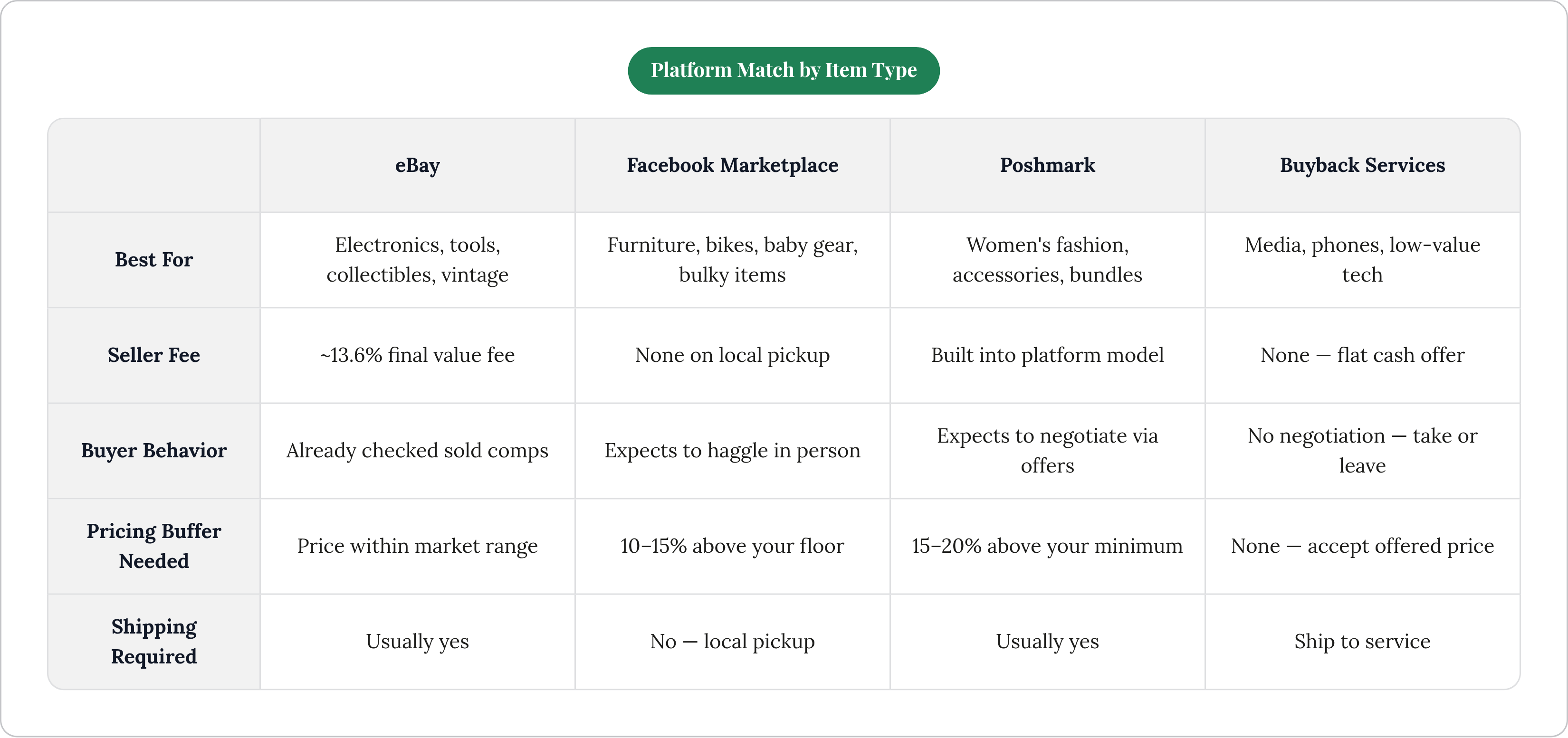
No single platform wins every category, and pretending otherwise just costs you time. The right one depends on the item, its size, and how fast you actually need the cash in hand.
eBay is built for electronics, tools, collectibles, vintage pieces, anything searchable by model number. It reaches more than 130 million active buyers worldwide, and its final value fee runs around 13.6%, landing closer to 14% once you factor in common category add-ons. Build that into your price floor before you list, not after. You get 50 free listings a month, then it's up to $0.35 per listing beyond that. Buyers here have almost always already checked sold comps, so keep your pricing realistic or expect silence.
Facebook Marketplace is the answer for furniture, big appliances, baby gear, bikes, anything where local pickup saves you the shipping headache entirely. There's no seller fee on local pickup deals, and furniture moves faster here than on eBay because buyers are searching by distance, not just by category. Negotiation culture runs strong on this platform, so that 10 to 15% buffer matters here more than almost anywhere else.
Poshmark is built around fashion, along with accessories, and its built-in bundling and offer tools reward sellers who leave a little negotiating room baked into the price. For lower-value stuff where your time matters more than squeezing out the last dollar, buyback services like Decluttr for media and tech, or Gazelle for phones and tablets, trade top price for speed and zero listing effort.
Here's the thing worth remembering through all of this: 46% of consumers say that if they can find something secondhand, they won't buy it new. That demand already exists, sitting there on every platform above, and showing up in the right one is most of the job.
Writing listings that actually convert
The title matters more than almost anything else in the whole listing, and it needs to use the words a buyer actually types into a search bar, not marketing language dressed up to sound impressive. Include the brand, the model name or number, the condition, and one key detail like color, size, or generation. "Nice camera, barely used" gets buried on page six, while "Canon EOS Rebel T7 DSLR Camera Body, Good Condition, Tested" gets found in under a minute.
Photos carry more weight than the written description ever will, no contest. Shoot in natural light against a plain background, from multiple angles, and photograph the flaws honestly rather than cropping around them. A surprise scratch the buyer didn't see coming is the number one reason for returns and ugly feedback. For clothing, lay it flat or hang it up. For tools, show it powered on if you can manage it, and for collectibles, get a close-up on any grading label, stamp, or authentication mark.
The description just needs to answer three questions: what is this exactly, what shape is it in, and what comes with it. List every cable, manual, and original box you're including, since those details build trust and can justify asking a bit more. Describe flaws in plain, specific terms ("small scratch on the right side," not the vague, meaningless "light wear" that tells a buyer nothing at all).
AI listing tools have made a chunk of this friction disappear. Snap a photo, let the tool identify the item and estimate condition, and it drafts the listing copy for you to review and post, instead of you staring down a blank text box every single time. The listing is the last place where value quietly leaks out of a sale nobody bothered to finish properly. Get it accurate, get it complete, price it honestly, and the buyer does the rest.