Reselling Ideas for Everyday Household Items
The secondhand market is booming—here's how to price your used stuff to actually sell.

The secondhand market hit $207.31 billion globally in 2025, and it's headed a lot higher by 2035. ThredUp's 2025 Resale Report found 58% of U.S. shoppers bought used apparel last year, up 6 points from 2023. This isn't a niche of vintage hunters anymore. It's just... shopping.
Here's what that means for the stuff sitting in your garage: the old KitchenAid, the kids' outgrown Legos, the laptop you upgraded from two years ago. People want it. New electronics and appliances cost 8 to 15% more in 2026 thanks to import tariffs, so buyers are actively hunting for used versions of things they'd have bought new five years ago. Most people don't lack sellable stuff. What they lack is category knowledge: what actually sells, where to put it, and what price won't get laughed at or ignored. That's the gap this piece is here to close.
How to check what an item actually sold for before you set a price
Active listings lie. Not on purpose, but they do. Someone asking $300 for a used stand mixer tells you what they hope to get, not what anyone's actually paid. The gap between asking price and final sale price on eBay commonly runs 30 to 80% higher than reality. So if you price off of what you see in a normal search, you're pricing off fantasy.
The fix is simple: filter to sold listings. Search your item on eBay, hit Filter, and toggle "Sold Items." That shows you the last 90 days of completed sales, actual money changing hands. If you want more depth, eBay's Product Research tool (it used to be called Terapeak, now folded into Seller Hub) stretches that window to three years and, more importantly, shows accepted Best Offer prices instead of just the sticker price.
That Best Offer detail matters more than people think. When a seller accepts a lower offer, eBay's regular search still shows the original asking price with a line through it, like a fake discount at a mattress store. If you price to that crossed-out number, you're not competitive. You're just invisible.
Watch for oversaturation too. If there are 200 active listings for a similar espresso machine and only three sold in the last 90 days, price toward the bottom of that range, not the middle. The market's telling you something.
For local sales on Facebook Marketplace or Craigslist, use eBay sold data as your ceiling, then knock the price down a bit since there's no shipping cost or wait involved for the buyer. Meanwhile, for trading cards or collectibles, digging into Best Offer Accepted data is genuinely useful in a category where almost nothing sells at list price.
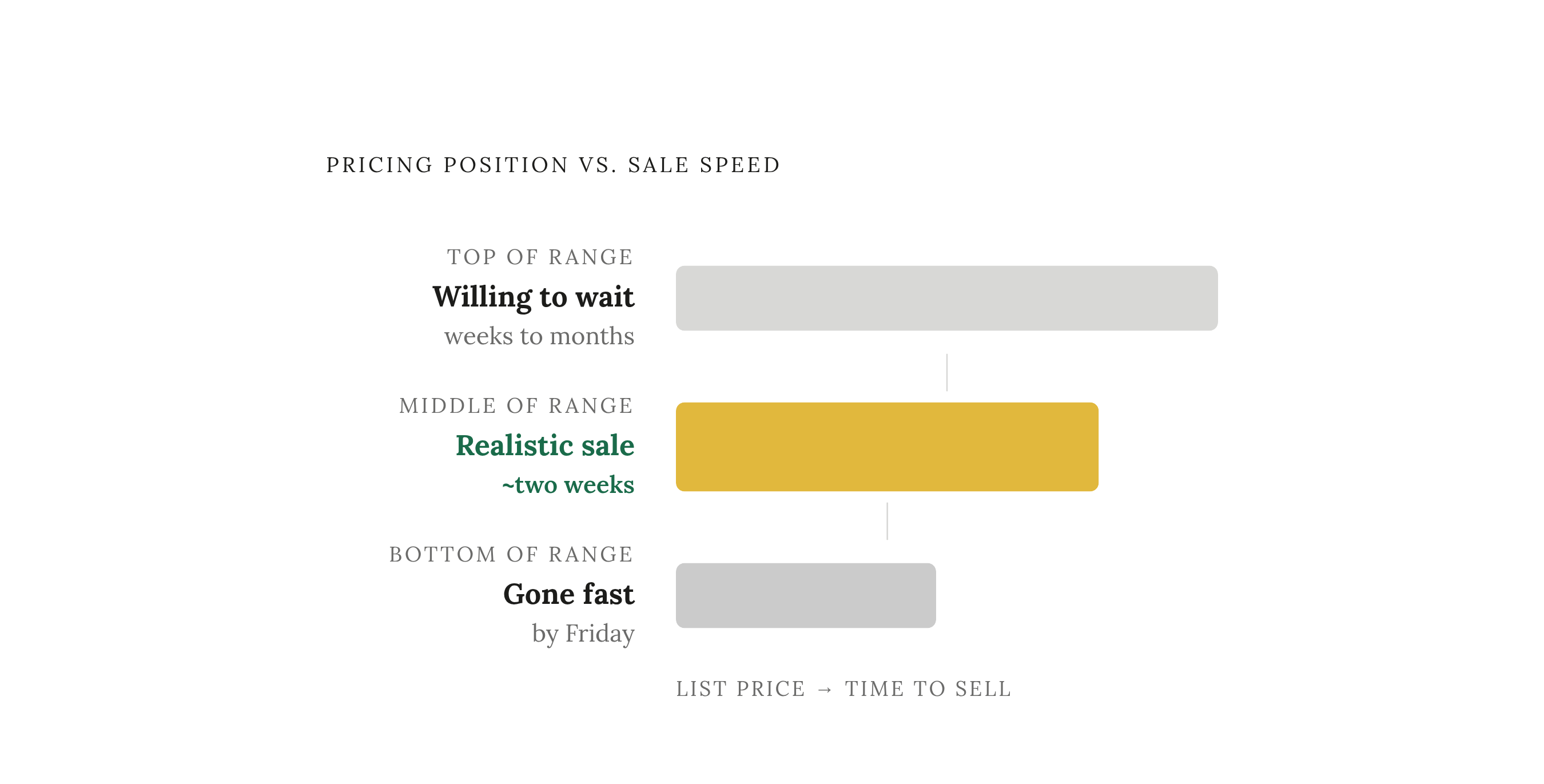
Once you've got real comps, pricing is basically a decision about patience. Top of the sold range if you're willing to wait it out. Middle of the range for a realistic two-week sale. Bottom of the range if you need it gone by Friday. And compare condition to condition; a "Like New" comp next to a "Good" item you own will just set you up to be disappointed.
Which marketplace fits which kind of item
Two platforms carry most of casual household reselling: eBay for anything with a national buyer pool, Facebook Marketplace for anything bulky or better sold in person.
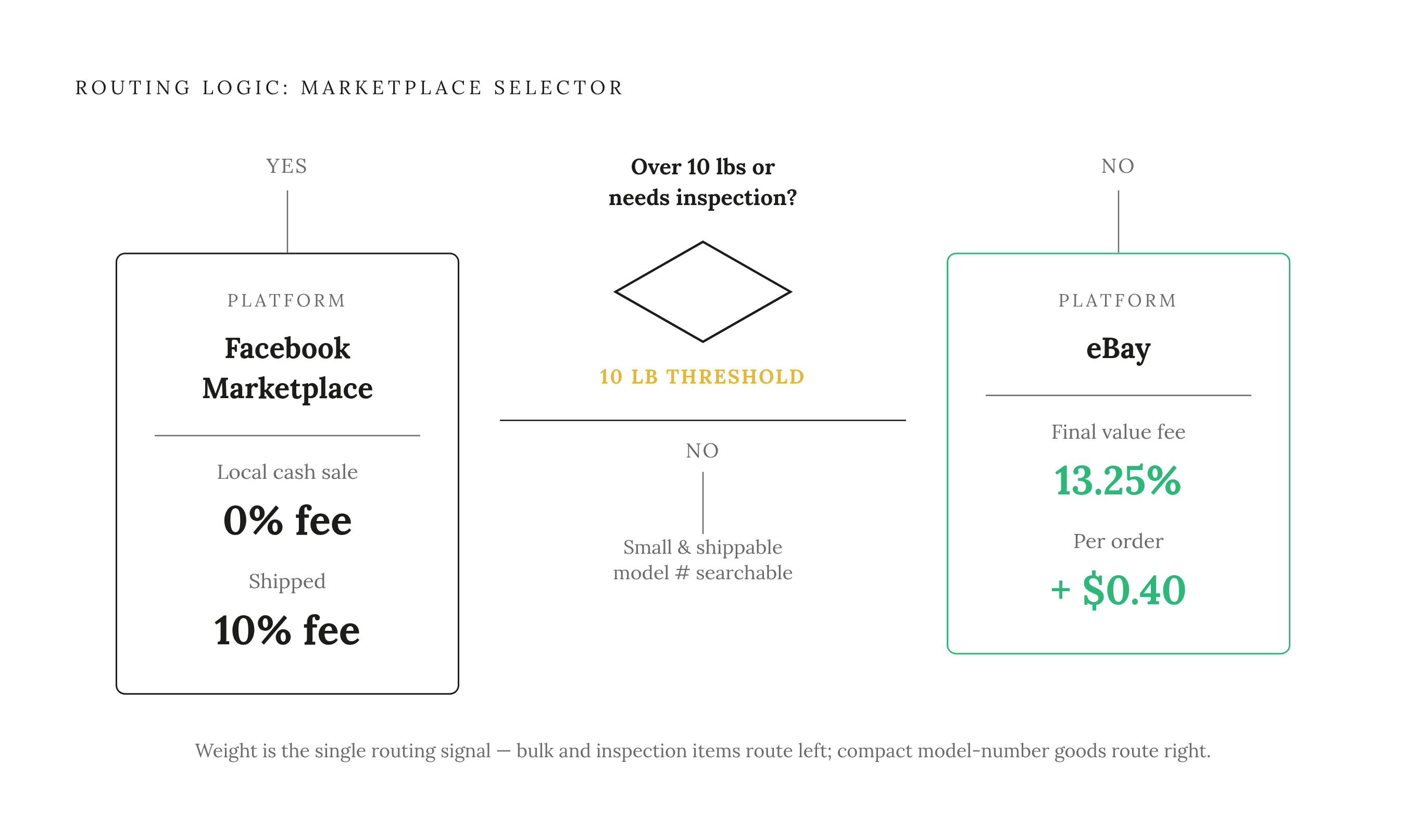
eBay has over 130 million active buyers worldwide, giving it a massive national and international reach. The final value fee runs 13.25% of the total sale for most categories, plus 40 cents per order on sales over $10. Books and media get charged 15.3%, a bit higher. New sellers get a break too: zero insertion fees and reduced final value fees for their first 50 sales. eBay is the right call for electronics, collectibles, name-brand clothing, small appliances, basically anything someone across the country might type into a search bar.
Facebook Marketplace works differently. Local pickup sales cost nothing; every dollar goes in your pocket. Shipped sales carry a 10% fee (minimum 80 cents), which doubled from 5% back in April 2024. Worth knowing too: if you're shipping through Marketplace, you'll need to arrange your own labels through a carrier or a third-party shipping service. Marketplace is built for furniture, large appliances, kids' gear, anything heavy where a buyer wants to see it before handing over cash.
One trap worth naming: eBay's promoted listings feature adds a 5% fee on top of the 13.25% final value fee. That's over 18% gone from the sale. On a $40 waffle maker, that's real money disappearing for a bump in visibility that may not even move the needle.
Rule of thumb: if it weighs more than 10 pounds, or the buyer really needs to see it in person to trust it, start on Marketplace. If it's small, easy to ship, and searchable by model number, start on eBay. You also don't need to build separate listings from scratch for each platform. Reclaim's AI listing tool takes one set of photos and one description and turns it into listings ready for multiple marketplaces, so you're not retyping the same paragraph three times.
Kitchen and small appliances: what moves and what doesn't
Stand mixers hold their value shockingly well, especially KitchenAid. Espresso machines and pour-over gear do well too, since that buyer searches by exact model number, which makes eBay the natural home for it. Instant Pots, air fryers, and waffle makers move steadily, mostly because half of them were gifts nobody asked for; sell duplicates locally or list brand names on eBay. Cast iron cookware, Lodge and Le Creuset especially, tends to sell for more than owners expect, and condition barely matters compared to brand recognition.
Generic no-name appliances rarely sell, and incomplete sets missing a lid or an attachment fare just as poorly, along with anything with a scorched or scratched cooking surface.
Clean the item before you photograph it. Grease residue and old food stains in a photo will tank buyer confidence even if the appliance runs perfectly. It's the visual equivalent of a restaurant with a dirty front window; doesn't matter how good the food is, nobody's walking in.
Search sold listings by exact model number, since a $30 no-name blender and a $200 Vitamix live in completely different price universes and need separate research. And with appliances especially, local buyers often want to plug it in and test it before buying, so listing on Marketplace first, then moving to eBay after a week with no bites, is a reasonable order of operations.
Electronics: the category with the highest ceilings and the sharpest condition penalties
Smartphones, tablets, and laptops sell best on eBay, where buyers search by exact model and storage size. Gaming consoles move well too, and bundling in controllers and cables bumps the price up. Headphones, especially AirPods and the Sony WH-1000X line, ship easily and sell fast. DSLR cameras and lenses attract careful, research-heavy buyers, so include every original accessory you've got. Smart home gear like Echo, Nest, and Ring devices sell fine while the manufacturer still supports them, but older generations lose value quickly once support ends.
With tariffs pushing new electronics up 8 to 15% through 2025 and 2026, buyers are actively looking for used alternatives right now. The timing works in your favor.
Condition in electronics isn't a sliding scale, it's a cliff. "Fully functional, no cracks" sells at one price; anything short of that drops hard, not gradually. So test everything before listing, and say exactly what you tested: "powers on, holds a charge, Face ID works." Vague phrases like "works great" invite lowball offers and buyer disputes, because nobody trusts a claim they can't verify. Also factory reset every device before it ships, both for your own liability and the buyer's peace of mind.
eBay's global buyer pool and searchability by model number make it worth the higher fee here. Local sales just don't reach the same audience for something a collector three states away might be hunting for.
Clothing: when brand and condition determine everything
Per ThredUp's 2025 report, 48% of younger shoppers said secondhand was the first place they looked for clothes in 2024, up 7 points from 2022. That's not a fringe behavior anymore; that's habit.
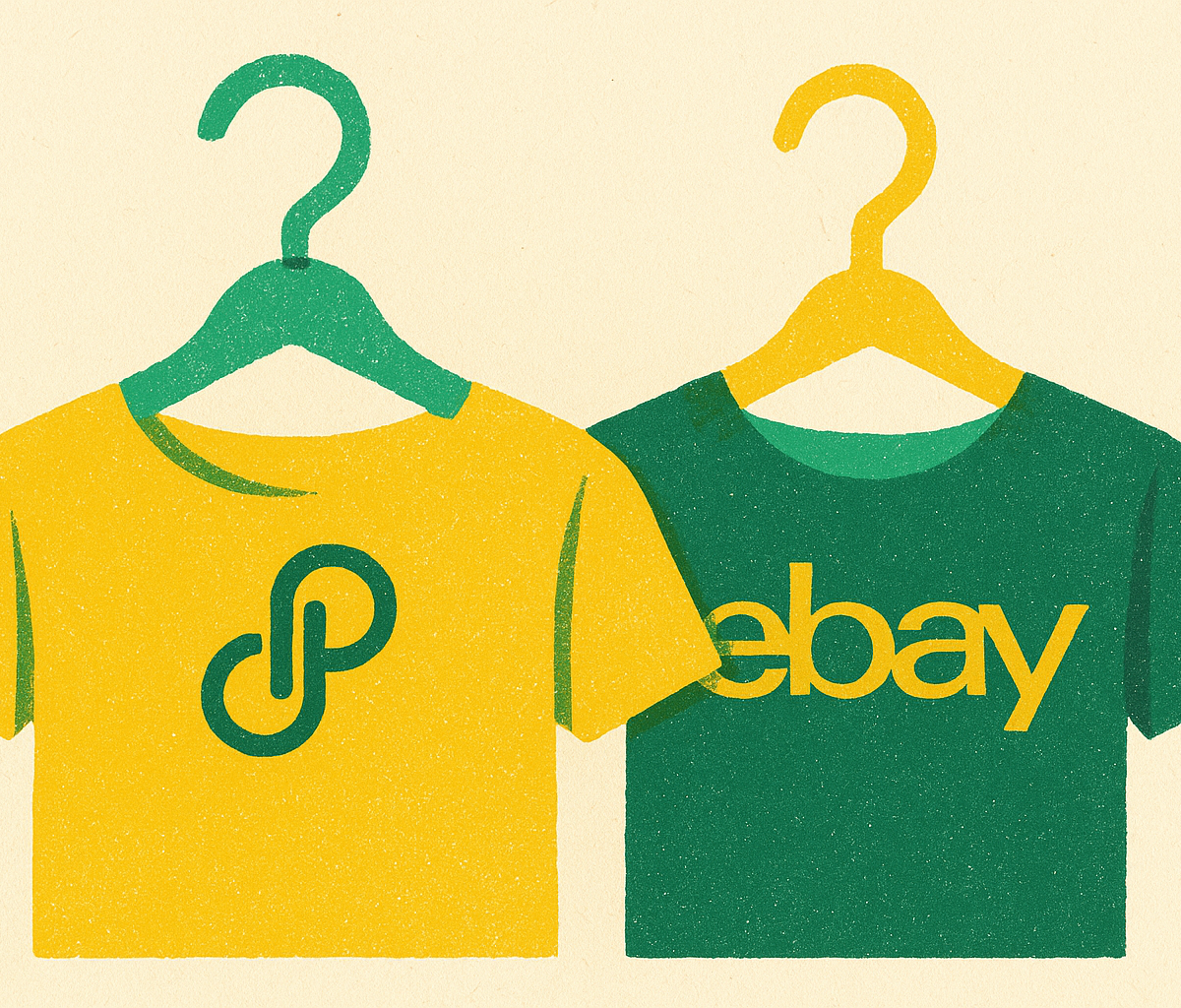
Name brands are the whole game here. Levi's, Patagonia, Nike, Lululemon, vintage Ralph Lauren, all of it sells because the brand name is what buyers type into the search bar. Designer and contemporary fashion do well on eBay and Poshmark, where shoppers search with intent. Kids' clothing in good shape sells constantly, simply because kids grow out of everything, and Facebook Marketplace works well for bundled lots. Seasonal outerwear is a quiet goldmine: winter coats picked up cheap in the off-season can sell for $40 to $80 come November, based on eBay sold data. Workwear and suiting in current cuts and good brands also do fine.
Unbranded basics rarely move, and the same goes for anything stained or pilling, along with fast-fashion pieces nobody's searching for by name.
eBay works for branded and vintage pieces with strong keywords. Facebook Marketplace works for local bundles, a "bag of kids' clothes size 4T" moves faster as one listing locally than as ten separate ones online. Poshmark suits fashion-forward buyers, though its commission structure eats a real chunk of the profit.
Photography matters more here than almost anywhere else. Natural light, flat lay or hung up, and close-ups of any wear or flaws so buyers aren't surprised later. Timing counts too: list coats in October, swimwear in April. Pricing can swing 20 to 40% just based on whether you're in season or out of it.
Toys, games, and kids' gear: the category where completeness controls price
LEGO is one of the most liquid toy categories on eBay, full stop. Complete sets with instructions and original box sell for real premiums over a bag of loose bricks. Pokémon and sports cards move fast too, ship easily, and rely heavily on Best Offer pricing, so checking Best Offer Accepted data is worth the extra step for accurate comps. Board games sell well when every piece is there, punched components included, rulebook intact. Wooden and Montessori-style toys hold value nicely, particularly from known brands. Baby gear, bouncers, swings, activity gyms, turns over constantly since kids outgrow it in months, and Marketplace local pickup is the natural fit. Bikes and ride-on toys are bulky enough that local listing should always come first.
Completeness isn't a minor detail, it's the whole price. A board game missing two pieces, or a LEGO set short ten bricks, loses value out of proportion to what's actually missing. Check before you list, and say so if something's gone.
One serious caveat: always verify that any child safety gear you plan to sell has not been recalled before listing it.
Timing helps too. Toys and games price 10 to 20% higher between November 1st and December 15th, based on seasonal eBay data, so plan your listing calendar around that window. eBay for collectibles and named sets, Marketplace for bulky gear and clothing lots.
Furniture and home décor: high value per item, different selling rules
Solid wood furniture, tables, dressers, bookshelves, commands a real premium over particleboard, so mention the wood type explicitly in your listing. Mid-century modern and vintage pieces have strong, steady demand, and style keywords matter here almost as much as brand name does. Accent chairs, side tables, and mirrors move faster than sofas simply because they're easier to carry. Outdoor furniture peaks May through August. Home décor, framed art, lamps, ceramic vases, moves quickly on Marketplace when priced to sell rather than priced to negotiate forever.
Marketplace is the default for furniture. Zero fees on local cash sales, no shipping headache, and buyers get to inspect it in person before they commit.
Shoot furniture photos in daylight, and show the whole piece plus close-ups of any damage. Buyers who show up and find wear that wasn't in the photos will walk, and you'll have wasted an afternoon. List exact dimensions too; the single most common reason a pickup falls through is the buyer realizing at the door that the couch won't fit through it.
Solid wood holds value. Flat-pack and particleboard furniture, IKEA being the obvious example, still sells, but buyers know exactly what it's worth, so price it honestly and don't anchor to what you originally paid. For higher-value vintage or antique furniture, eBay's national reach might justify the hassle of freight shipping; check sold comps first to see if the price premium actually covers the extra work.
Books, media, and collectibles: knowing which items have a market and which don't
Here's the part nobody wants to hear: most paperbacks and common hardcovers have no real resale market. Shipping a $2 book just doesn't pencil out once you factor in the box, the label, and the ten minutes it takes to package it. That stack of book club picks from 2015 is probably headed to a donation bin, not a buyer's cart, and that's fine.
What does sell: first editions, signed copies, out-of-print titles with a collector base, textbooks in current edition (students need those every semester, and they need them now), vinyl records in good condition, and vintage magazines tied to a specific cultural moment or cover subject. Board games and card sets already covered above overlap here too.
The test is simple. Before you list a book or a piece of media, search sold comps first. If nothing's sold in 90 days, or the sold price barely covers postage, it's not worth your time. Donate it, and move on to the next box.