How to Price an Item to Sell Quickly vs Maximize Return
Use sold listings, not asking prices, to anchor your pricing strategy.

Why asking prices mislead and sold data is a reliable anchor
Pricing a used item comes down to two decisions: how fast you want it gone, and how much you want in your pocket when it does. Most sellers skip both decisions. They pick a number that feels right, slap it on a listing, and hope. That's pricing based on wishing with extra steps. That's wishing with extra steps.
Secondhand buying isn't a bargain-hunter subculture anymore, it's just how a lot of people shop now. Tariffs pushed new retail prices up, which widens the gap between "new" and "used" and gives sellers who price carefully more room to work with. Sellers who guess just leave that room unused.
Checking what other people are asking for a similar item and treating that number as the price is the mistake nearly everyone makes at least once. Asking prices are hope. Sold prices are truth. Confusing the two is the single most common error in this whole process, and it's an easy one to make because asking prices are what you see first.
Facebook Marketplace makes the confusion worse by design. Unlike eBay, it never shows you what anything actually sold for, so if a seller's only research is scrolling Marketplace listings, they're pricing against everyone else's optimism instead of against reality.
eBay fixes this with one filter. Its "Sold Items" view shows completed transactions: actual dollars that actual buyers paid for actual items. Use that filter to set a price, even if the final listing goes somewhere else. eBay also gives sellers free access to a Product Research tool through Seller Hub, and its app can scan a barcode or a photo and surface pricing data right inside the listing flow. That's the anchor. Everything else is a guess wearing a nicer outfit.
The four price points every seller should know before listing anything
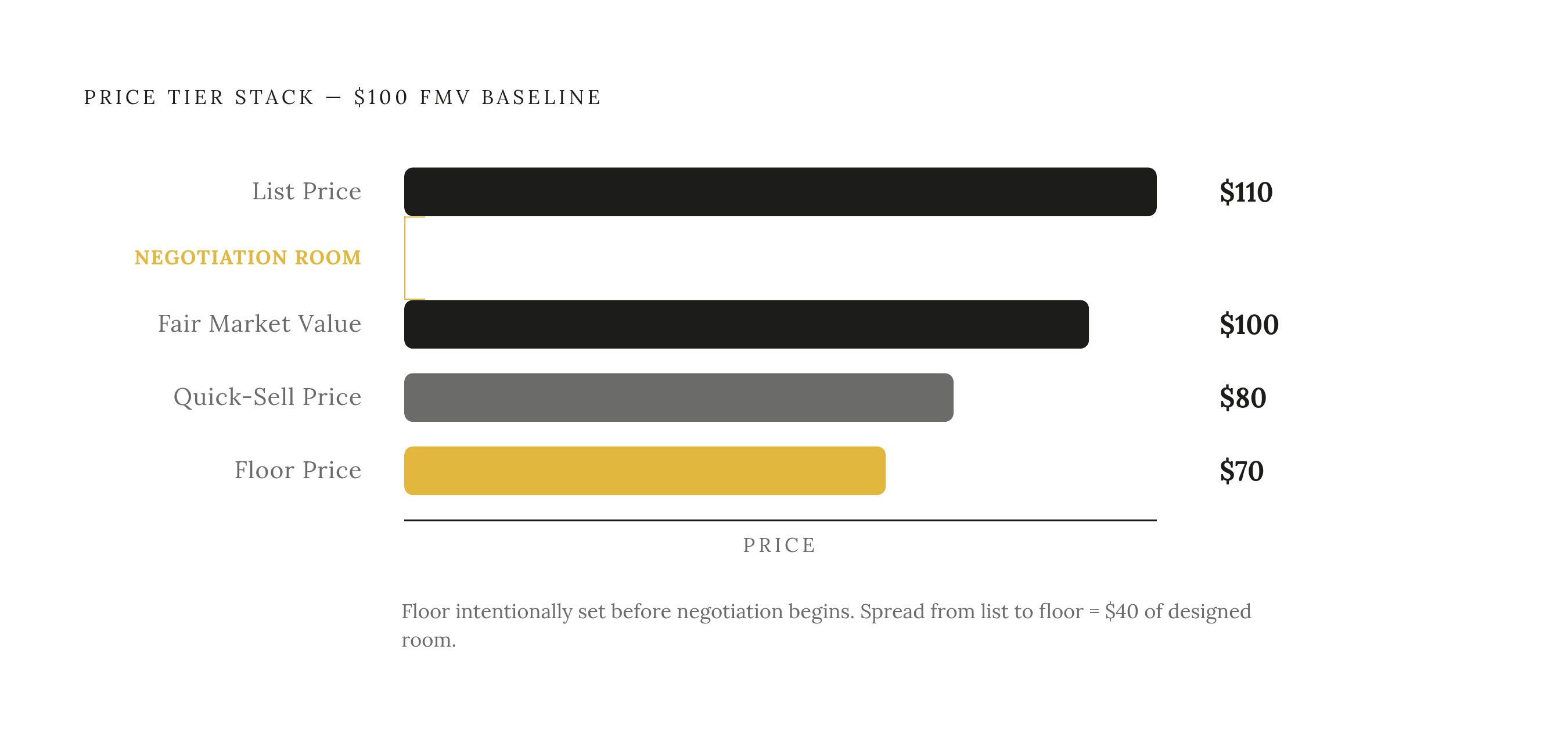
Every listing hides four numbers inside it, whether the seller knows it or not.
List price is where the listing opens, and it should sit 5 to 10% above the real target. List a lamp at $110 when $100 is the actual goal. A buyer offers $95, the seller counters at $100, and the buyer walks away feeling like they won. They did, just not by as much as they think.
Fair market value is the target itself, what similar items in similar condition actually sold for recently, pulled from sold comps rather than someone else's asking price.
Quick-sell price sits 15 to 25% below fair market value. This is the number that pulls in bargain hunters fast and clears out a listing that's been sitting untouched for a week.
Floor price is the number below which the seller walks away, no exceptions. Decide this before the first offer lands, not in the middle of a negotiation, because a buyer pushing back in real time makes it tempting to just say yes.
There's also the word "firm." If the target is $80, list at $90 to $95 and add "price is firm, no offers" when there's zero appetite for haggling. It shuts down the back-and-forth before it starts.
When sold comps run thin, most used household items hold onto roughly 30 to 60% of their original cost, and condition does the rest of the work. A Facebook Marketplace price calculator uses rough multipliers: Like New keeps full value, Good is around 82%, Fair is around 62%, Poor is around 42%. Misjudge the condition and the whole comp falls apart underneath it.
When to optimize for speed versus holding out for more
Some items are built to lose value the longer they sit around. Electronics ahead of a new model launch, seasonal goods past their season, anything with a shelf life ticking down in the background. If space or cash is the actual pressure, speed wins, no debate needed.
And a listing that's gone more than a week without a serious inquiry isn't just stalled, it tends to attract less and less attention the longer it sits. A stale listing performs worse, which makes it stall harder. That's a hole that gets deeper the longer it sits ignored.
Holding out for more money makes sense in the opposite case: the item is rare, discontinued, or has a real collector base chasing it nationally. Scarcity means the seller sets the terms. Condition still matters here, though. Something genuinely better than the competition, especially with the original box and accessories intact, can command a real premium over comps.
So the rule of thumb: price at fair market value when waiting and negotiating doesn't bother anyone. Price above it only when condition or extras earn that premium honestly. Price 10 to 20% below average asking price when the goal is simply to make the thing disappear.
Build in a cadence for price drops, too. A modest cut after a few days with no real interest, then down to quick-sell pricing after a week. After two weeks, it's time to bundle the item with something else or just donate it, because a listing ignored that long won't fix itself by sitting there another week.
How platform choice changes the math on both goals
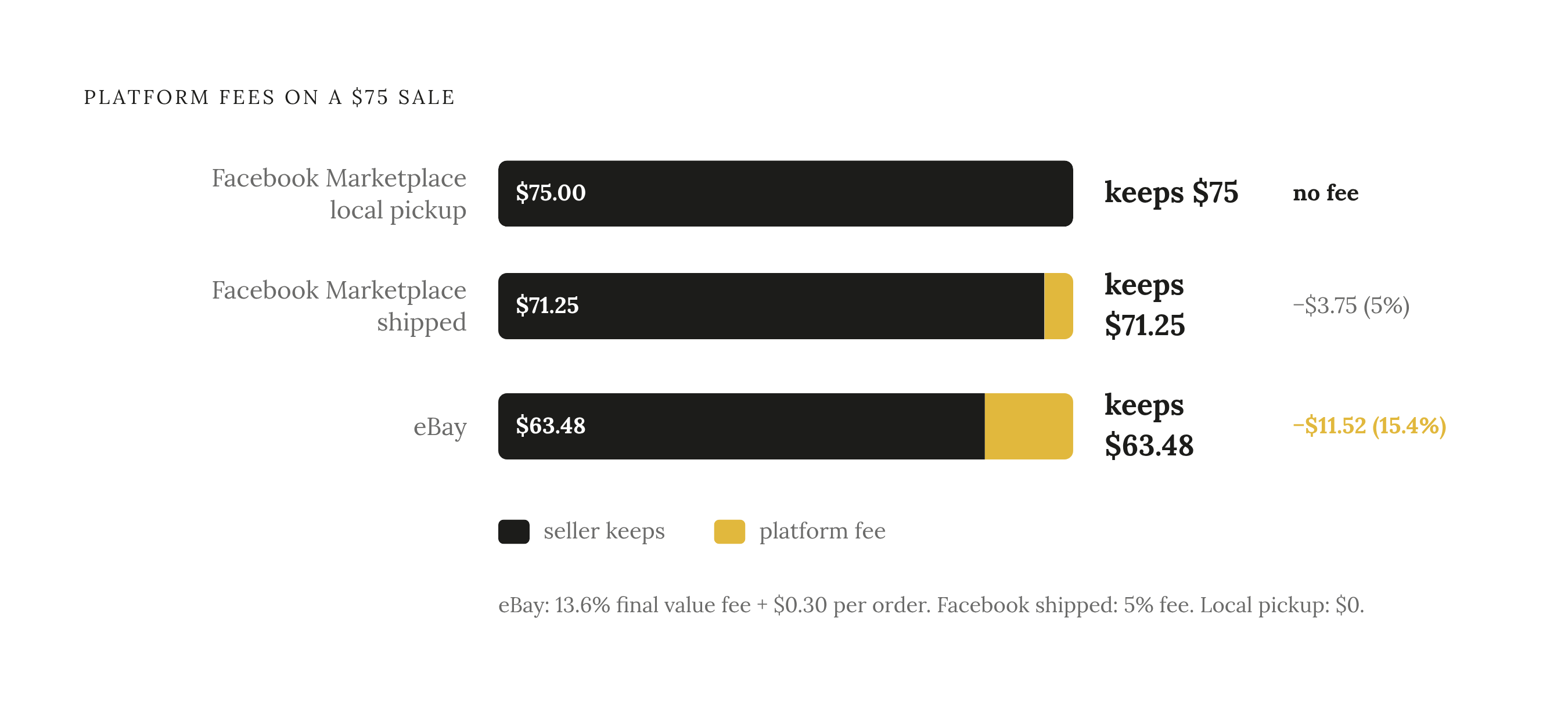
The platform runs its own math before a single buyer even opens the listing.
Facebook Marketplace charges nothing on local pickup, the full price goes straight to the seller. Shipping through Facebook instead adds a 5% fee. eBay runs closer to 14% all-in once the final value fee (13.6% in most categories) stacks with the per-order fee. On a $100 sale, that's about $15.36 gone on eBay versus $11 on Facebook shipped, a $4.36 gap that adds up fast across a dozen listings. Poshmark charges $2.95 flat under $15, then 20% above that, the steepest cut of the bunch, though the buyer covers the shipping label there.
Take a $75 vintage lamp. Sold locally through Facebook, the seller keeps the full $75. Sold through eBay, fees knock that down to roughly $64. Same lamp, same price tag, an $11 gap that comes entirely from where it got listed.
Fees aren't the whole story, though. Facebook Marketplace reaches close to a billion monthly active users. eBay's buyer base is smaller, around 130 million globally, but those buyers showed up already searching for a specific item and they're willing to pay for shipping to get it. In niche or collectible categories, that searching behavior drives the sale more than raw reach ever does.
Match the platform to the item instead of defaulting to whichever app is already open:
Furniture and anything bulky belongs on Facebook Marketplace, local pickup only. Shipping a $200 dresser can run $80 to $150, which wipes out the entire margin before the seller sees a dime. eBay works for electronics, collectibles, and branded goods, anything with a national buyer pool actively hunting for that exact item. Poshmark fits clothing, shoes, and accessories, built around a fashion-focused crowd. Depop suits vintage clothing, Y2K styles, and streetwear, popular with younger buyers. OfferUp acts as a second home for local items that didn't move on Facebook Marketplace. Whatnot handles trading cards, Funko Pops, vinyl, and collectibles, especially where a live sale format helps. Check current seller fees there before picking it over eBay.
How category affects which pricing goal is even achievable
Not every item gets to choose its own goal. The category decides that first, before the seller gets a vote.
Electronics (phones, laptops, gaming consoles) lose value fast, and the clock only speeds up once a new model gets announced. Speed is almost always the right call here, full stop. Margins can run anywhere from 20% to 100%, but only for sellers who move before the next release cycle makes their listing look like leftovers.
Furniture belongs on Facebook Marketplace, locally, for anything standard. Vintage or designer pieces with a national collector following can chase a higher return, but shipping costs of $80 to $150 on a $200 piece usually kill that math before it even gets started. Speed through local pickup is the practical answer for everything else.
Clothing sold piece by piece rarely does well on Facebook Marketplace. Bundling by size or season helps, and so does pulling out the genuinely valuable pieces, designer labels or true vintage, and selling those on their own, on a platform built for fashion. Vintage Levi's, for instance, can post margins of 30% to 80%, but that number depends on the right platform.
Collectibles and toys sit at the other extreme. LEGO Star Wars sets and similar nostalgia-driven items can carry margins of 40% to 120%, but only for sellers willing to wait out eBay's buyer pool instead of racing to sell fast. Graded trading cards follow the same logic, sometimes commanding a real premium over raw cards. Speed is the wrong instinct in this category. Patience is the entire strategy here, not a fallback.
Putting the framework into a repeatable decision before each listing
Before anything goes up for sale, run through four steps, in order, every time.
Name the goal first. Is this about clearing space, freeing up cash, or getting ahead of a depreciating item, or is it a rare piece in strong condition where waiting actually pays off?
Pull sold comps next, not asking prices. eBay's Sold Items filter or its Product Research tool are the standard tools for this. Some AI tools can now pull sold data straight from a single photo, which speeds up the research considerably. Whatever the source, match condition carefully: a "Good" comp doesn't validate a "Like New" price, no matter how close the two items look in the photo.
Pick the tier third. List price 5 to 10% above target for room to negotiate. Fair market value if there's no rush. Quick-sell, 15 to 25% below FMV, if speed is the actual goal.
Run the fee math last, before listing rather than after discovering the payout came in smaller than expected. The same item at the same price nets different money depending on where it's sold, so confirm the number clears the seller's actual profit threshold before hitting publish. Name the goal, find the real number, pick the tier, check the fees. Skipping a step makes the price just a guess with better formatting.
Sources
- How to Price Items on Facebook Marketplace - SellItRight Guide
- Reclaim — Snap a Photo. Sell Your Stuff in Seconds.
- Facebook Marketplace Price Calculator - Fair Resale Value
- eBay vs Facebook for Most Categories: Fees 2026
- eBay vs Facebook Marketplace: Fees & Profit
- How to Sell on Facebook Marketplace: The Complete Guide (2026)
- closo.co