How to Grade Item Condition for Online Listings
Precise condition grades prevent returns and boost buyer trust in competitive resale markets.

Secondhand selling runs on trust, and trust runs on one decision: the condition grade you slap on a listing before it goes live. Get it right, and buyers pay your price without a second thought. Get it wrong, and you're refunding shipping costs on a return while writing a three-paragraph apology to a stranger. This piece breaks down how to grade condition correctly, category by category, so that doesn't happen to you.
The stakes are higher than they used to be. The global secondhand market grew from $475.19 billion in 2025 to $535.03 billion in 2026, a 12.6% jump in a single year. Capital One Shopping research shows that in the U.S. market alone, the market hit $61 billion in 2026, up 8.93% from $56 billion the year before. Thrifting specifically has grown 143% in value since 2018. Fifty-eight percent of American consumers now shop secondhand regularly, and younger buyers in particular are driving outsized shares of resale market growth.
That growth cuts both ways for sellers. More buyers means more demand, sure. But it also means more competition. A shopper who lands on your vague, one-word condition label has dozens of other listings open in other tabs. If your description doesn't tell them exactly what they're getting, they're gone before you finish typing a follow-up message.
What condition grading does for a seller's price and return rate
A condition grade is the thing that lets a buyer justify your price to themselves. It's the thing that lets a buyer justify your price to themselves. When the grade and the description line up, the buyer doesn't feel like they're gambling. They feel like they're making an informed purchase, which means they hit "buy" instead of typing "is this still available?" for the fourth time this week.
Bad grading is the single biggest driver of returns for casual sellers. Not fraud, not shipping damage, just a mismatch between what the listing promised and what the buyer found in the box. A buyer who ordered something labeled "Excellent" and got something that was clearly "Good" isn't going to split the difference and shrug it off. They're filing a return, and now you're out shipping costs both ways plus whatever time it takes to relist.
There's also a discoverability angle that gets overlooked constantly. Search terms like "Like New Television" or "For Parts iPhone" aren't just honest descriptions, they're exact phrases buyers type into search bars when they know what they want and how much they're willing to spend on it. A precise condition label does double duty: it sets expectations and it puts your listing in front of the right eyeballs.
And it cuts down on the endless back-and-forth. A buyer who understands exactly what "Good" means on your listing doesn't need to message you five times asking about scratches before they commit. Clear grading answers the question before it gets asked.
The five-grade vocabulary that works across most categories
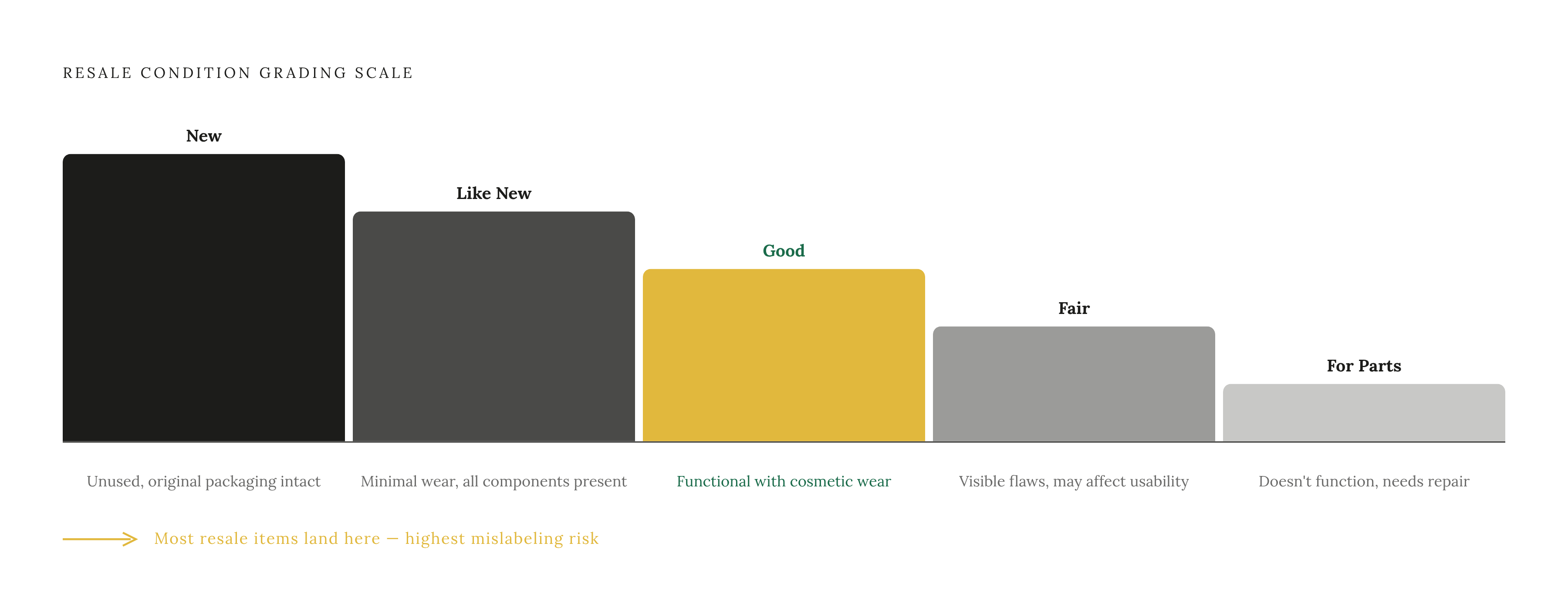
Most resale platforms have landed on some version of the same five-tier system, and for good reason. Fewer than five grades and buyers stop trusting the accuracy (everything's either "used" or "new," which tells them nothing). More than five and the categories start blurring into each other, and nobody, including the seller, can consistently tell "Very Good" from "Excellent."
Here's the five-tier structure that covers most categories:
New: Brand new, unused, unopened, undamaged, original packaging intact. Like New / Excellent: Barely used, if at all. Minimal to no visible wear. All components present, though original packaging might be gone. Good: Fully functional, with cosmetic wear that does not affect how it works. Fair / Acceptable: Visible flaws or wear that may affect usability or aesthetics. Functional, but with noticeable imperfections. For Parts / Not Working: Doesn't function as intended. Missing pieces, or needs repair before it can be used.
The label alone won't cut it, though. Every grade needs a plain-English line in the actual listing, because "Good" means something different to every seller who's ever typed it. Spell it out: "Good: minor scuff on the left corner, fully functional, tested and working." That one sentence does more to prevent a return than the label ever will on its own.
The rule of thumb when picking a grade: describe the worst true thing about the item, not the best. A phone with a great screen and a busted charging port earns whatever grade the charging port deserves, not "Excellent."" It's whatever grade the charging port earns it.
Physically Inspecting an Item Before Assigning a Grade
Grading is a process that runs on consistent, repeatable steps. It's a process, and skipping steps is exactly how sellers end up mislabeling things by accident. A consistent inspection order catches the flaws that a quick glance misses.
Start broad, then narrow. First pass: overall appearance. Look for scratches, scuffs, stains, discoloration, fading, pet hair, anything that smells off. These are the exact issues that appear repeatedly in platform disclosure guidance, because they're the ones sellers "forget" to mention.
Second pass: function. Power the thing on and off. Test every moving part, every zipper, every button, every port. If it's supposed to click, does it click? If it's supposed to charge, does it charge? Write down anything that doesn't behave the way it should, even if it seems minor.
Third pass: the details most people skip. Seams, corners, edges, hinges, labels, serial numbers. Check that all original accessories and packaging pieces are actually present, not just "probably somewhere in a drawer."
One rule overrides all three passes: grade to the worst flaw, not the average. A phone with a hairline crack in one corner and a flawless screen everywhere else is not "Excellent." The crack sets the grade. Buyers don't average out your item's condition, and neither should you.
Photos matter just as much as the written grade. Use a consistent background, consistent lighting, and the same angles across every listing, so buyers can compare items apples to apples. A lower-grade item with sharp, honest photos will outsell a higher-grade item with three blurry pictures taken on a bad couch, every time.
Category-specific grading: clothing, electronics, books, music gear, and collectibles
The five-tier system is a starting point, not a universal law. Different categories have their own grading quirks, and getting them wrong is where sellers get burned.
Clothing saw eBay roll out an updated system in mid-February 2025 (originally planned for February 4, delayed briefly, then launched globally), splitting the old single "Pre-owned" label into three tiers: Pre-owned, Excellent (like new, minimal wear), Pre-owned, Good (gently used, light wear or visible flaws), and Pre-owned, Fair (heavy wear, visible imperfections, possibly missing or damaged components). "New with defects" got renamed to "New with imperfections" for unworn items that still have visible flaws. Common disclosure issues named explicitly in eBay's own grading guidance: broken or missing fasteners, discoloration, wear, stains, pet hair, odor. When the update rolled out, every existing "Pre-owned" listing got auto-converted to "Pre-owned, Good," whether or not that was accurate. Anyone selling clothes who didn't go back and manually review those listings might be sitting on mislabeled inventory right now. This applies across categories like Women's, Men's, and Kids' Clothing, Baby & Toddler, Vintage Clothing lines, Specialty Clothing, Wedding & Formal wear, and more.
Electronics and general used goods. As of September 2025, eBay started defaulting used listings in certain categories to "Pre-owned, Good" in one major national marketplace. marketplace. That default is a starting point, not an answer. Sellers still need to manually check and correct the grade, because letting the default stand risks mislabeling an item that's actually better, or worse, than "Good." eBay is giving sellers a grace period here: "Item Not as Described" returns tied to condition misclassification won't count against seller performance metrics until December 31, 2025. After that, the protection expires. Electronics also depreciate fast and unevenly, so functional grading errors inflate return rates and shrink resale value more than they do in other categories. A laptop that boots fine but has a cracked hinge needs both facts in the listing, not just one.
Books get their own five-tier scale on eBay: Brand New, Like New, Very Good, Good, Acceptable. Each tier is defined around page condition, cover wear, underlining or highlighting, and dust jacket survival. Writing in the margins tanks the grade even if the cover looks pristine, and a hardcover missing its dust jacket can't be graded above "Good," no matter how clean the pages are inside.
Music gear. Sweetwater's Gear Exchange uses a five-tier scale too: Mint, Excellent, Good, Fair, Poor, judged on function and cosmetics together, not separately. Mint means like-new, with original packaging, protective stickers or tags still on, and full function with zero flaws. Fair means flaws that actually affect how the gear works, or serious cosmetic damage that goes beyond normal wear. Gear Exchange's own guidance recommends photographing every angle, especially the blemishes, and writing descriptions that name the specific dings and any modifications rather than a vague "some wear."
The Connection Between Condition Grade and Price
The grade you choose is the anchor for every pricing decision that follows. It's the anchor for every pricing decision that follows. Once you've settled on "Good" versus "Very Good," you've also decided which set of comparable sales you should be looking at, and mixing those up produces a number that's just wrong. A "Good" iPhone and a "Very Good" iPhone sell in different price clusters. Compare your item to the wrong cluster and you'll either underprice a clean item or overprice a beat-up one.
The only pricing data you can trust is what identical items at your exact condition grade actually sold for, not what other sellers are hopefully asking. Asking prices are aspirational at best and fictional at worst; a listing sitting unsold at an inflated price for six months tells you nothing except that the seller is stubborn. eBay's "Sold Items" filter is the fastest way to see real completed transactions instead of wishful thinking.
Once real comps are in hand, positioning is a matter of how fast you want the thing gone:
Price 10 to 20% below the average asking price for similar items to sell faster, trading some of the potential dollar amount for a quicker sale.
- Price at the average if there's no rush and some room to negotiate.
- Price above average only when the item is genuinely in better shape than typical comps, or comes bundled with extras that justify it.
Mistakes That Trigger Returns and How Accurate Grading Prevents Them
The single most common mislabeling mistake has nothing to do with malice and everything to do with sentiment. Sellers grade based on how they feel about the item, not what a total stranger would see looking at it cold. A jacket you've had since college feels like "Excellent" because you remember it new. A buyer who's never seen it before sees the faded elbow and the slightly stretched cuff, and that buyer is right.
eBay's September 2025 default-condition rollout is a live example of how this goes wrong at scale. Any seller who left listings sitting at the auto-assigned "Pre-owned, Good" without reviewing them may now have items mislabeled in either direction. The temporary protection against "Item Not as Described" returns runs out December 31, 2025. After that, a mislabeled listing isn't just an awkward return, it's a mark against seller performance metrics.
The clothing rollout carries the same risk, just earlier. Every "Pre-owned" listing got auto-upgraded to "Pre-owned, Good" the moment the update went live. Sellers who actually had Fair-condition inventory sitting under that new label were exposed to returns from day one; it made no difference whether they'd touched the listing or not.
A quick audit habit closes most of this gap. Check these four things on every active listing:
- Match the listing's condition against the platform's actual definition for that category, not a guess.
- Confirm every flaw mentioned in the text has a photo backing it up.
- Check that the grade reflects the worst flaw present, not an average of the good and bad.
- Add a plain-English note even when a preset grade is selected. The preset gets you found in search. The note is what makes a stranger trust you enough to buy.