Resale Value of Used LEGO Sets
Rare Star Wars sets can fetch thousands, but most used LEGO won't appreciate like you think.
Most people think old LEGO sets are basically savings bonds made of plastic. Stick a box in the attic, wait a decade, retire on the proceeds. That belief is only half true, and the half that's missing is the half that matters.
Research from the Higher School of Economics puts average annual appreciation for LEGO sets at 11%. That number gets repeated constantly, and it's real, but it's an average pulled way up by a small number of outliers doing all the heavy lifting. Mass-produced sets from high-volume themes like City, Duplo, and Classic often sit at or below their original retail price for years. Retirement alone doesn't move the needle. A set going out of production is not a value signal by itself, it's just a supply signal, and supply is only half of the pricing equation.
The practical cost of ignoring this: sellers price by brand name and retirement status alone, then either give away something valuable for pennies or list a common set for triple its worth and watch it sit for six months. Four factors actually decide where a used set lands: condition, theme, retirement and supply timing, and completeness. Each one is readable if you know what to check.
How condition creates distinct price tiers for the same set
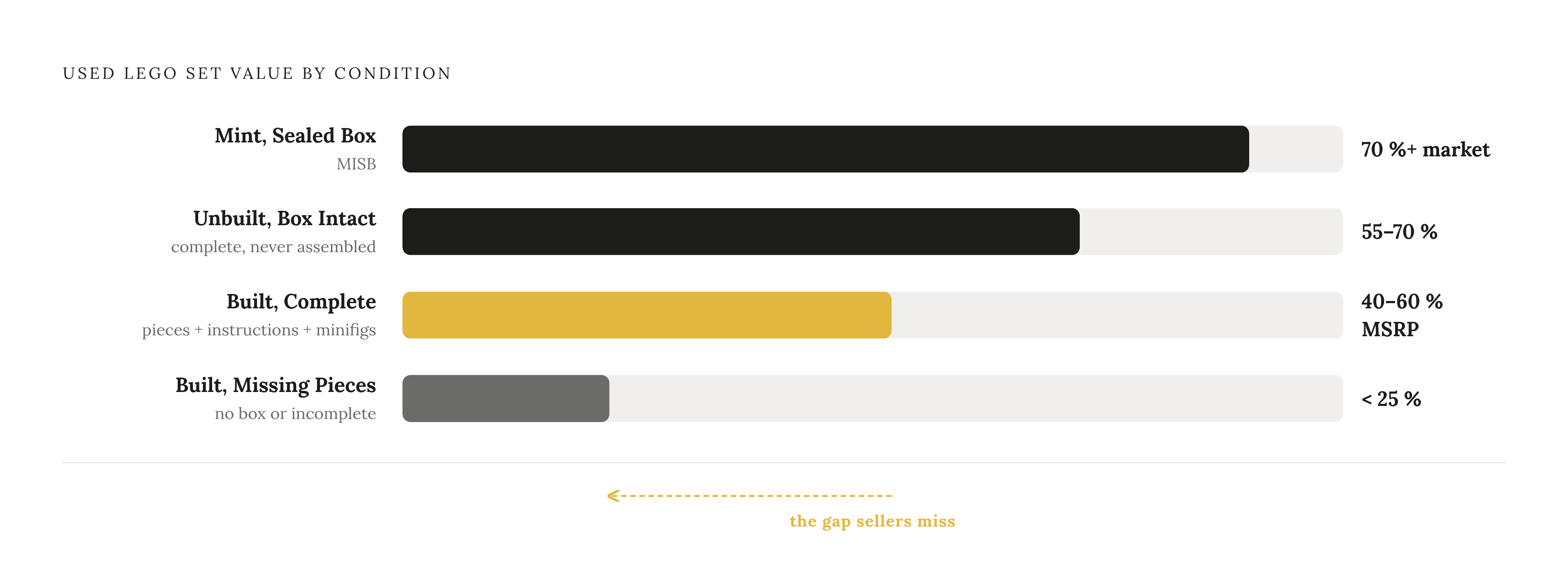
Condition doesn't slide up and down a smooth scale. It sorts sets into separate buyer pools, and each pool pays a different rate.
At the top sits Mint in Sealed Box (MISB), the domain of collectors and investors who will never crack the box open. Sealed sets can trade at 50% to 70% or more of current market value in a trade-in scenario, and that gap versus an opened copy of the same set only widens as the set ages.
Below that is complete-but-unbuilt, still in a good box with instructions intact. Strong demand here too, and the box condition itself starts to matter almost as much as the pieces inside.
Then comes the tier most sellers actually deal with: built, but all pieces and instructions present, including minifigures. These generally hold 30% to 60% of original value depending on condition, and a typical used set lands around 40% to 60% of MSRP.
Below that, built sets missing pieces or the original box are still sellable, just at a discount that grows with every missing piece. Losing a minifigure hurts a lot more than losing a handful of standard bricks.
One thing casual sellers miss constantly: sun-faded boxes and stickers drop value even on sets that were never built. Storage history counts. A set that lived on a sunny shelf for five years is not the same product, price-wise, as one that lived in a closet.
Knowing which tier a set sits in before setting a price is the difference between underselling something in great shape and overpricing something that's seen better days.
Why theme determines the ceiling a set can ever reach
Some themes have a fan base that outlives the retail shelf. Others don't. Star Wars, Harry Potter, and the Icons/Creator Expert line all keep collectors bidding long after LEGO stops making them, because the franchise itself, not just the plastic, keeps pulling people in.
The scale of that demand is not abstract. In 2024, Star Wars LEGO sales through the Upright Lister platform totaled more than $356,000, averaging $72.48 per sold item. That's one theme, one year, one platform's seller base, and it dwarfs what a comparable volume of generic sets would pull in.
LEGO Ideas sets ride a similar wave: short production runs plus strong display appeal create scarcity the moment they retire. Compare that to City, Duplo, and Classic, all of which get made in huge volumes and stay on shelves a long time. Broad availability during the active window plus a weak collector identity afterward means appreciation is simply rare.
Before doing any deep research on a set, check the theme first. It's a rough filter, nothing more, but a City set and a Star Wars set in identical condition are not having the same pricing conversation, and they never will be.
What actually happens to price when a set retires
Retirement is permanent. LEGO doesn't bring old sets back once they're gone, so total supply of that set is fixed the day it leaves shelves. If demand holds steady or grows from there, prices climb. That's the entire mechanism, and it's just supply and demand doing what supply and demand always does.
Most sets retire after roughly two to three years in production, according to Upright Labs.
Here's the part that trips up new sellers: right after a set retires, a wave of owners all decide to sell at once. Secondary markets get flooded, and prices dip, sometimes hard. It looks like the set is losing value. Usually it's just a short-term glut correcting itself. Sellers who list the moment a set retires often catch that low point and walk away thinking they got a bad deal on a good set. Patience tends to pay here. Wait out the initial flood, and prices often recover.
Retirement guarantees one thing only: no more will ever be made. That's necessary for appreciation, but it's not sufficient on its own. A retired set from a low-demand theme, with no scarce minifigures inside, still has nothing propping the price up. Supply drying up doesn't matter if nobody wanted more of it in the first place.
How minifigures function as the value floor inside a set
A single minifigure exclusive to one set can carry that entire set's resale value on its back. If collectors want the figure badly enough, they'll buy the whole set just to get it, box and all.
Individual figures range from a few dollars up past $100 depending on rarity and condition, and in extreme cases the figure is worth more than everything else in the box combined. An Ahsoka Tano minifigure from the 2016 LEGO Star Wars Rebel Combat Frigate set sells for $300 or more on its own. The Boba Fett figure from the LEGO Star Wars Cloud City set has traded above $2,000. Reported data has put a single Boba Fett figure's value past $3,000, a number that's frankly absurd for a two-inch piece of plastic, but there it is.
Betrayal at Cloud City, retired in 2019 after just one year on shelves, runs around £580 new and sealed today. Much of that value traces straight back to its sought-after minifigures and miniature vehicles. Short production run plus exclusive figures is about as good as this combination gets.
Before listing any set as one lump item, pull up every minifigure inside it by name and check its individual sold value. Sometimes selling the figures separately beats selling the whole set. And if buying bulk lots is more the plan, a box of loose bricks with a rare figure buried inside is worth far more than its weight suggests. Figure identification comes first, every time, before any pricing decision gets made.
What high-value used sets actually sell for, with specific examples
These are not typical sets. They're the ceiling, shown so the pattern is visible.
10123 Cloud City, from the Star Wars Episode V line, released in 2003 with 698 pieces and 7 minifigures (Boba Fett with markings, Han Solo in Carbonite, Lando Calrissian, Darth Vader among them), retailed at $99.99. Retired, it now sells used for $3,500.00 per BrickEconomy, roughly 35 times its original price, at the used tier alone.
LEGO Star Wars Death Star II, set 10143-1, carried a retail price of $269.99. Used examples now sell between $704 and $1,027 according to resale market data.
LEGO 6086 Black Knight's Castle, a vintage castle-theme set, had a modest original retail price. Used sets go for $362 to $458 according to resale market data.
LEGO Town 6399 Airport Shuttle, an older Town-theme set, carried a higher original retail price. Used copies range from $828 to $1,139 according to resale market data.
The Tower of Orthanc, from the Lord of the Rings theme, had an original retail price of £169.99. New-condition copies have sold for more than 160% above that figure, a strong signal the used market is holding up too.
At the time this data was pulled, 10123 Cloud City sat at $17,444.85 new and sealed on BrickEconomy, against $3,500 used. That gap, sealed versus used, on the exact same set, is its own lesson in how much condition alone can swing a price.
What all these sets share is a strong license, exclusive minifigures, and a long stretch off the shelves. What they don't share with most attic finds is being typical.
How bulk lots price differently from complete sets, and when each makes sense
Loose bricks sold by weight run about $3 to $5 per pound, with $2 to $5 cited as the general range across sources. A 10-pound mixed lot might bring $80 to $120 on Facebook Marketplace. A single retired, licensed set in good shape could clear $200 on eBay without much effort. These are not interchangeable formats, and treating them as the same mistake costs sellers real money in both directions.
Bulk isn't automatically the bargain bin, either. In 2024, sellers using Upright's software moved $66,374.17 in bulk brick lots, averaging $445.46 across 149 sales. Listed right, bulk brick moves real money.
The catch: minifigures hide in bulk lots constantly, and a rare figure buried in a pile of loose bricks can be worth several times the weight price of the whole bin. Sorting before pricing isn't optional if getting market rate is the goal.
So when does bulk make sense over a set listing? If the set is common, has no exclusive figures, and the box is long gone, weight-based bulk pricing might actually beat listing it as a "used set, no box." But once a set has a confirmed high resale value, listing it identified, by set number, almost always wins. And a small tactical note: pairing "Bulk" or "Lot" with "LEGO" in a listing title improves search visibility specifically for this category, per Upright Labs.
How to find what a set actually sold for, not what sellers are asking
Every credible source on this agrees on one rule: price against sold data, never against asking prices. Listings reflect what a seller hopes to get. Sold data reflects what someone actually paid.
On eBay, search the set number, filter by Sold Items, and look at the last 30 to 90 days. One sale isn't a price, it's a data point. Pull 5 to 10 recent solds in comparable condition before drawing any conclusion. Ignore outliers on either end unless there's a clear reason behind them, a bidding war over a rare box variant on the high side, or a missing-pieces listing mislabeled as complete on the low side.
A few tools do the heavy lifting here. BrickLink runs a catalog and price guide; check its sold listings, not the asking prices of whatever's still sitting unsold. BrickEconomy pulls both BrickLink and eBay sales data into trends and averages, and it's become the standard reference point for tracking sets and minifigures over time, useful for figuring out retirement timing too. PriceCharting tracks eBay sales for LEGO sets and shows historic pricing by condition, so patterns in rising or falling value become visible.
For sets missing their box, search BrickLink and eBay by set number filtered for "used, no box" or the closest equivalent. The actual sold comps in that exact condition are the price. There's no clean formula for discounting off the boxed price, so don't invent one.
One more step that most casual sellers skip is pulling the official instructions from LEGO's website for that set number and counting pieces against what's actually in hand. That single check is usually what prevents a dispute after the sale, when a buyer opens the box and finds three pieces missing nobody mentioned.
AI-assisted listing tools now handle identification, condition grading, and listing copy from a single photo, cutting out a lot of the research friction that keeps most sellers from ever doing this properly. Underneath, they're running the same sold-data logic described above, just automated.
Which marketplace fits which type of LEGO item
No single platform wins for every format. A rare minifigure, a 25-pound bin of loose bricks, and a sealed retired set belong in three different places, not one.
eBay has the largest buyer pool around, though all-in costs (shipping plus promoted listings) can eat up close to a quarter of the sale price. It's the right call for bulk lots, high-ticket rare sets, and anything uncommon enough that an auction format lets competitive bidding find the real price.
BrickLink, now under LEGO Group ownership, attracts serious collectors who pay full market value without blinking. Parts-only and minifigure-only sales are the norm here, not some fringe use case, which makes it the natural home for individual figures, loose parts, and rare sets that benefit from catalog-style organization.
Facebook Marketplace charges no platform fee at all, so the seller keeps the full sale price. It's best suited to local pickup, heavy bulk bins nobody wants to ship, and quick sales.
Whatnot, through live selling, can push prices meaningfully above what fixed-price listings pull in, particularly for sellers who've already built a following. An engaged live audience can push prices above what fixed-price listings typically achieve.
StockX is another option worth considering for sealed collector sets.
The simplest way to decide: chase top dollar on eBay or BrickLink, chase speed and simplicity on Facebook Marketplace locally, and if the inventory is large and mixed, split it by format instead of dumping everything into one listing.
Writing a used LEGO listing that earns what the research says it's worth
Photos first. Natural light, a clean background, every angle covered, flaws included rather than hidden. Stock photos pulled from LEGO's own catalog signal to a buyer that condition went unchecked, and buyers either discount the price on sight or skip the listing entirely.
The title and description need to carry the set number, theme, condition, completeness, and any missing pieces stated clearly in the listing, not buried in a paragraph. Vague listings get fewer bids and more refund requests after the fact, and that pattern holds across every platform mentioned above.
Search behavior matters too. Buyers hunting for these sets type in the set number itself, along with words like "discontinued" and "retired," so a listing that skips those terms is invisible to exactly the people most likely to pay full market rate for it.