Using Sold Listing Data to Write Competitive Titles
Sold listings show the exact search terms and title language buyers actually use to find items.

Using Sold Listing Data to Write Competitive Titles.
Why sold listings reveal what buyers pay
Active listings are guesses wearing a nice outfit. Anyone can type a number into the price field and hit publish, hoping someone bites. A sold listing is a receipt: a real buyer typed a search, clicked a result, and handed over actual money for the actual item. A sold listing is the only record worth trusting, and most sellers still skip past it to eyeball whatever's currently listed instead.
eBay's search behavior backs this up in a fairly unforgiving way. List something too far above what similar items have actually sold for, and the algorithm doesn't let it sit quietly near the bottom of results. It buries the listing, functioning less like a demotion and more like unplugging it from the internet. Overpricing on eBay costs visibility, not just time.
Facebook Marketplace makes the whole exercise trickier, since it won't show sold prices at all. Buyers and sellers only see the asking price; the platform keeps every completed transaction to itself. Pricing on Marketplace without checking eBay's sold data first is pricing blind, and that's true even for sellers who've used Marketplace for years.
What sold listings contain beyond a price
Most sellers open a sold listing, glance at the price, and close the tab. That habit throws away most of the value sitting right there on the screen. The real material is the title itself, a sold title is basically a fossil record of the exact words a buyer typed into the search bar right before they bought the thing.
Reading the words tells you what a buyer would actually search, which reading the dollar sign does not. Confirm that the model name and number are spelled the way a buyer would actually search, not some cleaned-up version a seller prefers. Check the condition words: the top sellers used sharper, more specific language than the listings sitting in the bargain bin. Check spec details: storage size, color, generation, what came bundled in the box. And check what's missing, because that's just as telling. Titles that sold fast tend to skip the cheerleading, no "L@@K," no "GREAT DEAL," none of the filler that eats character space without doing any work. That absence is the tell: keyword space is worth more than enthusiasm ever was.
A vintage board game makes the case almost comically well. The identical game sold for $40 when the listing mentioned the box, and $15 when it was just the loose pieces. Nothing else about the item changed.
How to pull sold listing data for your title
On desktop, eBay tucks this under Seller Hub, then Research, then Product Research. Type in the search phrase, filter by category, condition, and listing format, and set the date range. It takes a few clicks to find the first time and about five seconds every time after that https://www.zikanalytics.com/ebay/product-research.
Mobile is faster still. Search the item, tap Filter, then Show More, then flip on Sold Items, and eBay hands over everything sold in the last 90 days. It's not fine for anything that doesn't.
For slower or seasonal categories, Terapeak Product Research, also tucked inside Seller Hub, stretches that window back three years, and it shows the actual final sale price on Best Offer listings rather than just the number that got posted. That second detail changes what price a seller should anchor to when writing a new listing. A listing that posted at $100 but actually sold through a Best Offer likely closed at $75–$85, so sellers should use that adjusted figure, not the $100 display price, when anchoring a new title and price.
Reverse-Engineering a Competitive Title from Your Comp Set
Pull ten or more sold comps and ignore price at first. Look at language instead. The titles that sold fastest and for the most money tend to repeat the same handful of words, and those words are proven, buyer-tested search terms, not guesses.
From there, lock down the non-negotiable spec fields for the category. Sneakers and clothing need brand, model name, colorway, and size, all four, every time, because skipping even one of those quietly locks a filter shut. Electronics need model number and generation. Collectibles need completeness signals. Skipping one field removes the listing from every search that filters on it.
Condition words earn a specific spot in the title, near the front, not buried at the end. Buyers read left to right, and the search algorithm weights what shows up early more heavily than what trails off at the end.
eBay only gives sellers 80 characters to work with. Every character spent on "beautiful" or "must see!!" is a character stolen from a real, searchable spec. The sold comps already showed which words buyers typed. Use those words, and skip the adjectives that just take up rent-free space in the title.
Condition language in sold titles and its effect on price tier
Condition does double duty in a title. It's a filter buyers click, and it's also a word they type directly into the search bar. Get the word right and it does both jobs at once, which is more than most sellers ask of a single word.
Vague language does almost no work. "Good shape" or "used, works great" reads like every other listing on the page and matches nothing specific in a buyer's search. Precise language, "tested working," "no scratches," "complete in box," matches what a buyer actually typed, because those are the same words a buyer uses to describe what they want.
The price gap this creates isn't small. An item listed in "good" condition tends to sell for roughly 60 to 70% of what the identical item in "like new" condition brings https://www.sellitright.co/blog/how-to-price-facebook-marketplace. That's a third of the value gone, not a rounding difference, and the condition word in the title tells a buyer which tier they're looking at before they even click.
The exact words shift by category, though. Electronics buyers respond to functional language: "tested," "factory reset," "battery health," "IMEI clean". Nobody's browsing a used iPhone listing hoping to hear about cosmetic scratches; they want to know if the battery still holds a charge. Clothing buyers look for "no pilling," "no fading," "tags attached," "worn once." Collectibles and game buyers look for "complete," "with box," "all pieces," "sealed," which loops right back to that $40 board game.
Where category patterns change what your title must include
Electronics behave the most predictably of any category, because the specs are standardized and buyers search in a fairly rigid pattern. Model number, storage size, color, and generation are the filters buyers actually click. They're the filters buyers actually click, and skipping one quietly removes the listing from an entire slice of searches.
Sneakers and streetwear run on four fields: brand, silhouette name, colorway, and size, and buyers filter on all four at once, so all four need to show up. In the Jordan and Nike SB world, the Yeezy and Samba world, the New Balance premium world, the colorway name itself, not a plain description of the color, is what actually gets searched. "Bred" gets clicks. "Black and red" doesn't, even though it's describing the identical shoe. Trust markers matter here too, since counterfeits run rampant in sneaker resale. Phrases like "receipt included" or "authenticated" pull real weight in a title because they tell a nervous buyer the item is legitimate before they even click Buy.
Toys, games, and collectibles run on completeness. That board game comp isn't a fluke, it's the whole pattern: complete sets with the box earn a real premium over loose pieces. LEGO, trading cards, and used game consoles are some of the easiest categories to research because buyers search constantly and the sold comps stay dense and current. Set name and year belong in the title, front and center. A generic description without the set name is invisible to the exact buyer searching for it by name.
Home goods behave differently again. Brand name is the anchor when the brand is recognizable, and unbranded kitchenware or furniture is a much harder sell simply because there's no name for a buyer to type. On Facebook Marketplace specifically, big or heavy items like furniture and gym equipment do better with local-search phrasing than eBay-style keyword strings, since nobody's shipping a treadmill across state lines. Naming an aspirational comparison brand right in the title, something like "similar to West Elm / Joybird," pulls in buyers who know that brand's look and price tag but want the resale version instead.
Applying sold-data title logic on Facebook Marketplace, where sold prices aren't visible
Marketplace's algorithm leans heavily on photos, but its search function still runs on plain text. A great photo earns the click once someone's already looking at the listing. Keywords decide whether that listing shows up in front of them in the first place, and no amount of good lighting fixes a title that's missing the words people search.
Cross-referencing against eBay takes a bit of detective work, but it removes most of the guessing from an otherwise guess-heavy platform.
A title with style, color, and aspirational brand catches multiple buyer searches at once. A title that just names the bare item catches far fewer. "Mid-Century Modern Accent Chair, Teal Velvet, Similar to Joybird/West Elm" pulls in searches for style, color, and brand simultaneously, where a title that just says "Chair" pulls in almost nothing. One is a fishing net. The other is a single hook with no bait on it.
Local demand shifts things too. What sells fast in a dense city market isn't always what moves in a rural one, so the same item might need different emphasis depending on who's actually scrolling nearby. Condition language that reads fine on eBay, where the buyer never sees the item in person, sometimes needs to get plainer on Marketplace, where the buyer's about to show up at the door and look at it themselves. Since the platform doesn't reliably surface sold prices, the keyword research still has to run through eBay: search the same item there, filter to sold, read the winning title language, then use those same keywords in the FBMP listing.
Thin sold comp sets and unreliable patterns
Sometimes there just isn't enough data, full stop. Vintage items, discontinued models, regional brands, and very recent releases with no sales history yet all tend to produce thin comp sets, fewer than the ten-listing threshold that makes a pattern trustworthy.
When that happens, auction format is usually the more honest move: let the market set the price instead of guessing at a fixed one. The title's job shifts too. Instead of matching one precise, filtered search, it needs to catch a browsing buyer who isn't even sure yet what they're looking for.
Terapeak's historical data stretches the comp window out to three years for slow categories, so a vintage item that only sold twice in three years still hands over usable title language.
Sold-Data Logic in AI Listing Tools
None of this is complicated. It's just slow. Pulling comps, reading titles, spotting the repeated words, and building a title from scratch eats real time, something like 10 to 15 minutes per item before a single word of the actual title gets written. Multiplying that across a closet full of inventory turns the quick task into something closer to a part-time job.
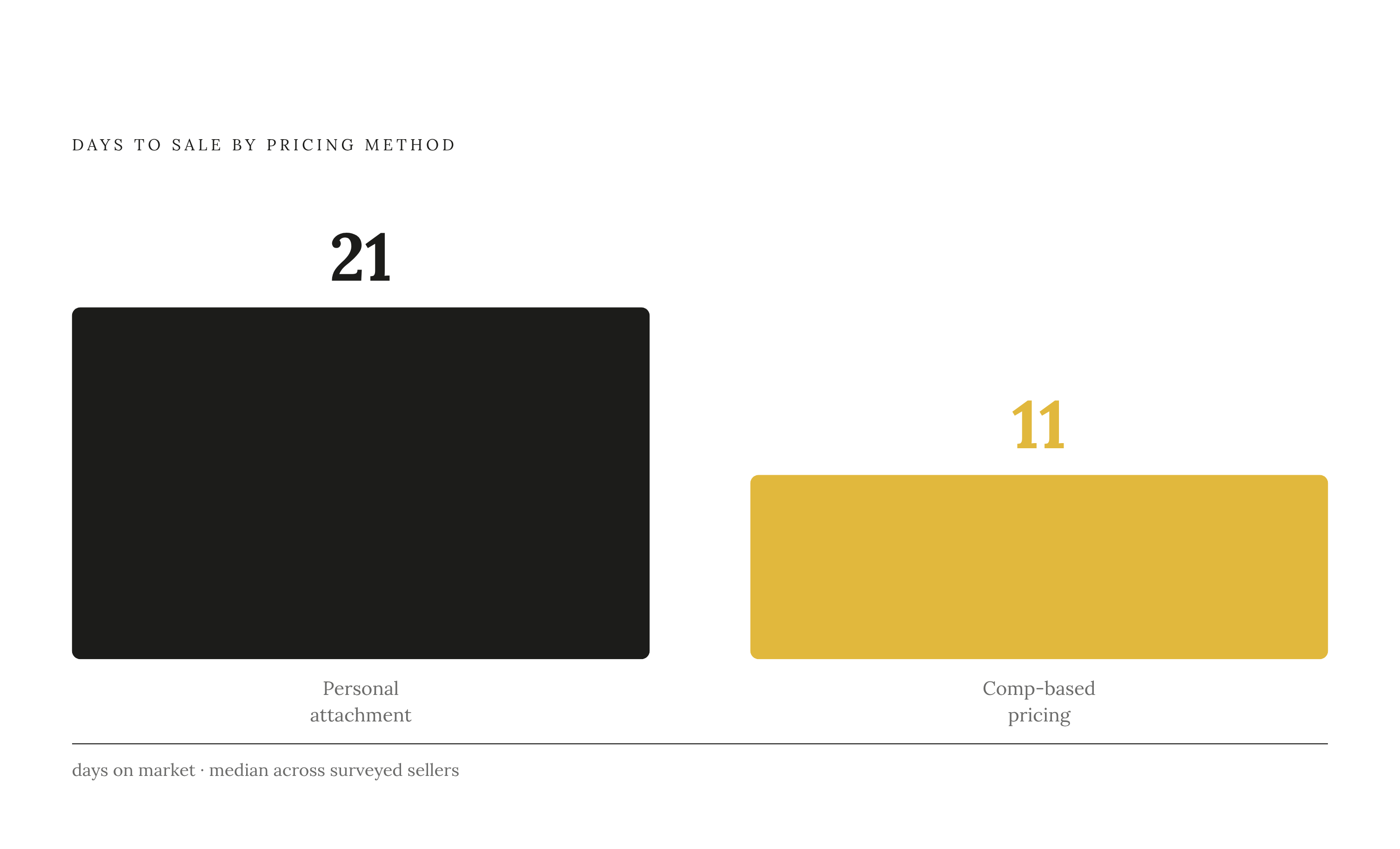
AI-powered listing tools exist mainly to compress that loop. Instead of a seller manually pulling sold comps, scanning for repeated keywords, and hand-building a title field by field, the tool runs that same lookup and pattern-match automatically, then hands back a title built on the same logic covered above: buyer-tested keywords up front, condition language placed where it actually counts, category-specific spec fields filled in, filler stripped out. The method doesn't change, only who's doing the typing. Pricing tools built on the same comp logic can flag when an item's gotten ten or more saves and suggest raising the price accordingly, or flag that a fixed price is underperforming a markdown, since one tracked test saw a marked-down listing pull 52% more views than its fixed-price twin https://closo.co/blogs/crosslisting/facebook-listing-price-complete-guide. None of that replaces the sold-comp research. It just does it faster than a person clicking through Seller Hub at midnight. Forever 21 had a predicted peak of 2026-04-05 on Closo Market Analytics https://closo.co/blogs/beginner-guides-how-tos/my-unfiltered-guide-real-tips-for-selling-on-facebook-marketplace-without-losing-your-mind. Facebook Marketplace buyers expect about 10–12% negotiation room on listed prices https://closo.co/blogs/crosslisting/facebook-listing-price-complete-guide. Average time-to-sale was 21 days when pricing based on personal attachment https://closo.co/blogs/crosslisting/facebook-listing-price-complete-guide. Average time-to-sale fell to 11 days when pricing objectively using comparable data https://closo.co/blogs/crosslisting/facebook-listing-price-complete-guide. 15 pairs of Air Jordan 1 Retro High OG Chicago sneakers were analyzed for average pricing https://nifty.ai/post/ebay-pricing-guide. Underpricing strategy involves pricing items 10–15% below the average sold listing price https://nifty.ai/post/ebay-pricing-guide. Overpricing strategy involves pricing items 10–20% above the average sold listing price https://nifty.ai/post/ebay-pricing-guide. Professional resellers recommend setting the initial price 5–10% above what you actually want to get on Facebook Marketplace https://www.sellitright.co/blog/how-to-price-facebook-marketplace. Quick sell pricing on Facebook Marketplace is typically 15–25% below fair market value https://www.sellitright.co/blog/how-to-price-facebook-marketplace. Clothing on Facebook Marketplace has an average negotiation margin of 10% https://closo.co/blogs/crosslisting/facebook-listing-price-complete-guide. Collectibles on Facebook Marketplace has an average negotiation margin of 20% https://closo.co/blogs/crosslisting/facebook-listing-price-complete-guide.