Why Browsing Active Listings Is the Fastest Way to Underprice Everything You Sell
Sold prices, not asking prices, show what buyers actually pay.

Active listings show what sellers want. An accurate resale price starts with sold transactions for the same item, then accounts for condition and demand. AI-assisted pricing is useful when it brings that evidence into the listing workflow, but a suggested number is no substitute for a clean comparison.
Why active listings are unsold inventory, not market data
A new reseller stands in a thrift store, pulls up eBay on their phone, and scrolls through prices. The numbers look promising. But the default search shows active listings, so the seller is looking at items still waiting for a buyer. A price tag is not a receipt.
That distinction creates a bias in what stays visible. Correctly priced items sell and leave the active pool, while overpriced items linger, making the remaining stock an increasingly poor guide to value. Not every active listing is overpriced, but a long stay is hardly a buyer endorsement. MDS's sourcing guide identifies confusing asking prices with paid prices as the core sourcing mistake. Facebook Marketplace has the same problem because its native feed shows what sellers ask and leaves out what buyers paid.
How copying active listings causes underpricing, not overpricing
The obvious objection is a good one. If active prices are inflated, wouldn’t copying them make an item overpriced? Yes, that can be the first result. Casual sellers use an unreliable anchor to decide both what to charge and how much to concede.
One route starts when a seller sets a price below similar active listings to make it look like a better deal. That feels like research, but it only establishes a cheaper place in a queue whose front may not be moving. The other route skips the queue entirely. A seller guesses low to get the item gone, leaving the margin to someone who knows what buyers actually pay and can flip it. Neither route establishes a defensible price.
Sell-through rate shows how quickly items are selling by comparing recent sales with active listings for the same search. Many listings and very few sales mean sellers outnumber buyers, so the next sale is likely to come from one of the cheapest offers. An unsold item has not technically been underpriced. But without demand evidence, the seller cannot distinguish a necessary discount from money given away.
What the gap between asking prices and sold prices actually looks like
The sold-listings guide shows this with used Nintendo Switch OLED consoles in the five days to October 19, 2026. With game bundles and consoles without Joy-Cons left out, the median sold price was well below the prices in many active listings. Buyers had established a middle band that the visible asking prices did not reflect.
The eBay pricing breakdown shows the cost in time through Seller A, who listed below a cluster of similar actives and waited three weeks without a sale. Those higher-priced listings were unsold too. Even what looks like a sale can hide a gap, because a standard eBay Best Offer result shows the first asking price struck through and keeps the price the seller took hidden. The visible number can therefore overstate what changed hands.
How do you find and read sold data correctly on eBay?
A repeatable five-minute check starts with an exact search. Include the identifiers that distinguish the item, such as model, size, color, and condition. On desktop, select Sold Items under Show Only in the left sidebar. The sold-listings guide reports that, as of October 19, 2026, signed-out users are redirected to login when requesting sold results. Sold results show a green price and “Sold” with a date.
On the mobile app, tap Filter on the results page, scroll to Sold Items, and switch it on. That is the essential switch. The scraping guide offers a shortcut for browser searches by appending &LH_Sold=1&LH_Complete=1 to an eBay search URL. For rare, seasonal, or slow-selling items, Terapeak Product Research is free inside eBay Seller Hub under Research, then Product Research. It goes back up to three years and shows the Best Offer prices sellers actually took.
Before calculating anything, remove mismatched condition tiers, lots, bundles, and obvious outliers. A five-piece lot is not a comparable sale for one piece, however encouraging the number looks. Keep auction sales apart from Buy It Now results, and compare fixed-price sales when setting up a fixed-price listing. Compare the item price plus shipping, since buyers look at what they will pay in all. Then use the median so an unusually high sale does not pull the benchmark above the center of the transactions.
Why condition and sell-through rate change what the sold data means
The median is a place to start within a range of prices, with the final price still to be set. Condition determines where the item belongs. A worn piece should not inherit a New With Tags price, and condition tiers do not fall in neat, equal steps. The drop from Very Good to Good is steeper than the drop from New to Very Good. Electronics also take sharper condition discounts than clothing, where brand can outweigh wear.
To apply that distinction, adjust honestly when the available comparisons do not match the item's condition. Disclose every flaw in photos and text. An undisclosed defect can turn a sale into a return, taking shipping both ways and the original margin with it. A flattering description can only postpone the conversation about a scratched item.
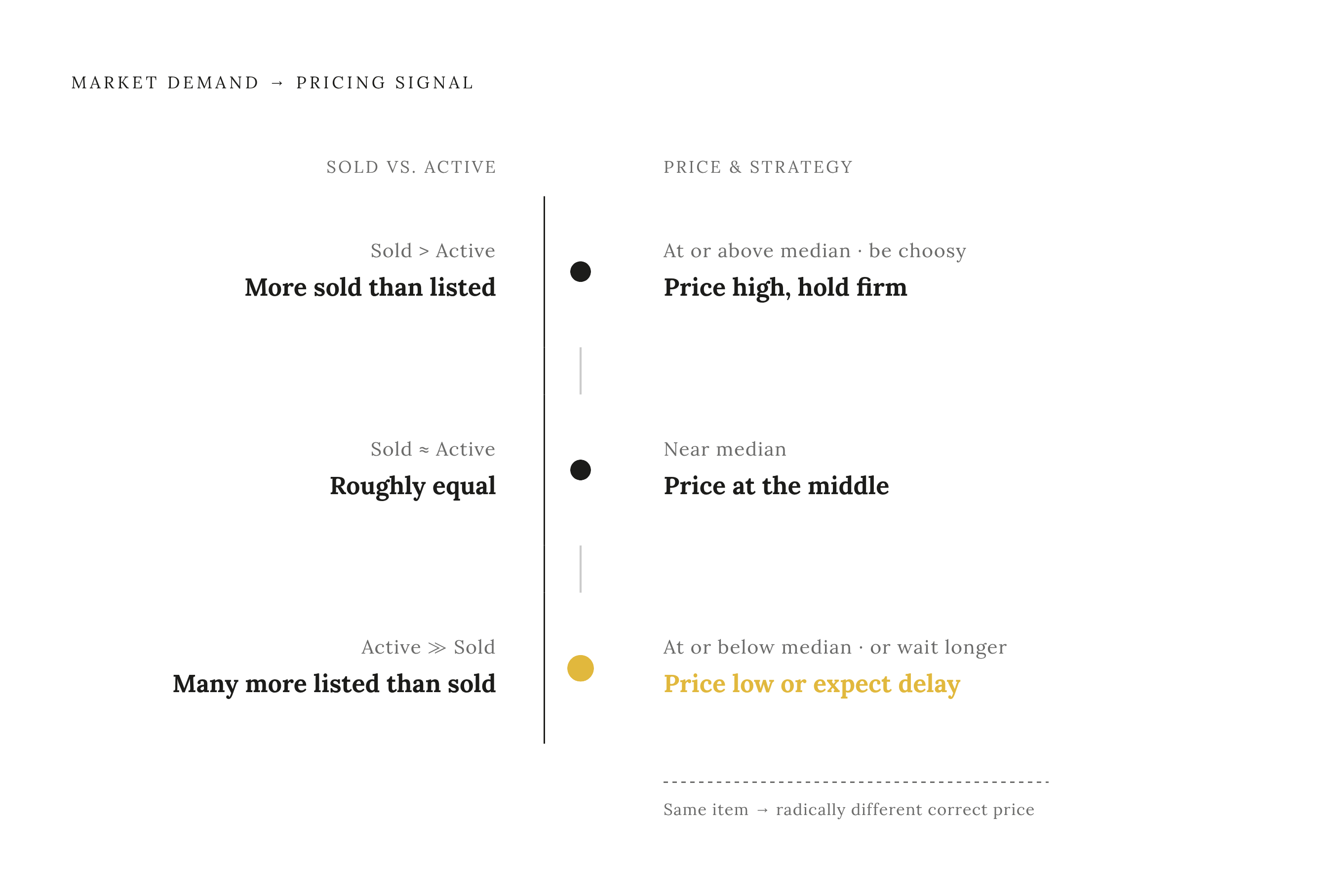
When more items have sold than are active, a seller can price at or above the median and be choosy about offers, while about the same number of each points to a price near the middle. Many more active listings than sales call for a price at or below the median to move the item, or acceptance of a longer wait. When almost nothing has sold, search further back in Terapeak before calling an item rare, since it may be something buyers do not want. After several weeks without a sale, consider a price drop or relist, and after a prolonged wait, reassess the comparisons themselves.
Where the sold-data method pays off most — categories where the ask-versus-sold gap is widest
Electronics punish almost-right searches because a small difference in the model description can change the price profile. “iPhone 14 Pro 128GB unlocked” and “iPhone 14 Pro 256GB unlocked” are not interchangeable comparisons. Mixing them creates an average with no clear job. Small-ticket accessories can move in high volume on eBay, but that does not make a broad electronics search useful for pricing a specific item. The model is the anchor.
Clothing invites a different mistake, which is treating visual similarity as price similarity. The same style from a recognizable label and an unbranded maker can sell for very different amounts. Knowing the brand often helps more here than small changes in price for the item's condition. A similar silhouette is not a comparable sale. Research effort pays off when it establishes what the label commands before deciding where wear places the item within that range.
Small kitchen appliances reward equally specific research. Stand mixers and blenders can look interchangeable on a thrift-store shelf while buyers search for particular models, and researched resale prices can be multiples of the purchase price. Guessing misses that distinction. Across these categories, broad sell-through signals are weaker than they first appear because the individual item's brand and condition do more to explain whether it will sell near the median. A busy category does not guarantee a buyer for everything in it.
Choosing the right platform changes which sold data to pull
Platform choice determines the audience as well as the useful price evidence. Facebook Marketplace fits furniture and bulky goods when shipping would erase the margin and local pickup solves the problem. It also suits mid-tier fashion and baby gear where local discovery helps drive the sale. Convenience is part of the offer. An item that sold for a price on eBay may sell for a different price in a local feed.
For items worth more that can be shipped, eBay has buyers across the country, which gives specific models and known brands a better chance of selling fast and near the researched median. Its buyers arrive through keyword searches and compare prices, while Marketplace buyers are more likely to respond to proximity and convenience. The same price can work differently in each setting. The sold-listings guide says eBay's standard final value fee is based on the whole sale amount, with shipping and tax included, while Marketplace charges nothing for local pickup. That changes what remains in the seller's pocket.
Listing to both through one workflow cuts down on switching apps, which can push sellers to choose a platform out of habit.
Where sold data itself can mislead if used carelessly
A sale shows that someone bought an item under the conditions at the time, but another buyer may pay a different amount now. Seasonality makes that limitation obvious. Demand for a coat in July differs from demand in November, so the default ninety-day view may not fit the season when it will be sold. Looking further back helps only when those sales still fit the demand cycle for the item.
The label on the result also needs care. Completed listings include both sold and unsold outcomes, so treating all completed prices as paid prices lets failed asks back into the calculation. MDS's guide uses those unsold results for failure analysis. Sale format adds another boundary. An excited auction bidder can produce an outcome that does not translate into a realistic Buy It Now price.
The used-item pricing guide says Terapeak is the only free native tool that shows the Best Offer amount the seller actually took, which the standard filter keeps hidden. Fewer than three to five clean comparisons in ninety days are also too thin to support a confident price and warrant a longer look before committing to list. Match the season, condition, and sale format, then check the sales that remain against sell-through.
Turning the sold-data habit into a repeatable pre-listing step
The useful place for research is before the listing goes live, while the item and its details are already in hand. Search the exact identifiers, apply the sold filter, and sign in if prompted. Remove mismatched condition tiers, bundles, lots, and format outliers, then take the median and check sell-through. Adjust within the range for the item's actual condition and disclosed flaws. Finally, choose Buy It Now or auction according to demand depth and the seller's timeline.
The pricing breakdown puts that routine at roughly five minutes once it becomes familiar. Switching tabs, setting filters, and doing math in their head for every item can make guessing feel like a sensible shortcut to a seller. Motivation has a short battery life. A workflow with too many choices uses it up before the listing goes live.
Tools that surface sold comparisons, median prices, and sell-through at the point of listing can remove that friction while leaving the final price with the seller. An AI-assisted workflow can work out what the item is, pull real sold data, and write the listing without turning each step into its own chore. Condition still needs an honest description. The aim is to describe the item honestly, price it using sales that fit, and get the listing live before selling it becomes another job for next weekend.