Used Video Game Resale Values by Console Generation
Older consoles appreciate like collectibles while newer ones depreciate like electronics.
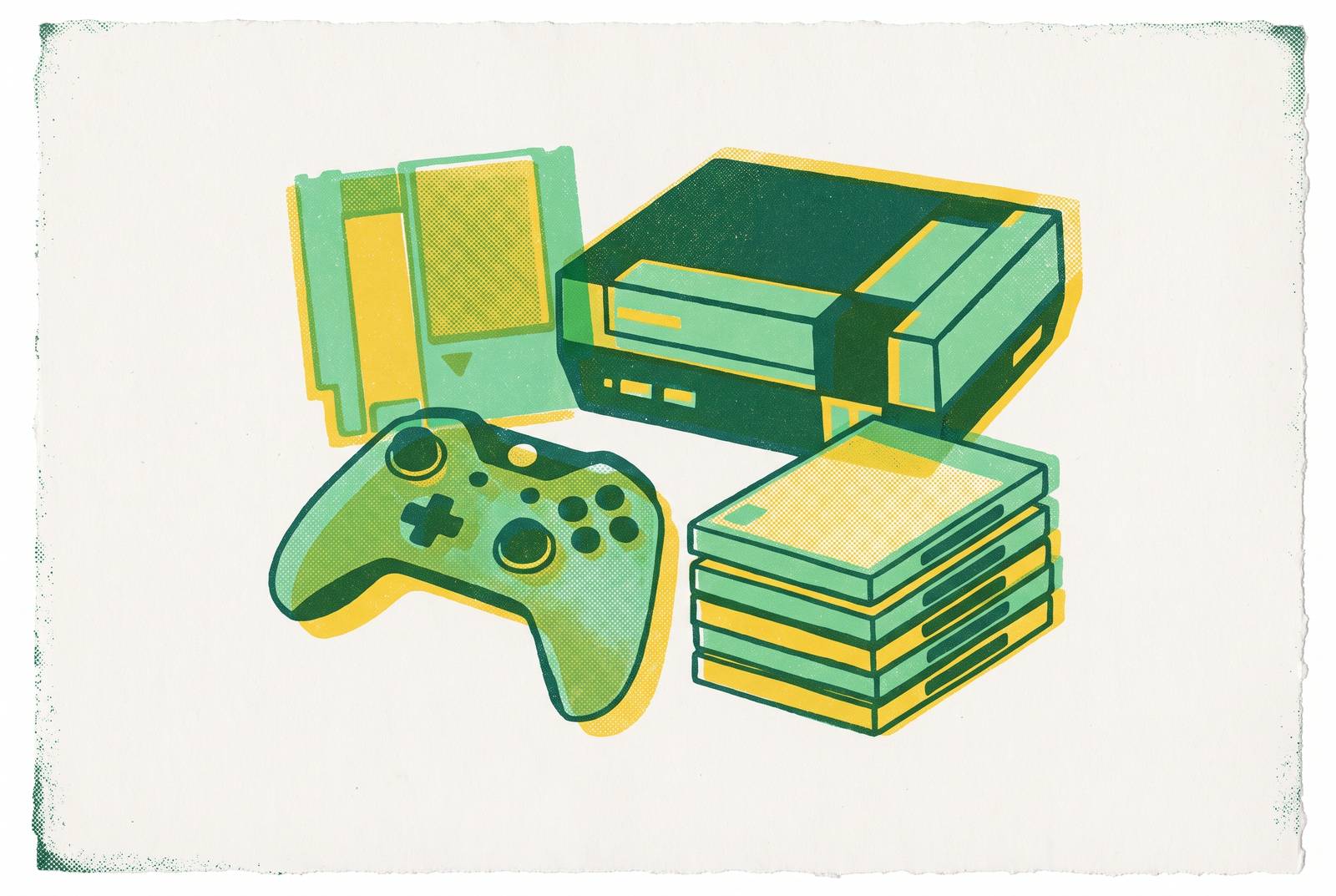
Used game and console prices don't decline in a straight line the way a laptop or a TV does. Some hardware from the 1980s is worth more today than it sold for at launch, adjusted for inflation, while a PS2 or original Xbox still depreciates the normal way electronics do. Two games from the same console, same release year, can sell for $10 and $200, and the gap has nothing to do with which one is more fun.
That split isn't a fringe hobby thing anymore, either. The retro gaming console market hit $3.8 billion in 2025 and is projected to reach $4.18 billion in 2026, growing at roughly 10% a year, which is faster than the 3 to 5% growth rate of the broader gaming console market, according to Icon Era. North America alone accounts for $1.19 billion of that, about 38% of the total. On eBay, video game consoles generated $13,966,960 in the site's most recent 30-day settled window, and video games ranked second by unit volume, with 205,905 sold, per resellbot.com's sold-listings data. People are buying and selling this stuff right now, in real volume, not just posting about it in forums.
To make sense of any of it, you need two variables at once: how old the system is, and what physical condition the item is in. Get those two right and the pricing patterns below start to make a lot more sense.
How condition tiers set the price ceiling before generation even matters
Three condition tiers determine every price in this article, so it's worth nailing them down first.
Loose means just the cartridge or disc, no box, no manual. This is usually the floor. CIB, complete in box, means the game plus its original case, manual, and any inserts that shipped with it. That phrase, complete in box, is the one that quietly does the most work in a listing description, because it usually signals a real jump in price. Sealed or new means factory shrink-wrap, never opened, and it's typically the ceiling, sometimes by a wide margin.
CIB games routinely sell for significantly more than loose copies, and rare titles can fetch several times the loose price. The gap gets dramatic fast: a loose Ocarina of Time cartridge for N64 runs $40 to $70, but a CIB copy in good shape brings $150 to $300. A sealed copy of Super Mario 64, for common print variants, can hit $300 to $500 or more, while the same game loose is $30 to $60 (per whattheslab.com).
NES collectors deal with a specific headache here. Those boxes were cardboard, and cardboard doesn't survive decades in a basement or a kid's closet. Most got tossed. So even a CIB copy of a common NES title is genuinely hard to find, and a sealed one borders on mythical.
Sealed games carry their own trust problem, too. Resealing machines exist, so a "sealed" listing isn't automatically a guarantee. High-value sealed games often go through third-party grading services that encapsulate the game in a graded case. That adds another layer of verification, and another layer of price on top.
Reproduction cartridges, the unlicensed reprints sold online, carry minimal value regardless of what game is printed on the label, because authenticity gets priced in rather than assumed, which is worth remembering before moving on. And condition grading doesn't stop at the tier line. A loose cartridge with a torn label sells for less than a loose cartridge with a clean one, even though both technically sit in the same "loose" bucket.
Ultra-vintage and collector-grade systems (pre-NES through early 1980s)
The oldest hardware on the used market skews collector, not gamer, and the prices reflect that.
SNK's Neo Geo topped the used market in 2024 at $1,568, with the 3DO Interactive Multiplayer close behind at around $1,527, a console that originally launched at $699 in 1993, according to Journo Research findings reported by Stark Insider. The rest of that top-10 list reads like a museum catalog: Mattel Intellivision at $1,145 (it launched at $299 in 1980), Atari 2600 at $1,036 ($199 in 1977), Atari 5200 at $880 ($269 in 1982), NEC TurboExpress at $601 ($249 in 1990). Sega Saturn is $399, notable because it originally sold for $826 adjusted for inflation back in 1995, making it one of the rare consoles that now trades below its inflation-adjusted launch price. The NES is $199 against an adjusted original price of $584, the Master System at $200 against $576 adjusted, and the ColecoVision at $175 against $572 adjusted.
Loose console pricing from SellGPU fills in the picture below the top tier: an Atari 2600 runs $37 to $300 or more depending on the version and what games came bundled with it, an Atari Home Pong goes for $20 to $30 (up to $100 in its original box), an Intellivision without games is $20 to $30, and a Magnavox Odyssey without games tops out around $50.
None of this is really about gameplay. These consoles had short production runs to begin with, and most units that survived did so by accident, not by anyone's careful storage plan. A working Odyssey today isn't valuable because it's fun to boot up, it's valuable because it's rare, full stop. This is preservation money and nostalgia money, not "I want to play this tonight" money, and buyers looking for a functional gaming setup will find better options in the tiers that follow.
Third and fourth generation: the mainstream retro tier (NES, SNES, Genesis, TurboGrafx-16)
This is where the market gets a lot bigger and a lot more liquid, because these are the systems most people actually owned.
Loose third-generation console prices, per SellGPU: NES runs $20 to $50, though rare bundled games or accessories can push that meaningfully higher. Sega Master System is $40 to $70. Atari 7800 goes for $50 to $75. Fourth-generation loose consoles: SNES up to $60, Sega Genesis averaging $40 to $50, TurboGrafx-16 at $50 to $150 (one of the most beloved consoles of its generation, and priced like it), and Neo Geo at $150 or more, overlapping with the collector-grade pricing above.
The real story, though, sits inside the game libraries, not the hardware. A widely owned platform launch title. for NES is everywhere, and a loose copy typically goes for $10 to $15. EarthBound for SNES, by contrast, is genuinely scarce, and a loose copy can run up to $200. Same console generation, wildly different outcome, and the difference comes down entirely to how many copies exist and how many people want one.
The NES box-fragility problem from the last section applies here too: finding both the cartridge and its original cardboard box, even for a common game, counts as unusual. And the condition multiplier is steepest in this generation of all of them; a sealed mid-tier SNES title can trade at ten times its loose price. GoCollect's active-seller data shows titles like Super Star Wars and the 5-screw version of a widely owned platform launch title. among the most-traded items over recent months, which confirms this isn't a theoretical market. People are actively buying these games, today, at these prices.
Fifth generation: the PS1 and N64 era, where the RPG premium is most extreme
Loose console prices settle into a wide range here: Nintendo 64 at $35 to $70, original PlayStation at $15 to $35, Sega Saturn at $80 to $100, and the Atari Jaguar, considered genuinely rare, at $100 to $200 or more (per SellGPU).
UK eBay data from 2025 gives a snapshot of just how active this market is on the ground. PlayStation 1 moved 2,995 sold items, generating £267,064 at an average of £89.17 each. Nintendo 64 sold fewer units, 1,698, but generated £225,953 at an average of £133.07, the highest average resale price among the UK's top 10 retro consoles (per protectyourbubble.com). Fewer units, higher average price. That's not a fluke, it's the N64 library talking: its most sought-after titles hold demand hard, while the PS1's catalog is broader and more uneven in collectible value.
And PS1 software is where this generation's price ceiling really shows up. Suikoden II runs $180 to $250. Valkyrie Profile runs $200 to $300. Xenogears is $90 to $130. Black label copies, the original print run rather than a later Greatest Hits reissue, carry a real premium over those reprints, because collectors treat them as a different product entirely, even though the disc plays identically (per valuesnap.io).
Then there's the extreme end, the sealed and graded sales that make headlines. GoCollect's chartbuster data lists sealed and graded sales of the most sought-after cartridges reaching well into the tens of thousands of dollars. Those are ceiling numbers, not typical ones, but they show what collector demand is capable of doing to a cartridge that cost $30 or $40 at launch.
The wide spread between loose and CIB prices noted in the earlier section applies acutely here too. And the wider point about this era is that console hardware and game software price on almost entirely separate tracks. A PS1 costs less than a tank of gas. The rarest game that plays on it can cost more than the console, the TV, and the couch combined.
Sixth generation: Dreamcast, GameCube, PS2, and original Xbox entering collectible territory
Loose sixth-generation consoles cluster together in price more than any other generation covered here. Per SellGPU, the Sega Dreamcast, original Xbox, Nintendo GameCube, and PS2 Slim all generally run $40 to $60 loose, with some listings hitting $100 and others as low as $30. Most of that spread comes down to timing of sale rather than any real difference between the models.
What's changing right now is status. The GameCube and original Xbox are aging out of "used electronics" and into "retro collectible," and that shift is happening in real time, not down the road somewhere (per newplayerready, via medium.com). UK eBay data backs this up in a concrete way: the original Xbox shows a 795% increase over its inflation-adjusted original retail price, one of the sharpest appreciation curves in the entire dataset (per protectyourbubble.com).
The PS2 carries the largest physical game library of any console ever made, 2,268 titles in GoCollect's database alone, which means that library contains both bargain-bin $5 games and genuine sleepers worth far more. The Dreamcast, discontinued in 2001, built a loyal cult following, and its library includes games that never got released anywhere else, which is exactly the kind of scarcity that drives collector prices up.
GoCollect's recent active-seller data lists the Trilogy versions of Grand Theft Auto III, Vice City, and San Andreas among the most actively traded titles from this era, so this generation isn't sitting quietly in a closet waiting to be rediscovered, it's trading now. For anyone who stumbles across a $40 GameCube at an estate sale, the console itself is the least interesting part of the find. Check whatever game case is sitting next to it, one by one, before assuming the whole lot is pocket change.
Handheld consoles: the Game Boy line and Nintendo DS era values
Handhelds flip the usual script, because volume and value show up together instead of trading off against each other.
The original Game Boy, released in 1989, was the highest-grossing retro console in the UK eBay market: 5,344 units sold, generating £302,417 at an average resale price of £56.59 (per protectyourbubble.com). That's not a niche collector number, that's a volume number, meaning huge quantities of Game Boys are changing hands at real prices, not sitting unsold on shelves. The Nintendo DS shows a 904% increase over its original retail price in that same UK dataset.
Specific hardware models change prices and screen quality here because handhelds went through more screen and design revisions than home consoles. The Game Boy Advance SP, specifically the AGS-101 model with the brighter backlit screen, runs $100 to $140. A working DS Lite goes for $50 to $80. The New 3DS XL, especially in limited-edition finishes, commands $180 to $250.
Software carries its own premiums too, sometimes tied to an included accessory rather than the cartridge alone. A complete copy of Pokémon HeartGold with its Pokéwalker pedometer attachment runs $150 to $200, because the Pokéwalker is the part that actually goes missing over the years.
And at the very top of the handheld market sit the kind of sales that read like typos. A Game Boy Color Pokémon Center 3rd Anniversary Edition sold for $32,500 at Heritage Auctions, and a Game Boy Color Pokémon Edition in yellow sold for $17,500, also at Heritage Auctions. Those are extreme outliers, not a guide to what's sitting in most people's junk drawers, but they mark the outer edge of what a limited-run Pokémon handheld can fetch when the right buyer shows up.