Responding to Lowball Offers Without Losing the Sale
Set your floor price first, then answer every lowball calmly.

A lowball offer sitting in your inbox feels like an insult, but it isn't one. CT Acquisitions' 2026 guide on business sales puts it in plain terms: a lowball offer is a signal, not an insult, and the seller's job is to read that signal instead of stewing over it. The buyer testing your resolve with a low number is running a standard opening move, not judging your couch, your iPhone, or your business. They're running a standard opening move, and it works the same way whether you're selling a lamp on Facebook Marketplace or negotiating a seven-figure acquisition. The buyer's opening number reflects their position and their tactics, nothing more, and it says exactly zero about what your item is actually worth.
Not the offer itself, but what a seller does after reading it. Underpriced's 2026 reseller strategy guide names three specific ways sellers torch their own time and money in response to a number they don't like: they burn hours arguing with someone who was never going to buy, they make emotional decisions instead of business ones, and they let their pricing discipline erode one accepted lowball at a time. Every one of those failure modes is fixable if the fix happens before the offer shows up, rather than during the five-minute scramble to respond to it.
Why lowball offers are usually the seller's own doing
Flooded with lowballs? Check the listing before blaming the buyer pool. Underpriced's 2026 guide lays out the specific conditions that reliably drive lowball volume up, and none of them are about buyers being unusually cheap this quarter. A price anchored too high relative to the actual market invites buyers to test how much flexibility is hiding underneath it. Offer rules that let almost anything through teach buyers that your floor is soft, so they keep pushing. Listings that have been sitting for weeks train buyers to expect an urgency discount, whether or not you're actually desperate. And when something about the listing raises trust friction (unclear condition, thin photos, vague shipping terms) buyers price in that risk by offering less.
The question to ask before responding to any offer is what the listing is telling buyers about how much flexibility is available. Usually, the answer traces back to one root cause. Sellers price off asking prices instead of sold prices, and those are two completely different numbers. An asking price is just what another seller currently hopes to get. It tells you what ten other people wish were true for their own listing. A sold price is a closed transaction, the only number that reflects what the market will actually bear. Ten other listings saying $150 pushes sellers to price high, and the lowball offers that follow are a predictable response to that inflated anchor. They're the market correcting a guess the seller never had to make.
Facebook Marketplace makes this worse by design. The platform doesn't show sold prices anywhere in its interface, so a seller who hasn't gone and checked eBay's completed listings filter is pricing on vibes. Listing quality piles a second layer of pressure on top of pricing. When buyers sense risk (fuzzy condition notes, weak photos, no mention of whether the thing actually works) they offer lower to cover themselves. Electronics buyers negotiate hardest when test status is unclear, and proof that a device actually powers on and holds a charge often does more for the offer than knocking ten bucks off the price. Collectibles work the same way: a clear provenance note and a rundown of what's included close more of the gap between the opening lowball and the final number than any negotiating tactic will. Fix the listing conditions and lowball volume drops. The offers that still land, though, need a floor behind them, which is the next problem to solve.
Setting your floor before any offer arrives
None of the tactics above matter without a number to defend. A seller who knows the floor price before any offer shows up can counter without a knot in their stomach and decline without a second thought, because neither move requires a decision made under pressure. The floor comes from arithmetic, not a round number pulled from the air or a gut feeling about what "seems fair." It's arithmetic. Underpriced's 2026 guide spells out the formula: floor equals cost of goods, plus fees, plus shipping and supplies, plus a risk reserve, plus the minimum profit that makes the sale worth doing at all.
Walk through what each piece of that formula actually changes. Cost of goods is whatever you paid to acquire the item, whether that's a thrift store tag or a wholesale invoice. Fees vary a lot by platform: Facebook Marketplace charges nothing on a local cash sale, while eBay takes roughly 14% on a standard-category sale. Sell the same item on both platforms and the eBay floor needs to sit higher just to net the same cash in hand. Shipping and supplies can eat the entire margin on anything bulky, so a dining table or a treadmill belongs on a local-only platform. The risk reserve and the minimum profit target are the two numbers that make the whole exercise worth running: without them, "selling something" and "running a business" start to look identical on paper, and only one of those actually pays rent.
None of this works if the asking price feeding into the formula is itself a guess. eBay's Sold Items filter is the fastest way to see what an identical item actually closed for, not what some other seller is hoping to get for theirs. For clothing, pull completed listings for the exact item and size. Price toward the lower end of the sold range if moving inventory fast matters more, or toward the higher end if there's no rush. For electronics, condition and functionality do most of the work: iPhones across generations, MacBook Air and Pro models, Apple Watch Series 6 and newer, and AirPods all move in predictable, consistent bands when priced against real sold comps rather than hope. Setting the asking price a modest margin above the median sold price gives room to negotiate, which matters most on Facebook Marketplace where offers are simply the norm, without setting the number so high that lowballs pour in by the dozen.
The floor itself can sit higher in 2026 than it would have two years ago for one specific category. Sellers of used electronics and imported consumer goods have more pricing leverage now than in prior years. Underpriced's 2026 flipping guide points to tariffs on new electronics and appliances pushing retail prices up, which makes used units look more attractive by comparison and widens the gap between what a seller paid to source an item and what it can sell for. This means the floor can sit higher than it could in 2024 to 2025, so sellers have less reason to cave on used electronics than recent habit might suggest.
The four-tier response system that turns offers into decisions, not debates
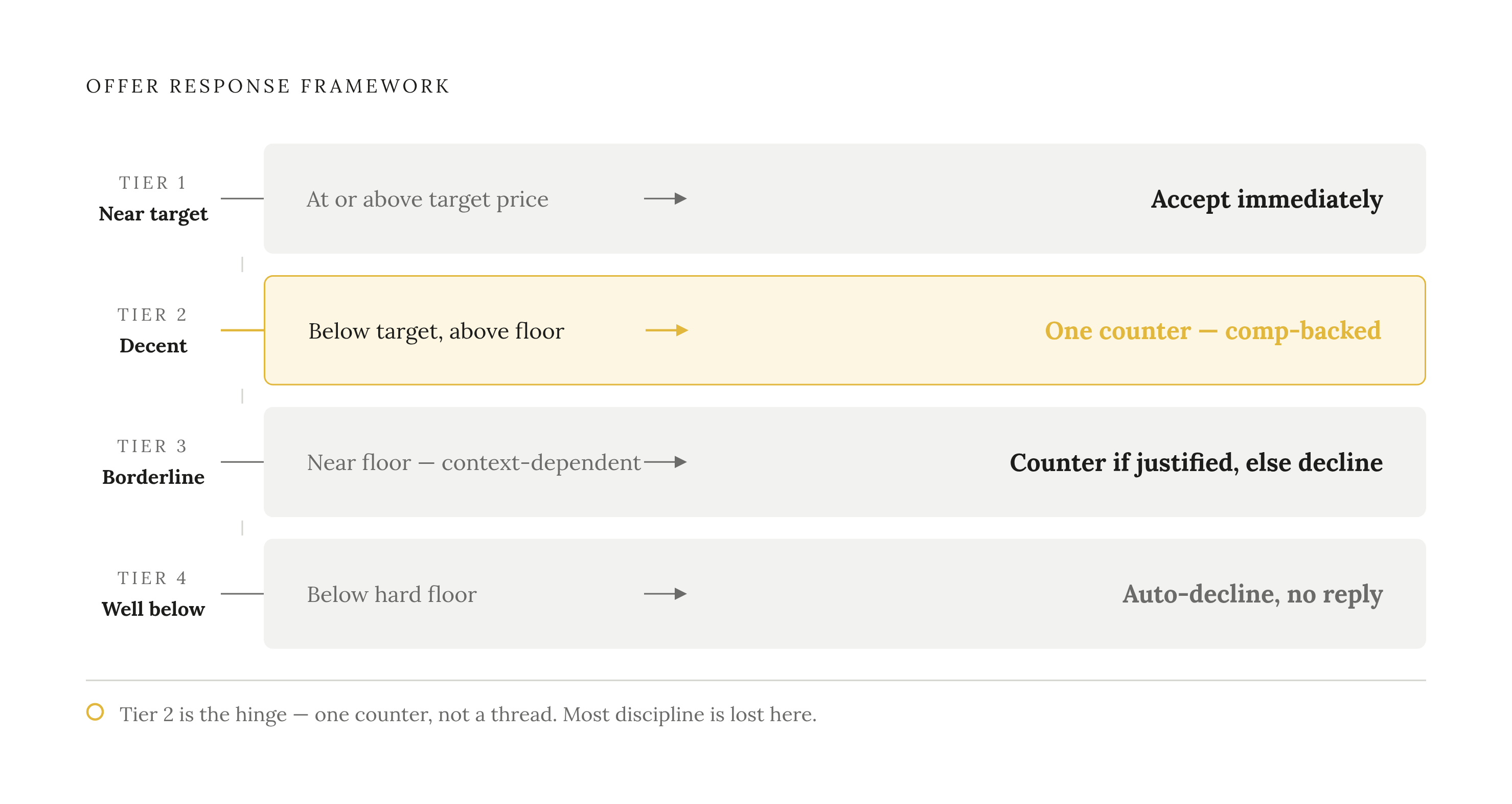
A floor number is only useful if it turns into action fast, before frustration or wishful thinking talks a seller out of it. Underpriced's 2026 guide sorts every incoming offer into four tiers, and each tier comes with exactly one pre-decided move. Offers in Tier 1 land near the target price, so accept on the spot with no negotiation theater, since protecting throughput means not spending time defending a number that's already good. Tier 2 covers offers that are decent but could be better: counter exactly once, backed by the sold-comp data pulled earlier, and skip the long back-and-forth message thread entirely. Tier 3 covers borderline offers sitting close to the floor: counter only if the listing's age or a cashflow crunch actually justifies flexing, otherwise decline politely and move on to the next lead. Tier 4 covers offers well under the floor: auto-decline, no custom reply, no negotiation attempt at all.
The discipline that holds the whole system together sits in Tier 2. The key discipline is one counter, not a negotiation marathon, Tier 2 gets one response, not a thread. Where a counter lands matters as much as whether one gets sent. Countering just above the floor, rather than retreating back to the full original asking price, tells the buyer there's real room to move without handing over the entire discount they asked for. Going straight back to full price after a lowball tells a buyer the conversation is closed. Countering near the floor tells them there's a real number and a seller who knows exactly where it sits. Zoltan Peresztegi's 2026 comments on FastExpert make the identical point in a real estate context: counter at the midpoint between the offer and the asking price, and the midpoint itself becomes the new reference point, giving the buyer room to negotiate down again from there. Counter at the number actually wanted, with a short reason attached, and there's nowhere further down to drag the conversation.
Three scripts do this work without giving away the floor or sounding defensive. A strong counter: "Thanks for the offer. I can do $X today based on condition and shipping costs." A final-range counter: "Best I can do right now is $X. If that works, I can confirm immediately." A decline that leaves the door cracked open: "I can't accept $A, but if your budget is near $B, I can work with that today." Treat these as starting points, not incantations. What matters is a tone that's calm and specific, not the exact words used.
Deep lowballs deserve a different response entirely: none. For deep lowballs, offers well below 50% of asking price, the right move is no response at all. The time math backs this up cleanly. Five lowball messages a day, two minutes spent replying to each, adds up to hours every month spent on buyers who were never going to close the deal anyway. eBay's auto-decline rules exist for exactly this reason: they take emotion out of the equation entirely and hand back the time. Manual countering earns its keep only in the borderline Tier 3 zone, where judgment about listing age and cashflow actually changes the right call.
Listing age should change your counter, not your floor
Time on the market is the one variable that legitimately changes how firmly to hold a line, and it should shift tactics without ever touching the floor itself. Underpriced's 2026 guide maps a counteroffer ladder against how long a listing has been live, and it reads like a schedule rather than a vibe check. For a fresh listing, hold firm, counter with confidence, and offer minimal flexibility while demand is still being tested. In the active window, allow moderate flexibility and a single-step counter ladder, and prioritize quality buyers, defined by Flipper Helper's 2026 guide as anyone whose offer lands within 20 to 30% of the asking price, signaling genuine interest rather than a fishing expedition.
In the aging window, allow a bit more give, but before discounting further, reassess the title and condition language and consider bundling the item with something else. Past day 46, the listing needs an actual decision, not another week of quiet hope: mark it down, bundle it, or move it to a different channel, because leaving a dead listing unmanaged is its own kind of cost.
Peresztegi's FastExpert advice applies just as well outside real estate: a buyer showing up weeks or months into a stagnant listing, with no competing offers and thin traffic, is often telling a seller something true about the price rather than something insulting about the buyer's cheapness. A listing stuck past day 45 without closing usually has one of three things wrong with it. Price is the first, and the fix is checking against current sold data, since comps from three months ago may no longer reflect what's actually happening now. Condition presentation is the second: Underpriced's guide recommends a trust pass on any listing generating a high volume of lowballs, tightening up photos, sharpening the condition description, and spelling out shipping terms clearly. Channel is the third, and repeated lowballs on an otherwise solid listing can be a sign the item is sitting on the wrong platform entirely, not that the pricing is broken.
When the channel is the problem, not the buyer
Moving the item to a marketplace where the buyer pool actually values it correctly can fix what a sharper counter can't. Facebook Marketplace runs on local, cash-in-hand deals, where buyers expect to negotiate and physical proximity drives most of the demand. That makes it the natural home for anything bulky or annoying to ship, furniture, home goods, baby gear, sporting equipment. eBay's buyer pool is national instead of local, and that reach can pull higher bids for vintage pieces, designer items, or anything with collector appeal. Underpriced's 2026 marketplace comparison lays this exact tradeoff out side by side.
Repeated lowballs on a listing that's otherwise priced correctly and photographed well read as a channel signal before anything else. A rowing machine drawing nothing but insulting offers on eBay might sell at full price to the first local buyer who sees it on Facebook Marketplace, simply because that buyer doesn't have to think about a freight quote. The floor stays the same wherever the item ends up listed. The buyer pool that shows up willing to pay it is what changes.