Reselling Websites Specifically for Clothing
Match each item to the app where its buyers actually shop.
There's no single "best" clothing resale app. The right one depends on what you're selling, who buys that kind of thing, and how much fuss you're willing to put up with to sell it. The secondhand clothing market has grown into a genuine industry with so many platforms that a vintage denim jacket, a Lululemon sports bra, and a Chanel bag each have their own crowd of buyers waiting in a different corner of the internet, and shoving all three onto the same app just means fewer eyes, lower offers, and a longer wait for a sale that might never come. Three questions narrow things down fast for any item sitting in the closet: what the platform takes in fees, who's actually shopping there, and how much work the listing demands, from photos to shipping to replying to messages. Keep those three questions in mind, and you can sort out the rest of this guide.
Poshmark: the social marketplace for branded women's fashion
Poshmark is the platform most people picture when they think "sell my clothes online," and it earns that reputation with branded women's fashion. The fee structure rewards higher-priced items and punishes cheap ones: anything over $15 gets hit with a 20% commission, while anything under $15 pays a flat $2.95 fee instead. A higher-priced listing still leaves the seller with the larger share of the sale, which beats watching a flat fee eat a big chunk of a cheap item's price. Below roughly $25, the fee structure starts working against the seller instead of for the platform, so Poshmark performs best above that line.
Shipping got simpler in September 2025, when Poshmark dropped its prepaid label rate from $8.27 to a flat $6.49 for anything up to 5 pounds. On Poshmark, the social layer is the bigger lever over the fee or the shipping label. Once an item sells, funds release three days after delivery, and you get free direct deposit in two to three business days, or you can pay $2 to get it instantly.
Depop: where vintage, Y2K, and streetwear sell
Depop speaks a different language than Poshmark, and it's a younger one. The buyer base skews Gen Z, the aesthetic leans vintage and Y2K and streetwear, and the fee structure backs that up. Depop changed its fees in July 2024, and US sellers now pay zero selling commission. A thrifted vintage denim jacket can sell within minutes on Depop if a buyer has been hunting for that silhouette, but the same jacket might sit on Poshmark for a week, because that audience is shopping for something else. That's category fit doing more work than any fee comparison could.
Depop also offers optional boosted listings at 12%, charged only if the boost actually leads to a sale, so there's no cost for boosting and striking out. Shipping runs through "Ship with Depop," which hands out prepaid USPS labels with scannable QR codes, so no printer is required, just a phone and a post office counter. Modeled shots consistently outperform flat lays on Depop, because its buyers are shopping for a look, not just a garment. If you skip tracked shipping, you wait up to ten business days after the sale closes, but tracked shipping cuts that down to two business days after delivery, plus up to five more days for the bank to process the deposit.
eBay: the strongest platform for men's clothing, odd sizes, and vintage with broad search demand
eBay wins the category that Poshmark and Depop quietly ignore: anything with a buyer out there somewhere, but no natural home on a fashion-first app. Men's clothing is the clearest example. The scale backs this up. eBay carries more than 135 million active buyers, and nearly 40% of clothing, shoes, and accessories sales on the platform come from pre-owned items, with vintage and niche pieces performing especially well.
Odd sizes and hard-to-find sneakers belong here too. A men's size 14 sneaker that gathers dust on a fashion-first app will often move on eBay simply because someone, somewhere, is searching for exactly that size. For pricing research, eBay's Terapeak tool, free through Seller Hub, shows up to three years of sales history including the actual accepted prices on Best Offer transactions, which makes it the strongest pricing resource available, useful well beyond eBay itself. eBay has also rolled out AI listing tools that generate titles and item specifics straight from photos, cutting down the manual entry that used to slow sellers down, especially those listing in volume. For a seller sitting on a pile of menswear or oddball sizes with no obvious home, snapping photos and letting a tool like Reclaim pull live eBay sold data and write the listing before publishing it directly to eBay removes most of the research and typing that used to make this kind of selling feel like a part-time job.
Vinted: zero-fee selling for everyday brands and high-volume closet clearing
Vinted makes the boldest fee pitch in clothing resale: sellers keep 100% of the price they list. You pay no listing fee, no selling commission, and no payment processing charge as a seller. Vinted makes its money differently: it charges buyers a protection fee of 5% plus $0.70 instead. Sellers can pay for optional "Item Bump" promotions, running $0.75 to $5.00, if they want extra visibility on a listing, but nothing is required.
The catch shows up in who's shopping. That trade-off makes sense for everyday branded basics like Zara, H&M, and Nike, along with women's dresses, knitwear, kids' clothing bundles, and activewear, items where the buyer is hunting for a deal on something useful. The platform rewards sellers who clear volume with minimal fee anxiety, but not sellers who chase top dollar on a single standout piece.
Grailed and Vestiaire Collective: the specialist platforms for menswear and luxury
Some items need a buyer who already knows what they're looking at, and Grailed and Vestiaire Collective give you that. Grailed is the main destination for men's fashion, streetwear, and designer menswear. Labels like Supreme, Nike Dunks, vintage Polo Ralph Lauren, and Comme des Garçons have a buyer base on Grailed that's both active and genuinely knowledgeable, a depth eBay and Poshmark simply don't match in this category. Vestiaire Collective covers the luxury side, with authenticated resale for brands like Chanel, Hermès, Reformation, and Isabel Marant. If you used to sell on Tradesy, you should know that platform has folded into Vestiaire, so the experience has changed from what you may remember.
Both platforms ask for patience in exchange for reach. These platforms reward category expertise and a willingness to wait over speed and volume. Specialist demand beats generalist traffic when the item calls for a specialist buyer.
ThredUp and hands-off consignment: when getting rid of it matters more than maximizing return
ThredUp solves a different problem than every platform listed so far. It solves the problem of not wanting to deal with any of it. The mechanics are simple: a seller sends a bag of clothes, ThredUp processes and photographs whatever meets its criteria, lists it, and pays out a percentage of whatever it sells for. A standard bag costs $14.99 to send, a premium bag costs $34.99, both deducted from eventual sales, but sending clothes purely to donate costs nothing.
The payout math is steep, and anyone choosing ThredUp needs to walk in with clear eyes about it. Certain common brands, including Target, H&M, and Old Navy, aren't even eligible for resale earnings unless they sell above $20. ThredUp is built for decluttering with a small financial upside, nothing more and nothing less.
Pricing Used Clothing Before You Pick a Platform
Pricing mistakes usually come from looking at the wrong data. Active listings show what other sellers are hoping to get, not what anyone actually paid, and that gap can decide whether a listing sells this week or is still sitting there next month. Sold listings are the data that counts. eBay's sold filter, along with the free Terapeak tool in Seller Hub, shows real transaction prices, including the accepted amounts on Best Offer sales, not the wishful asking prices still floating around active listings. A tool like Reclaim leans on this same principle, pulling live eBay sold data to suggest a price automatically, which sidesteps the guesswork that leads most sellers to either underprice out of fear or overprice out of hope.
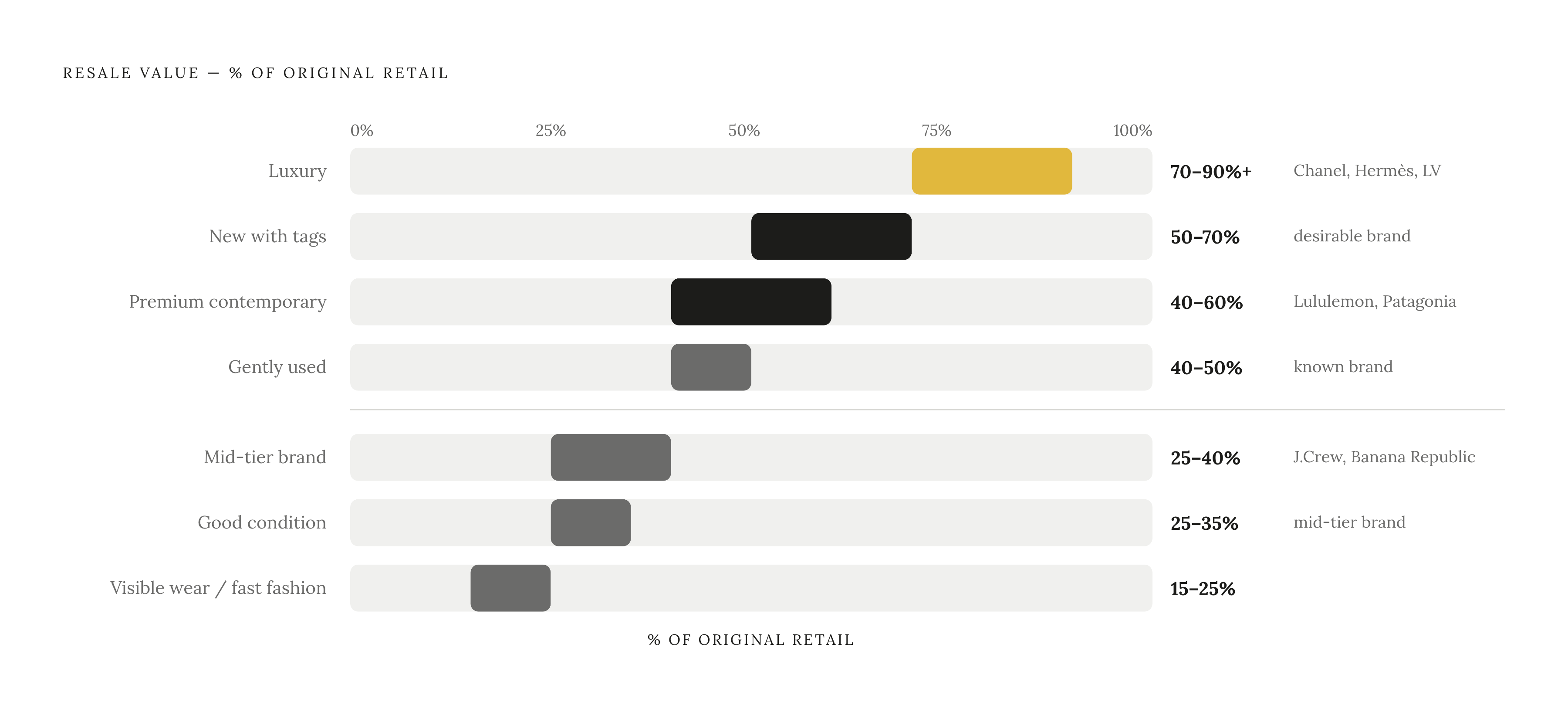
A rough framework can help you set a starting point, and then you adjust for brand. New items with tags still on, from a desirable brand, typically fetch 50% to 70% of original retail. Gently used pieces from a known brand run 40% to 50%. Good condition items from a mid-tier brand run 25% to 35%, and anything with visible wear or from fast fashion drops to 15% to 25%. Brand tier shifts these numbers further, since luxury names like Chanel, Hermès, and Louis Vuitton can command 70% to 90% or more of retail, with some pieces appreciating beyond their original price. Premium contemporary brands like Lululemon, Patagonia, North Face, and Coach run around 40% to 60%, while mid-tier brands like J.Crew, Banana Republic, and Zara settle closer to 25% to 40%.
Kids' clothing breaks the pattern in a good way. Iconic Mini Boden prints can even sell above retail. Timing plays its own role regardless of brand: a winter coat listed in October will sell faster and for more than the identical coat listed in January, so pricing strategy works best when it's paired with a sense of seasonal demand.
What Makes a Clothing Listing Convert
A well-priced item on the perfect platform can still sit unsold if the listing itself doesn't do its job. Photography carries most of the weight. On-body shots consistently outperform flat lays on Poshmark and Depop, because buyers want to see how the fabric actually moves and fits on a real person. Hanger shots are the weakest option on the table, since clothing drapes shapelessly off a wire hanger. If a hanger is unavoidable, a thick wooden or velvet one photographs far better.
Every listing benefits from the same basic shot list: a full front view, a full back view, a close-up of the tag showing brand, size, and material, detail shots of texture or stitching or buttons, and clear, honest photos of any flaws like stains or pilling or damage. Titles matter just as much as photos for getting found. A title like "Royal Blue Silk Button-Down Blouse Size 8" packs in brand, item type, size, color, and material, and search algorithms reward that specificity. Disclosure rounds out the formula. If you disclose small flaws upfront and price accordingly, buyers generally forgive them, but they don't forgive surprises, so a misrepresented item tends to come back as a return, plus negative feedback that follows your account. Condition language should match reality: "new with tags" is at the top of the pricing range, "excellent, worn twice" is a notch below, and visible pilling, staining, or fading pulls the price down meaningfully no matter how good the photos look.
Matching your item to the right platform: a decision framework
Women's fashion from mid-to-high-end brands priced at $25 or more belongs on Poshmark as a first choice, with Vestiaire Collective as the alternative for authenticated contemporary luxury. Vintage, Y2K, and streetwear belong on Depop, where category fit outweighs any fee savings another platform might offer. Men's clothing, odd sizes, and hard-to-find sneakers belong on eBay, because it's the only platform with a buyer pool deep enough to match that kind of niche demand through search. Designer menswear and streetwear from labels like Supreme, Comme des Garçons, Nike Dunks, or vintage Polo belong on Grailed, where that buyer base exists at a depth no other platform matches. Luxury authenticated resale from brands like Chanel, Hermès, Reformation, or Isabel Marant belongs on Vestiaire Collective. Everyday branded basics from Zara, H&M, or Nike, along with kids' clothing and anything being sold in high volume, fit Vinted best, thanks to its zero seller fees and lack of margin anxiety. A large volume of everyday clothing with no time to photograph or ship individually fits ThredUp's consignment model, trading the lowest payout for the lowest possible effort.
None of these choices are exclusive, either. List the same Lululemon top on both Poshmark and eBay at once, and you widen the pool of potential buyers for a bit more listing effort, since the two platforms draw different crowds and don't compete for the same sale. Running an item on multiple platforms at once is one of the simplest ways to hedge against guessing wrong about where the buyer is hiding.
AI listing tools that reduce the friction keeping most sellers from starting
Most people don't have a motivation problem when it comes to selling the clothes piling up in their closet. They have a friction problem. Writing a listing, researching a fair price, and repeating that process item after item is enough work to make the whole pile easy to ignore for another six months. eBay has already built its own AI listing tool, called Magical Listing AI, which can generate titles and item specifics straight from photos and cut down the manual typing that slows down sellers working through volume.
Reclaim takes that same idea further. A photo gets snapped, the app identifies the item, pulls live eBay sold data to suggest a price, and writes the listing itself, then publishes it to eBay and Facebook Marketplace in a single tap, with no comp research or copywriting required from the seller. The stuff sitting in the closet that's been "the one to sell eventually" can go live today instead.