Why Your Resale Price Should Come From Completed Sales Not Active Listings
Sold prices, not asking prices, reveal what buyers actually pay.

Resale prices should start with completed sales that found a buyer. Anchoring to asking prices can substantially inflate your estimate. Sold data gives you the foundation for an accurate price, while condition, demand and platform fees determine how to use it.
Why active listings are unreliable as a pricing signal
A used iPhone 12 can appear valuable when its active listings cluster well above the prices it has actually sold for. Yet dozens of sales in the same period can tell a different story, with buyers paying far less. The asking price has not passed that test. Anyone can list a phone at any price, but typing a number into a box does not establish market value. If it did, clearing out a drawer would count as a plan for retirement.
The distortion grows when an item sells slowly. Unsold listings accumulate because supply outstrips demand, leaving a visible pool of prices buyers have not accepted. A casual seller who copies those prices joins the queue. The mistake is understandable because active listings are easy to find and look like evidence. They record intent.
What sold data actually measures and where to find it on eBay
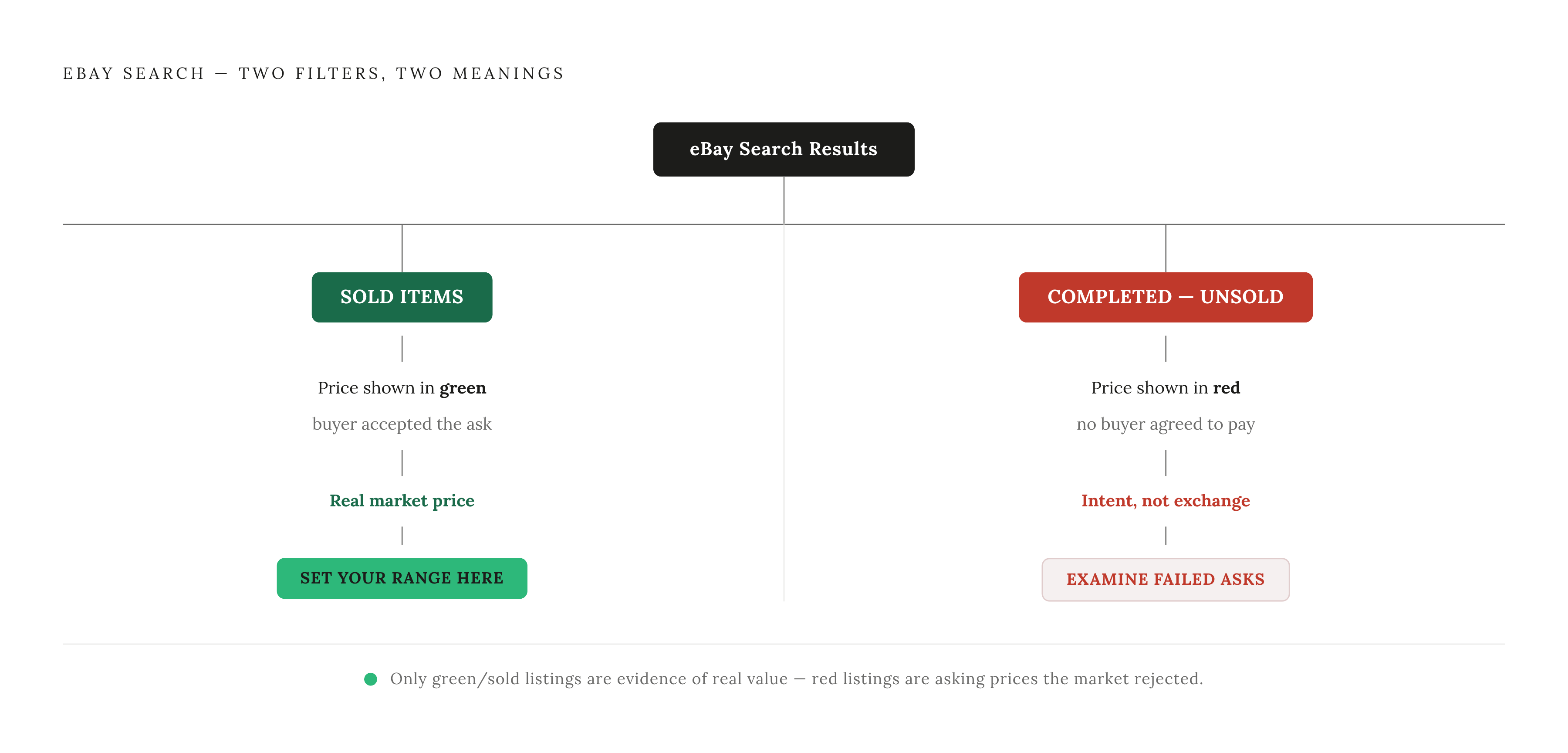
To find evidence of an exchange, search eBay using specific terms, including the brand, model, storage, size and condition where relevant. On desktop, use the left sidebar. On mobile, open Filter. Under “Show Only,” check “Sold Items” and “Completed Items,” then sort by End Date, newest first. This puts recent results first so older ones have less sway over your estimate.
The distinction between the two filters is important. Sold listings have their prices in green and ended with a buyer. Completed listings also show items that never sold, with red or unsold results showing prices that no buyer agreed to pay. Use sold results to establish the price range, and completed results to examine unsuccessful asks. An ended listing alone is not proof of a sale.
eBay keeps standard sold-search data for about 90 days. For a longer view, eBay Product Research, formerly Terapeak and now inside Seller Hub, provides up to three years of sales data. It also shows the Best Offer prices that sellers actually accepted, the average sold price, the sold-price range and the average shipping cost.
How to read the sold data correctly once you have it
Finding a sale is not the same as finding a comparable sale, or comp. Match brand, model, storage, size, color, generation and condition. A 256 GB phone is not a sound baseline for a 128 GB phone, just as a Jordan 1 High is not a Low. Small differences can change the price substantially. Remove parts-only units, misidentified listings and obvious anomalies before reading the remaining cluster.
Use the median of that cluster rather than the average or its most flattering result. A mint item with its original box and a visibly damaged example describe different conditions. One sale does not establish a dependable price. Weight recent sales more heavily because new phone launches, collectible events and seasonal demand can change what buyers pay.
An accepted Best Offer may not display the actual sale price.
eBay’s sold page can show the original asking price crossed out. Treating that number as exact overstates the market. The 130point.com tool shows the offer amounts that sellers accepted but the sold page hides. Also add shipping when comparing prices, because a low item price with substantial shipping is not the bargain its headline suggests.
Sell-through rate: the companion metric that tells you how fast, not just how much
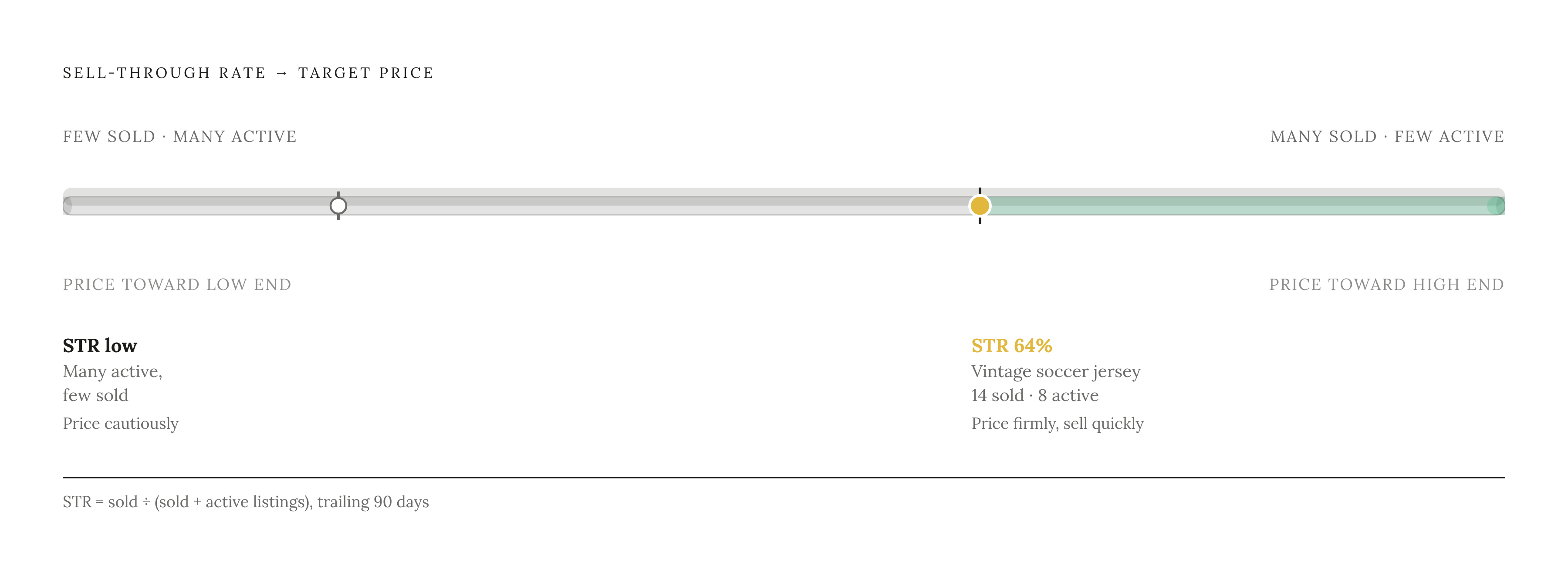
A sold price answers what someone paid, but it does not show how crowded the queue is. Sell-through rate, or STR, shows how much demand there is. For identical items, use a 90-day sold count and divide it by sold plus active listings. Use the same search criteria for both counts. Otherwise, different variants can distort the comparison before any arithmetic begins.
When sold and active counts are roughly equal, demand is healthy enough to support pricing near the top of the sold range. When very few have sold against a large active pool, the lower end is more likely to move the item within a reasonable time. Demand changes both the pricing decision and the number. In the vintage soccer jersey example, 8 active listings against 14 sold gave the seller confidence to price firmly, and the jersey moved quickly.
If every current ask sits above the sold range, could matching an older sale leave money on the table? The spread is useful information, but demand determines how much confidence it deserves. With strong STR, a seller can try the upper end, while weak STR is a reason to be wary of prices set by sellers who are still waiting.
Why a 90-day window matters and what short data windows get wrong
An outerwear price drawn from a narrow slice of sales may describe a seasonal trough or spike. For vintage clothing, holiday items and lawn equipment, the full window, or data from several years, helps show which prices change with the season and which fall in the usual selling range.
For current-generation electronics and popular sneakers, shorter periods can show where prices are heading because so many sell in that time. Items that sell slowly give fewer clues over the same stretch of time. Recent sales deserve weight without treating a quiet week as the whole market. A jacket follows a calendar, even when its owner follows a decluttering deadline.
How platform fees change the price you actually need to set
Once the market range is clear, the next task is to calculate what you would keep. A sold comp is revenue. The brief’s eBay fee figure for August 2026 is 13.6% plus a per-order fixed fee in most categories. That deduction can turn an apparently promising pair of shoes into a poor use of your time.
For a rough estimate, multiply the comp by 0.86, then subtract acquisition cost and outbound shipping. This is a shortcut because the fixed fee still needs attention. If the remaining margin is not meaningful, the flip is not worth the work. The price tag should not be the only number allowed into the meeting.
Platform choice changes that calculation too. Depop, a good fit for vintage clothing and Y2K fashion, charges a small processing fee made up of a percentage and a fixed amount, while another resale platform charges new sellers more. The same sold comp can therefore leave a seller with different amounts after fees on different platforms. Fees belong in the pricing decision, but they do not make buyers willing to pay more than the market supports.
What sold data reveals in specific categories most casual sellers underestimate
Patagonia Synchilla Snap-T pullovers illustrate why research can prevent underpricing as well as overpricing. Their sold data shows a consistent median across over a hundred sales. That is a stronger basis than treating one as an ordinary used fleece or copying an ambitious current ask. The label changes the comparison you need. These results show how to use the method, but prices can change, so each seller still needs current comps.
Electronics offer a similar lesson in precision. The iPad Pro 11-inch 2nd gen has a steady median across dozens of sales, which gives a clearer sense of what that exact model sells for than a broad search for used tablets. Home goods can hide value less obviously. Le Creuset Dutch ovens found in thrift stores often sell for well over a hundred dollars, while vintage Lodge and vintage Griswold cast iron hold value. Even rusted pans can be restored and resold.
Depending on its brand, a used jacket can have meaningful resale value or little appeal. A recognizable label deserves a different search from an unbranded item. Vintage single-stitch, 1990s band tees also need a careful check of exactly what they are, as Nirvana tour tees sell for hundreds of dollars. Quality denim, outerwear and workwear are reliable winners in the notes’ examples. The opportunity lies in recognizing what the item is before deciding what it is worth.
Where the "only look at sold, ignore active" rule breaks down
A sneaker seller may find that every active listing asks more than the sold comps show. Simply setting the price at what sold before could mean earning less than a seller who is willing to wait. Sold data remains the foundation. Active prices describe the current alternatives buyers face, while STR helps judge whether the gap offers room to price higher or simply reflects stalled stock.
In practice, a seller in that position should use the spread as a working range, entering higher when STR is strong and lower when it is weak. This is different from copying the cheapest sold result by default. A race to the bottom is a real risk if every seller follows that habit. Pricing near the top of a justified range means distinguishing a defensible ask from a wish.
How do you research accurate resale prices without spending an hour per item?
The practical workflow is to search precisely, filter to sold and completed results, and read a cluster of 10 or more recent comparable sales. Check condition, shipping and Best Offer flags before working out how much is likely to be left after platform fees. Doing that research by hand takes several minutes per item. At a thrift store or estate sale, the work can accumulate faster than the pile of promising finds.
To save clicks each time on desktop, bookmark an eBay search that has the URL parameters &LH_Sold=1&LH_Complete=1. Mobile-friendly tools can also put filtering and price calculations on one screen. Snap-to-value tools shorten the search further by identifying an item from a photo and returning sold comps. The useful shortcut reduces searching while preserving the evidence. A fast number based on the wrong variant is still the wrong number.
AI-powered listing tools can take this workflow further by working out what an item is, grading its condition, using real data to price it and writing its description. Condition grading is useful because the chosen condition needs to match the comps used to price the item. The same distinction applies to pricing itself. A tool that brings back actual sold comparisons works better for this method than one that just repeats active asks. Compressing those tasks can close the gap between knowing something has value and getting its listing published.
Listing quality and scam avoidance: what sold listings also teach you about how to write a winning post
Sold listings offer clues about presentation as well as price. Condition phrases such as “tested,” “authentic” and “original box” appear in successful listings because they signal legitimacy and reduce hesitation. Use them only when they describe your item. A complete description should include brand, model, condition, dimensions, pickup area or shipping preference, payment method and defects. Honest flaws are less expensive than angry surprises.
Clear terms also leave less room for a scammer to steer the conversation. For local listings, wording such as “cash or verified Zelle only” and “pickup near [area]” reduces ambiguity and low-intent inquiries. Never accept personal checks, cashier’s checks or money orders, which can be forged and take weeks to bounce. Refuse overpayments paired with requests to refund the difference. If a buyer claims Zelle requires a “business upgrade,” stop because that is a known payment-app scam pattern.
High-value local sales need care beyond the description. Write down serial numbers, remove personal data and check the ownership documents. For phones, erase the device only after completing backups and account removal. These steps address a different risk from pricing, but they belong to the same transaction.