Common eBay Scams Targeting New Sellers
New sellers face predictable scams that exploit their inexperience with eBay's systems.
Common eBay Scams Targeting New Sellers.
Why new sellers are the preferred target for eBay scammers
eBay is enormous, and that's exactly the problem. Roughly 136 million active buyers across 190 countries spent about $79.6 billion on the platform in 2025 Moonlock eBay scams 2026. A marketplace that size draws honest buyers looking for a deal, and it draws scammers looking for an opening, in roughly equal measure.
New sellers happen to be that opening. According to an informal video discussion cited by a seller-side screening resource, 45% of scam attempts target new sellers specifically Digital Footprint Check eBay buyer scam. It's a target selection process, and it makes sense once you think about who's easiest to fool: someone who's never seen what a normal transaction looks like won't notice when something's off. Someone who doesn't know eBay's buyer protections inside and out won't see them coming when a buyer weaponizes them. And someone shipping their first few orders probably isn't photographing serial numbers or weighing packages before they seal the box, simply because nobody told them to.
None of this means eBay is a bad place to sell. Most transactions go through exactly as they should, and the platform's scale is a feature, not a bug, for anyone building a resale business. Industry estimates put eBay seller fraud losses somewhere between $1,500 and $5,000 a year, which is a rough year for a casual seller and a genuine dent for anyone treating this as a side income Underpriced eBay scam prevention guide. Scammers running these plays are working from scripts that exploit specific, predictable gaps in a new seller's knowledge, and once you can name the scripts, you've already closed most of the gap.
How scammers use eBay's own buyer protections against sellers
eBay's Money Back Guarantee is a genuinely good policy. It protects buyers from getting ripped off, which is the entire reason anyone trusts the platform enough to buy from a stranger in the first place. A system built to default toward trusting the buyer can be turned around and pointed at sellers who did nothing wrong.
When a buyer files a claim, saying the box arrived empty, or the item wasn't as described, the process leans toward issuing a refund first. The burden of proving otherwise lands on the seller. That's not a flaw exactly; it's the tradeoff eBay made to keep buyers confident enough to keep shopping. But it means a new seller without documentation is arguing against a system that's already inclined to side with the other guy.
The scam, the chargeback, and the dispute get lumped together in seller anxiety, but they're three separate things. The scam is the actual move, the trick that gets money or merchandise released before anyone's even filed a complaint. A chargeback or Money Back Guarantee case is what happens next, once a bank or eBay's Resolution Center gets involved. New sellers often mix these stages up. They respond to the wrong process at the wrong time, or realize too late that the window to act has already closed.
One line dictates outcomes across this entire topic: eBay's protections only apply inside eBay's own systems. The moment a payment or a conversation moves off-platform, both sides lose that safety net, buyer and seller alike. Internalize that boundary before the first sale ships, because everything else in this piece is really just variations on what happens when that line gets crossed. Non-payment and non-delivery schemes cost victims $309.6 million in 2023, per the FBI's IC3 report, as cited by chargeflow.io, indicating that the fraud category eBay scams fall into carries substantial scale.
Return fraud: the most damaging scam category new sellers face
If there's one category that costs new sellers more than any other, it's INAD, Item Not As Described return fraud. It's overtaken Item Not Received as the primary threat sellers face, and the reason is almost administrative: eBay's policies make it easy to open an INAD case with minimal evidence. A buyer doesn't need much to start the process rolling, and once it's rolling, the seller is the one playing defense.
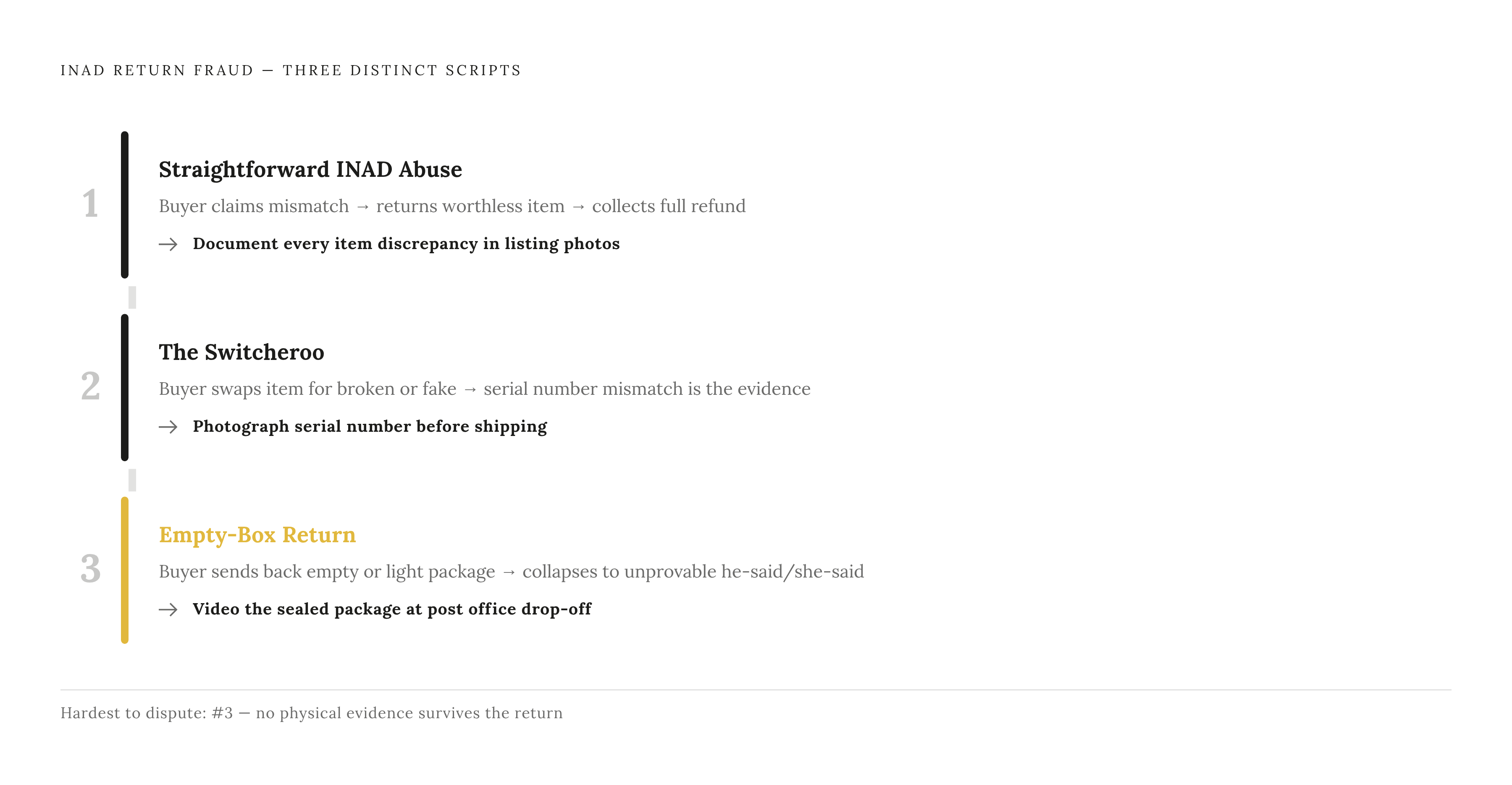
Three separate versions of this scam are worth knowing by name, because each one calls for a slightly different kind of proof.
The first is straightforward INAD abuse. A buyer claims the item doesn't match the listing, sends back something worthless or completely unrelated, and collects a full refund. The seller loses the item and the sale price in one move, about as clean a theft as exists on the platform.
The second is the switcheroo. The buyer returns a broken, fake, or entirely different item in place of what actually got shipped. Recording a serial number before shipping turns a resolved case into a lost one or vice versa, because a mismatched serial number is hard evidence, not a story.
The third is the empty-box return. The buyer sends back a package that's empty or suspiciously light, and without a pre-ship weight record or video, it collapses into a "he said, she said" that nobody wins cleanly. A forum post from eBay's own seller community describes exactly this: a buyer claimed the item didn't match the photos, mailed back an empty box, eBay forced the refund anyway, and the seller ended up filing a police report over what was, functionally, theft.
One specific request should raise a flag every time: a buyer asking for a refund before the item ships back, or asking to use their own return label instead of eBay's prepaid one. That's a buyer trying to route around the tracking and documentation eBay's own system would otherwise generate automatically.
The fix isn't complicated, it's just a habit most new sellers haven't built yet. Photograph the item, the serial number, the packaging, the label, and the package on a scale, every single time, before it leaves your hands.
Payment manipulation: overpayment schemes, fake confirmations, and off-platform requests
These scams all lean on the same lever: urgency. Get the seller to ship before the money's actually confirmed, or get the seller to move part of the transaction outside eBay's systems where nothing is protected anymore.
The overpayment scam runs like this. A buyer sends more than the asking price using a payment method that later turns out to be fraudulent, then asks for the difference back through a different channel, Zelle, PayPal Friends and Family, a wire transfer. The original payment fails or gets reversed later, but by then the seller has already refunded the "extra" money and shipped the item.
Fake payment confirmation is simpler and just as effective. A scammer sends a forged screenshot or email that claims payment went through. A seller who's never actually looked closely at eBay's own payment dashboard might ship based on that email alone, because they don't yet know what the real confirmation is supposed to look like. The rule here doesn't bend: check for cleared funds inside eBay's own system, never off a forwarded screenshot, no matter how official it looks.
Off-platform payment requests usually get dressed up as a favor to the seller. A buyer offers a discount in exchange for paying through Zelle, Venmo, PayPal F&F, a wire transfer, crypto, or gift cards. It sounds like the buyer's doing the seller a solid by skipping eBay's fees. It isn't. Wire transfers, gift cards, cryptocurrency, Cash App, Venmo, Zelle, anything that steps outside eBay's own rails, should be treated as a closed door, not a discount. Gift cards deserve their own callout here: a gift card code functions like handing someone cash on the street, and once it's spent, there's essentially no getting it back.
Account-level attacks: phishing, fake eBay emails, and credential theft
Everything above is about losing one transaction. Account takeover is a different order of problem entirely, because instead of losing a single item, a seller can lose their whole feedback history, their payout account, and every listing currently live.
The mechanics are familiar to anyone who's used email in the last decade: a phishing message dressed up to look exactly like eBay, pointing to a fake login page built to harvest the seller's username and password. Once an attacker has that, they can relist inventory under the real seller's name, redirect payouts to themselves, or run fraudulent sales riding on a feedback score somebody else spent months building. New sellers are especially exposed here, mostly because they haven't yet developed a feel for what a genuine eBay email looks and sounds like versus a convincing fake.
A close cousin is the fake PayPal email, built to look exactly like a real PayPal notification, designed purely to harvest login credentials or personal details. There's also a version that happens over the phone: fraudulent support numbers set up to look like eBay customer service, where the scammer pressures the caller for login details or payment information once they've got them on the line.
A few things should trigger an immediate pause: a password-reset email that wasn't requested, a payout account that changed without the seller's involvement, or any message claiming the account is locked or a payment failed. In every one of those cases, go directly to eBay's site rather than clicking anything in the email. Suspected spoof emails have a dedicated reporting address, and turning two-factor authentication on, plus typing ebay.com into the browser by hand instead of clicking a link, closes off most of this category before it starts.
Emerging and less obvious scams that catch even cautious sellers
Some of the newer scams don't look like scams at all, even to sellers who've already learned to spot the obvious ones.
AI-generated listing fraud is the clearest example. Scammers now use AI image generation to produce photorealistic listings for vehicles and products they've never owned. Because the images are generated rather than lifted from somewhere else online, a reverse-image search comes up empty, which used to be the go-to check for exactly this kind of fraud. The pattern tends to repeat: a price well under market value, a convenient excuse for why the item can't be seen in person, and a payment request routed through wire transfer or gift card. Knowing roughly what an item should sell for turns out to be one of the better scam detectors available, because a price that's too good has usually been priced that way on purpose.
Feedback extortion works on anxiety rather than technology. A buyer threatens negative feedback unless the seller hands over a refund outside the normal return process, and new sellers, worried about a feedback score that's still thin, are the most likely to fold under that kind of pressure. The right move is to screenshot everything and report it to eBay directly, not to negotiate privately in the hope the buyer goes away quietly.
Triangulation fraud flips the usual script. A scammer lists an item on eBay, takes a buyer's payment, then goes and buys that same item from a retailer using a stolen credit card, shipping it straight to the original buyer. In that setup, the person actually harmed as a "seller" is the buyer receiving stolen goods without knowing it, and the tell is a package arriving from a retailer nobody in the transaction actually ordered from.
There's also a slower version of the con: feedback laundering. A scammer builds up a clean-looking feedback score by selling cheap, ordinary items for a while, then pivots to selling expensive fakes once the account looks trustworthy. The lesson for a seller isn't about selling, it's about screening incoming buyers, too: a brand-new buyer account with zero feedback making a play for a high-value item deserves a second look, every time. The scale of counterfeit activity on the platform backs this up. eBay pulled roughly 7.9 million counterfeit or prohibited listings in 2025, which says fake-item fraud isn't a fringe problem, it's common enough that eBay has to fight it at the platform level Chargeflow eBay scams 2026 guide.
Red flags to screen before shipping anything
Scams rarely open with an obvious red flag. They tend to start small, a minor favor, a slight deviation from how the transaction was supposed to go, something that on its own barely registers as odd.
Watch the buyer's account first. A brand-new account with little or no feedback buying something expensive is a signal to watch closely. So is a buyer profile carrying a pattern of returns, refunds, or negative feedback left by other sellers. A request to change the shipping address after the purchase already went through, especially to a different country, is a genuine warning sign, not a quirky preference. So is a buyer pushing hard for fast shipping before payment has actually cleared, or a new account suddenly buying multiples of the same high-ticket item. And any request to talk or transact outside eBay's own messaging system should be treated as disqualifying on its own, regardless of how reasonable the excuse sounds.
Then there's the transaction itself. Requests for personal information that has nothing to do with completing the sale don't belong in a normal exchange. A payment confirmation arriving by email instead of inside eBay's dashboard is a fake until proven otherwise. And any ask to use a non-eBay payment method, no matter how it's framed or how good the discount sounds, is the same request wearing a different costume.
The pattern to watch for isn't one big red flag, it's a sequence of small ones stacking up. A buyer asks to ship a day early. Then asks for a slightly different delivery address. Then asks for a partial refund handled off to the side, outside eBay. Each step alone looks like a reasonable, low-stakes request. Together, they're a buyer quietly walking the transaction outside of eBay's documented record, one small favor at a time, until there's no paper trail left to defend the seller if something goes wrong. Online purchases made up 41% of all global scams in 2023, so treating every pre-shipment check as routine is just good practice, not an overreaction Bitdefender eBay scams 2026.
What to do before every shipment to protect yourself if a dispute is filed
Winning a dispute almost never happens after the fact. It gets decided by what got documented before the box ever left the house. Prevention isn't just the better strategy, it's really the only one that works.
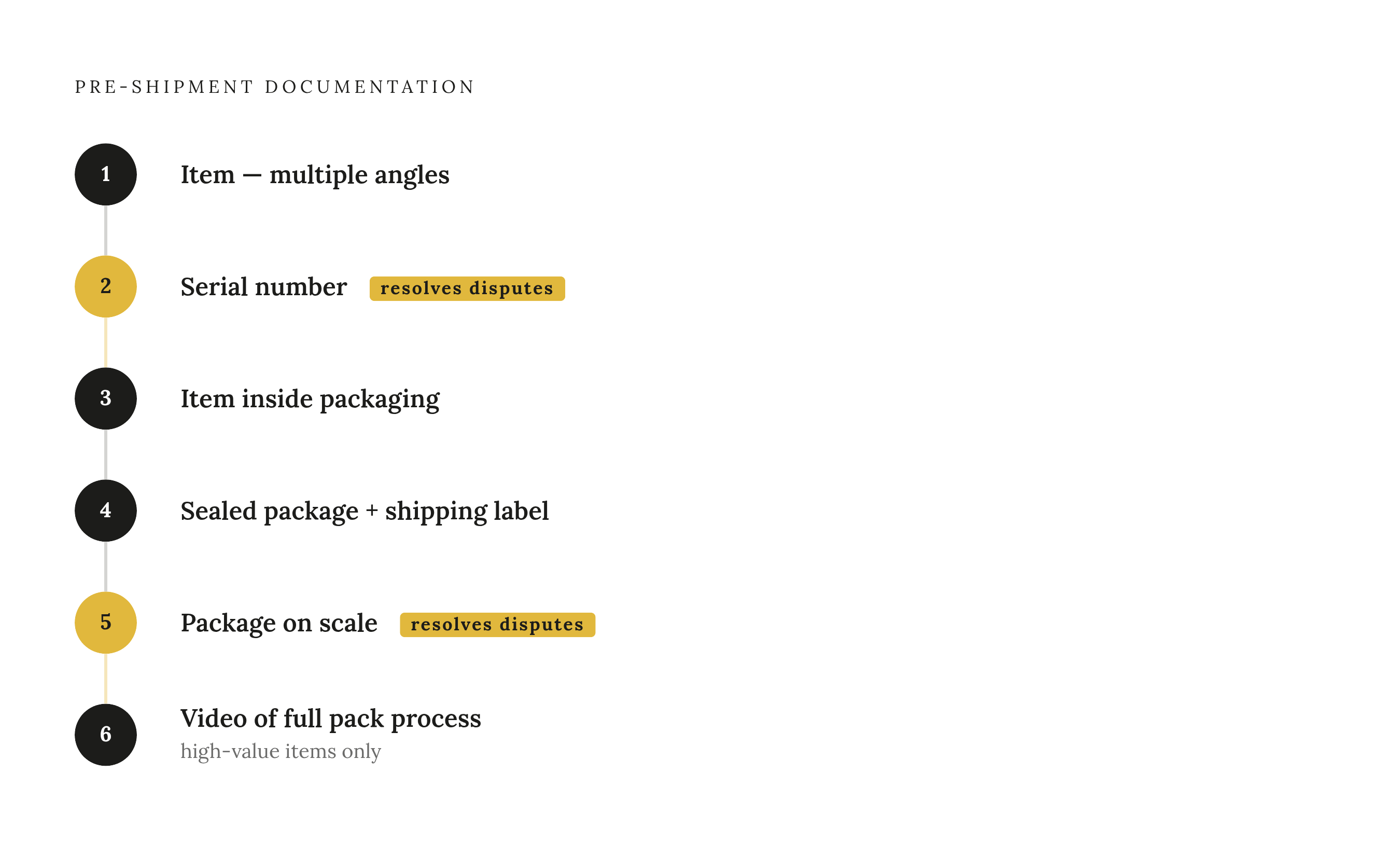
Before every shipment, photograph the item from several angles, catching any identifying marks or existing flaws, as a fixed routine. Photograph the serial number if the item has one, since that single photo is often what separates a resolved switcheroo case from a lost one. Photograph the item sitting inside the packaging, then the sealed package itself, the shipping label, and the package sitting on a scale so the weight is on record. For anything high-value, record video of the entire packing process from start to finish, since video is the strongest evidence available against both empty-box claims and switcheroo returns.
None of this takes long, maybe a couple of minutes per shipment. A seller who can point to hard evidence when a dispute lands fares differently than a seller stuck arguing their word against a buyer's, with eBay's own system already leaning toward the buyer by default.