Why the Condition Grade Comes Before the Price Tag Every Time
Grade the item honestly first, then match sold comps to that tier.

Condition grading comes before pricing because it determines which sold items are valid comparisons for yours. An accurate resale price starts with inspection, then uses actual sold transactions for items in matching condition. AI photo-to-listing tools can shorten that workflow, but they cannot make a hidden defect disappear.
Why casual sellers grade condition last — and what that sequence costs them
A seller picks up a wool coat in a Goodwill aisle, likes the fabric and brand label, and calls it “Excellent.” The lining never gets checked. The coat goes into a listing, then off to a buyer, who finds a four-inch seam separation under the left interior pocket. ScanFlip’s condition guide uses this example to show where grading goes wrong. The buyer’s photograph reveals the problem, but the mistake happened when the seller assigned a grade before finishing the inspection.
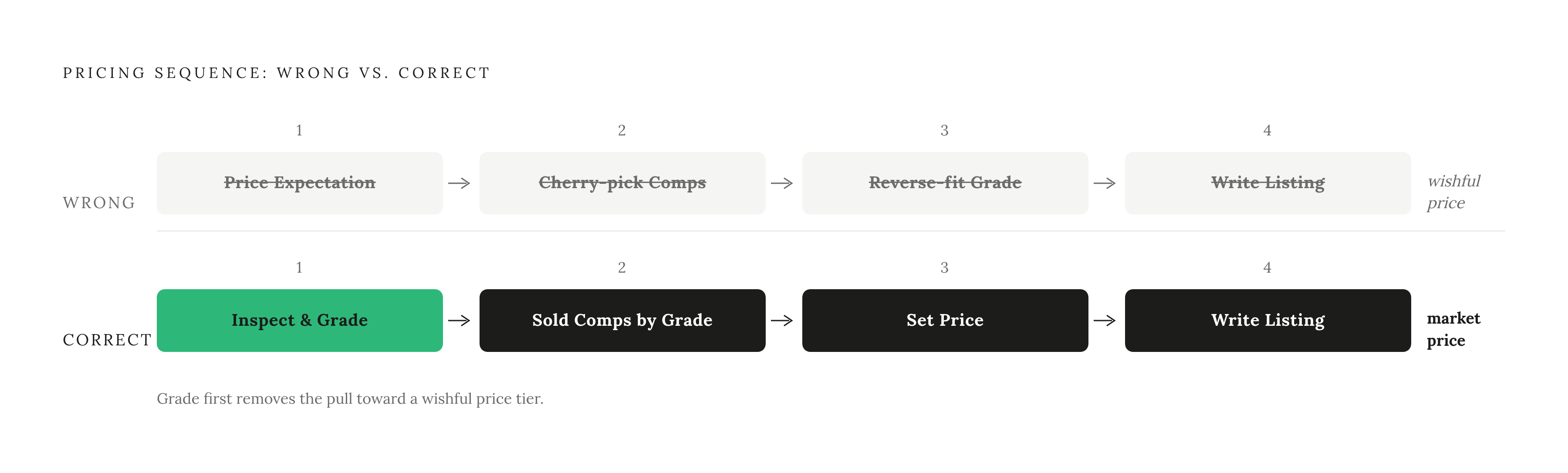
That shortcut fits a familiar selling routine. First comes a price expectation, then a search for listings that support it, and finally a condition label that does not obviously contradict the chosen comparison. The expectation may come from what the seller paid, needs, or hopes to receive. None describes the coat’s condition.
What the overcalling mistake actually costs — beyond the one lost sale
An overcalled grade can turn a completed sale back into unsold inventory. The buyer opens a return request, which brings return shipping or partial-refund negotiation, followed by relisting work if the item comes back. The seller has not simply lost the original transaction. They now have more work attached to the same item, plus the possibility of negative feedback.
The guide identifies overcalling as the most expensive grading error for newer resellers because those costs compound. A higher gross price can leave the seller with less money after costs than an honest sale at a lower grade. Feedback also follows the seller beyond that coat, potentially weakening visibility and buyer confidence on later listings. A lower but defensible grade often avoids that chain because the buyer receives what the listing promised. The question, then, is how to establish that grade before a hopeful price gets a vote.
The six condition tiers resellers actually use and what each one requires to defend
The guide sets out six working condition tiers. A defensible grade reflects a complete physical inspection, with every material issue documented and the item graded down to the level its defects require. Appearance alone does not settle the question. For clothing, inspection includes turning the garment over, lifting its lining, feeling along seams, and checking for odor.
New With Tags, or NWT, means unworn with the original retail tags attached. New Without Tags, or NWOT, means unworn with tags removed or absent. It also requires no wash wear, odor, stains, stretched elastic, or storage damage. An unused item can still have damage from storage.
Excellent means the item has barely been used and has no flaw that matters when checked in the usual way. Light handling marks may fit, but pilling, discoloration, and missing parts do not. Very Good allows light, everyday use as long as the item still looks good and can be used fully. Small pulls, light creases, and faint marks on the surface can fit if the seller points them out. Wear decides the grade, regardless of how much status the brand has.
Good means noticeable wear is present, but the item remains usable. Pilling, seam wear, scratches, stains, and heavier creasing belong in the notes, with their location and severity named. Fair / For Parts covers substantial damage, limited or untested function, missing parts, or repair that affects the buyer’s decision. The operative rule is to grade the defect the item has.
How do you get an accurate resale price from sold items in matching condition?
A sold price records what a real buyer paid in a closed transaction. An asking price records what a seller hopes to receive. Those are different kinds of evidence. An active listing may support a seller’s ambition without showing that any buyer shares it. Using asking prices as proof can inflate expectations before inspection even begins.
For a sale to be a useful comp, an item with the same name or a similar look in a search result must also match yours in condition. Otherwise, the price reflects a different proposition for the buyer, such as a nearly unused item rather than one with visible wear or a repair to consider.
The practical change is to finish grading before searching for comps. Searching first can draw the seller toward the condition tier that goes with the price they want. Grading first reverses that pull. The confirmed tier becomes a filter, so the search returns evidence about what buyers paid for equivalent condition rather than evidence recruited to defend an expectation.
Access to sold data also affects the process. Facebook Marketplace does not show sold-price history the way eBay does. The practical workaround is to search the item on eBay with sold listings selected, then use matching-condition transactions as a starting point for a Marketplace price.
How much the condition tier is actually worth in price, by category
Condition does not change value at one fixed rate. Its price effect depends on the category, so the same grading slip can have very different financial consequences. Coins and stamps are especially sensitive. A one-grade difference can mean a tenfold price change, so a small difference in grade can have a huge effect on what the item is worth.
Furniture shows why “better condition” cannot always mean “looks newer.” A Chippendale chair with its original finish could be worth many times more than the same chair with a bad refinishing job. Furniture and folk art can otherwise be more forgiving, with some collectors valuing honest age and patina over restoration. In that setting, Good with disclosed wear can be more desirable than Excellent with signs of intervention.
Books have their own condition trap. For modern first editions, meaning post-1920s, the dust jacket can represent the majority of the book’s worth. Its condition therefore needs a separate grade from the book itself. An intact book does not settle the valuation if the jacket has problems, just as clean upholstery would not settle the question of a chair’s original finish.
A crack in porcelain, a replaced chair leg, or a repainted toy surface can substantially reduce value on its own. The rest of the piece may look great. That is why comprehensive inspection is necessary even when the first impression is strong, since the price-changing defect is not obliged to sit where the seller first looks.
Platform vocabulary differences that make the same grade mean different things in different markets
Condition grading takes some judgment, and marketplaces do not all use the same terms. An honest label on one platform may not map neatly to the same word elsewhere. That is a real limitation. This limitation means a condition match requires more than finding identical words in two listings.
Some categories have established third-party grading standards. PSA and Beckett serve sports cards, PCGS/NGC serve coins, and CGC serves comics. In those markets, a generic Excellent label can signal unfamiliarity to serious collectors and reduce the realized price even when the item is genuinely excellent. The calibration step is to read condition in the market’s own terms before treating a transaction as comparable.
For ordinary self-grading, the practical rule is conservative. Grade one level below the initial instinct, and when in doubt, grade down. A flaw that seems small to a seller grading an item Excellent can look far more prominent to a buyer, who may call the same item Very Good. Specific disclosure helps resolve that gap, since a photograph of a small scratch offers clearer evidence than “minor wear.” Listings with located flaw disclosures have lower return-request rates than listings that leave buyers to interpret vague language.
How AI grading is making condition accuracy pay more than it used to
Used-item buyers have historically demanded an uncertainty discount not just for wear, but because they could not verify a seller’s description. AI-assisted grading addresses that second problem. A documented standard with photographic evidence gives buyers something more concrete than a seller’s confidence. It also narrows the familiar dispute in which one side says Good and the other says Fair.
Assurant used AI-assisted diagnostics to process 13 million+ devices around the world in 2025, and its recovery network reached downstream partners in dozens of countries. The consequence extends beyond professional device recovery. Buyers who encounter consistent, evidence-backed grades in those channels have more reason to question vague self-grading elsewhere, even when the individual seller means well.
eBay has also rolled out a conversational AI shopping agent to a small percentage of U.S. customers. Its 2026 outlook describes a shift toward agentic commerce, including agents verifying provenance, optimizing payment and delivery, and executing complex cross-border transactions end-to-end. That outlook points toward a way of finding items that leaves sellers more at risk when their condition descriptions are vague or do not agree.
For casual sellers, ScanFlip’s AI-powered photo-to-listing approach fits the same movement toward identification, condition assessment, and listing generation in a shorter workflow. The useful compression is in the work between seeing an item and describing it consistently. It is not permission to skip physical inspection. A photo cannot replace checking a hidden seam or smelling fabric, and a condition assessment still needs sales of items in the same condition to back up a price.
The practical inspection-first routine that makes grading fast enough to actually do
The obstacle to inspection is often pace: a slow ritual feels incompatible with casual selling, particularly when every item needs a description and a price as well. A short, repeatable check targets the defects that cause returns.
For clothing, the guide gives four steps. Flip the garment and check the back, hem, lining, and inside panels. Lift the lining to look under pockets and along hidden seam joins, then run two fingers along each seam to feel for separation or loosened stitching. Finally, smell the fabric for mildew, smoke, perfume, or storage odors. Odor counts toward the grade just as wear that can be seen does, even though the camera is politely silent about it.
For collectibles, shift attention to the single-flaw scan. Look for a crack, replaced component, or repainted surface that changes the grade regardless of the rest of the piece. For electronics, check function before cosmetics. An untested button or battery of unknown health belongs in the condition note, and the guide specifically places untested buttons in the lower Fair / For Parts classification.
After checking the item, write down where each flaw is and how bad it is. “Small scratch on bottom-right corner of screen” gives a buyer usable information, while “minor wear” leaves the meaning open to dispute. ScanFlip can shorten the photo-to-listing work through AI identification, condition assessment, and listing generation without changing the order of decisions. Confirm the grade, search sold comps filtered to that grade, set the price from those transactions, and write the listing to match. Grade, then comp, then price, then list.