Resale Apps That Read Condition From a Photo and Pull Prices From Completed Sales
Photo-to-price apps only help when prices come from sold items.

Resale apps that assess condition from a photo are most useful when they connect three steps, namely precise identification, condition grading, and prices from completed sales. Underpriced explicitly uses sold data, while FlipAI uses active listings and Flip describes “live eBay listings.” Trust in AI condition grading and real-data pricing depends on whether the price comes from similar items that buyers actually bought or from what sellers hope to get.
Why asking prices mislead sellers and sold prices do not
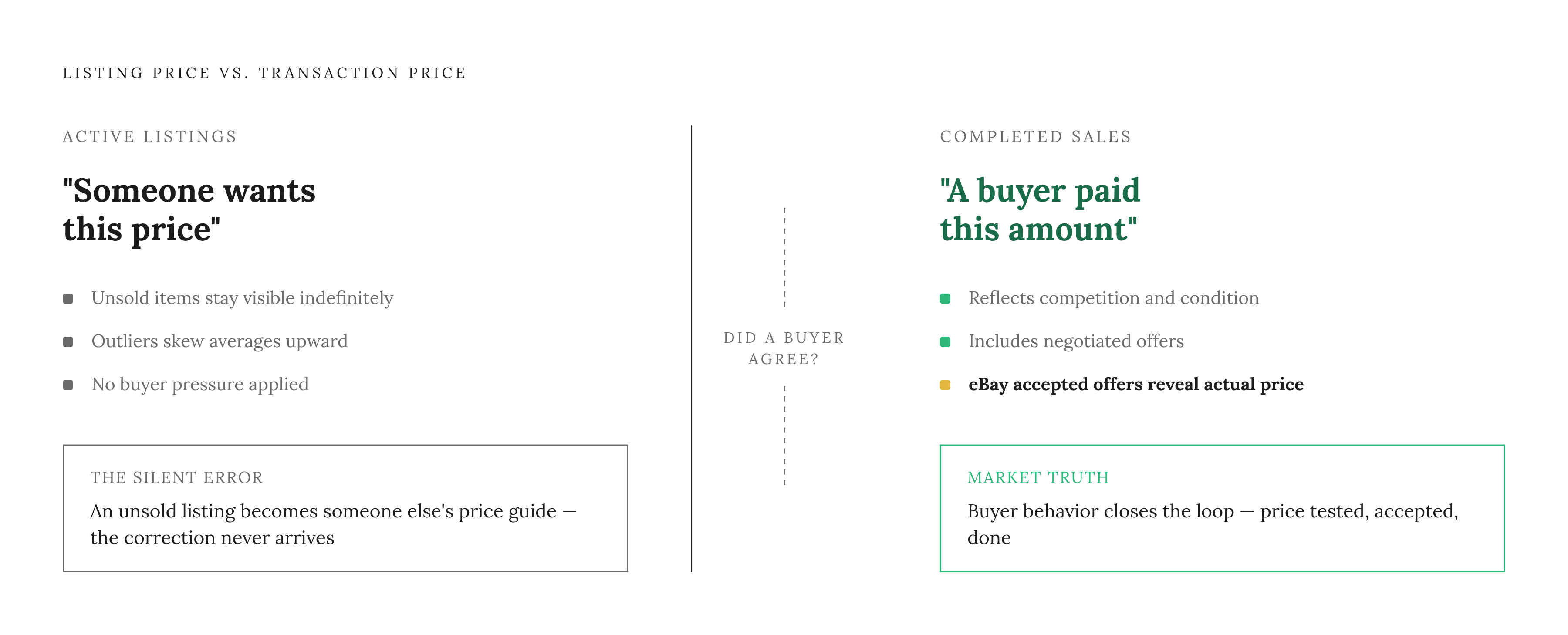
An active listing proves that someone wants a price. An overpriced item can sit unsold for months or years and quietly become the price someone else uses as a guide. That is wishful thinking with a search ranking. High-priced outliers make the problem worse because they can make an ordinary used item look much more valuable than recent transactions suggest.
A used Nintendo Switch OLED illustrates the gap. Its median sale price in one week was well below active asking prices, and 16 more sales had accepted offers whose actual prices eBay did not show publicly. Those hidden discounts complicate even sold-price research. An eBay “Best offer accepted” strikethrough means the buyer paid less than the displayed ask, but only eBay’s own Product Research tool surfaces the actual accepted-offer price.
Completed sales also provide context beyond the amount. They show when the transaction happened, whether it was an auction or Buy It Now, and approximate demand volume. The exact price paid is available where it is disclosed. Together, these details distinguish a repeatable market price from an ambitious listing enjoying a very long holiday.
How the three-step chain inside a photo-to-price app actually works
A trustworthy photo-to-price workflow starts with a specific identity. A vision AI model needs to identify the brand, model, era, and variant. “Cuisinart DLC-7 Pro” produces usable comparisons, while “food processor” produces noise. Some tools run independent recognition passes that must agree before the price lookup begins. When several models look alike, asking the seller is better than guessing, and Flip’s version 1.4.0 release notes document a “Which one is it?” prompt for that situation.
Condition grading then narrows the comparison further. The image is examined for visible wear, scratches, flaws, missing parts, and completeness. The grade should change which comparable sales get selected. Otherwise, a worn item can get a price pushed up by mint-boxed examples. A useful output pairs the condition label with a price range supported by items in a similar state.
The final step queries completed sales using that identity and grade. eBay retired its findCompletedItems API on February 4, 2025, while its Browse API returns only active listings. Marketplace Insights is a Limited Release API restricted to previously approved developers and is not open to new users. Third-party data pipelines therefore play a critical role in consumer access to sold data, and the quality of their item matches shapes the price an app returns.
Why condition grading from a photo is harder than identification — and what it cannot see
Identification asks which product appears in the image. Grading asks how that item differs from another, often in ways that are hard for a camera to show. A scratch may appear only in direct light. Meanwhile, a sold listing described as “used, good” may omit damage that influenced its final price. So there can be gaps in what the scan shows and what the comparison record says.
Those gaps have real dollar consequences. Used items in Good condition can sell for 25–40% less than those listed as New or Excellent. Completeness is also hard to check because a photo of the item alone cannot show whether it comes with its original box, cables, or accessories. A camera is not an inventory clerk with X-ray vision. Even a sensible grade remains an approximation when the visual evidence is incomplete.
The practical response is to photograph damage, labels, and missing-part areas separately. Flip explicitly supports extra shots of labels, tags, and damage within its scan workflow. Sellers should also add their own condition notes when listing. SnapPrice AI’s app listing acknowledges that actual resale value varies with condition, demand, market timing, location, and selling platform. That makes the automated grade a prompt to verify.
The manual fallback: what to do when you do not have an app or want to verify a price
A seller who already knows the item can use eBay’s sold-listings filter without a pricing app. The manual route is to sign in, search for the item, and turn on “Sold Items” in the sidebar. A free account is enough for access. The essential input is still the correct brand, model, and variant, which is precisely the identification work a photo app can remove.
For vintage items, antiques, and collectibles, the correct search term may be much less obvious. WorthPoint offers an archive of past sales and mobile image recognition that surfaces visually similar results from its Price Guide and Marks database. The apps augment the research, but the underlying practice remains matching the actual item to evidence of completed transactions.
How the specific apps in this space compare on identification method, data source, and pricing output
Underpriced explicitly uses sold data and supports barcode lookup as well as photo-based identification for antiques. Its workflow targets sourcing decisions, including profit after fees and demand signals before a purchase. It also writes a listing draft and leaves the condition fields for the seller to review. That review step is worth noting. Its iOS and Android plans go from Reseller to Pro to Ultra, and plans that allow more checks cost more per month.
Its barcode-first approach suits standard retail goods with an intact barcode, and it is available on iOS, Android, and the web. A limited number of lifetime scans are free, followed by monthly Pro or Power Seller subscriptions. The distinction is the pricing evidence: its result reflects listed prices, so it should not be read as proof that buyers have paid that amount.
Flip’s App Store listing says it checks “live eBay listings,” not completed sales. That wording places its stated evidence on the listing side of the comparison and does not establish sold-comps access. The iOS app accepts a photo and optional detail shots, then returns a quick-sale price, a top price, and a sell-now-or-wait recommendation. Its output is broader than a single number. It also offers one-tap listing copy, Batch Scan, daily Price Alerts, and a sold-item profit tracker with CSV export, under a pay-as-you-go model without a subscription.
WorthPoint is strongest at finding past sales of objects that lack tidy model names. Its database has millions of past sales of vintage items, antiques, and collectibles, and its mobile visual search finds items that look alike. This is a discovery tool as well as a price reference. Visual similarity helps locate candidates when keywords fail, but it should not be confused with proof that two objects share the same identity or condition.
ReSell AI’s App Store listing identifies it as a value AI app for iOS, but the supplied primary-source detail is limited. It does not support a firm comparison of its identification method, condition grading, or pricing data source. SnapPrice AI writes listing copy and has a free tier with ads for those who use it now and then. Its stated value caveat is useful, but the supplied details do not establish a completed-sales source. A feature description is not a data pedigree.
What the data source underneath an app's price actually determines for the seller
The first question to ask any pricing tool is simple. “Is this price based on what sold, or what’s listed?” Active listings can skew high because unsold, overpriced items remain visible without correction from buyer behavior. Completed sales record the pressure of competition, condition discounts, and negotiated offers where those amounts are available. A polished interface cannot turn one kind of evidence into the other.
The next distinction is whether the comparisons match. A sold price for the wrong variant or colorway is still the wrong reference, and a blended median can overvalue a worn item by including mint-boxed examples. Sold data is necessary, but not sufficient. The useful benchmark is a completed transaction for the right item in comparable condition, with the actual accepted amount where available.
For a seller using active-listing prices, the practical implication is to mentally discount the returned number. There is no universal discount to apply. A tool that surfaces actual accepted-offer amounts offers more granular evidence, while condition-matched sales remove another source of distortion. The data source determines what the number can legitimately tell the seller.
How do you know whether to trust the resale price an app returns?
The records used to set a price help show how well it fits the item. For example, eBay items described as “Used — Excellent” command materially higher prices than the same items described as “Used — Acceptable.” If the references are in better condition, adjust downward. A phone with its original box and all accessories can also sell for noticeably more than the same phone without them, so completeness needs a manual check even when the main item looks identical.
A sale from six weeks ago may not reflect today’s season, trends, or supply. Filtering comparisons by date helps. Buyers who search eBay from across the country may pay a higher price, while an item on Facebook Marketplace local can sell faster with no fees. A small difference in the estimate may be less important than where the item is offered.
Volume provides the final confidence check. Many recent sales clustered around a consistent price support a stronger estimate than a handful scattered across a wide range. The Nintendo Switch OLED example shows why sale counts and prices need to be read together, particularly when accepted offers hide part of the picture. Thin markets deserve wider uncertainty. A precise-looking number is not necessarily a precise estimate.
Matching the right tool to the item category and the seller's situation
For consumer electronics, books, and standard retail goods with intact barcodes, barcode-first tools such as FlipAI or Underpriced avoid the harder visual-identification task. That can make lookup faster and more accurate. The choice then turns on evidence, with FlipAI using active listings and Underpriced using sold data. For a thrift-store or estate-sale sourcing decision, the latter also provides profit after fees and demand signals before the seller commits to buying.
Vintage items, antiques, and collectibles need a different starting point. When an item has no standard model name, visual search can find similar items that a keyword search may miss. WorthPoint is built to find those items in past sales. Underpriced also covers antiques by photo, while the seller still needs to distinguish a visually similar object from a truly comparable one. In these categories, finding the identity may be the hardest link.
Occasional sellers have a separate constraint, which is paying for a tool they rarely open. Flip’s no-subscription model, with scans from 8¢ after the first top-up, suits infrequent pricing, while SnapPrice AI’s ad-supported free tier removes the payment hurdle for occasional use. Both also generate listing copy. Underpriced offers a draft with condition fields left for review, which suits sellers who want pricing and listing preparation in the same workflow.
A barcode can settle identity, detailed photographs can improve grading, and condition-matched completed sales can anchor the price. The chain from identification to grading to sold-comps lookup is now available in a phone, though not every app supplies every link.