Snap a Photo and Know What Your Item Is Worth Before You Write a Single Word
Photo apps can name your item, but only sold prices set its value.

A photo-first AI valuation is useful only when its price comes from completed sales. To get secondhand pricing right, use photo identification to find the item, check recent sold transactions, and adjust the price for condition and fees. An app’s ability to recognize your stuff is not proof that it can grade its condition or show what buyers actually paid.
Why asking prices mislead sellers and sold prices do not
A seller finds several listings for the same item at roughly the same price and decides to match them. It feels like research. But those listings show what other sellers want. If every seller copied another unsold listing, what looks like agreement could be a queue of people making the same expensive guess.
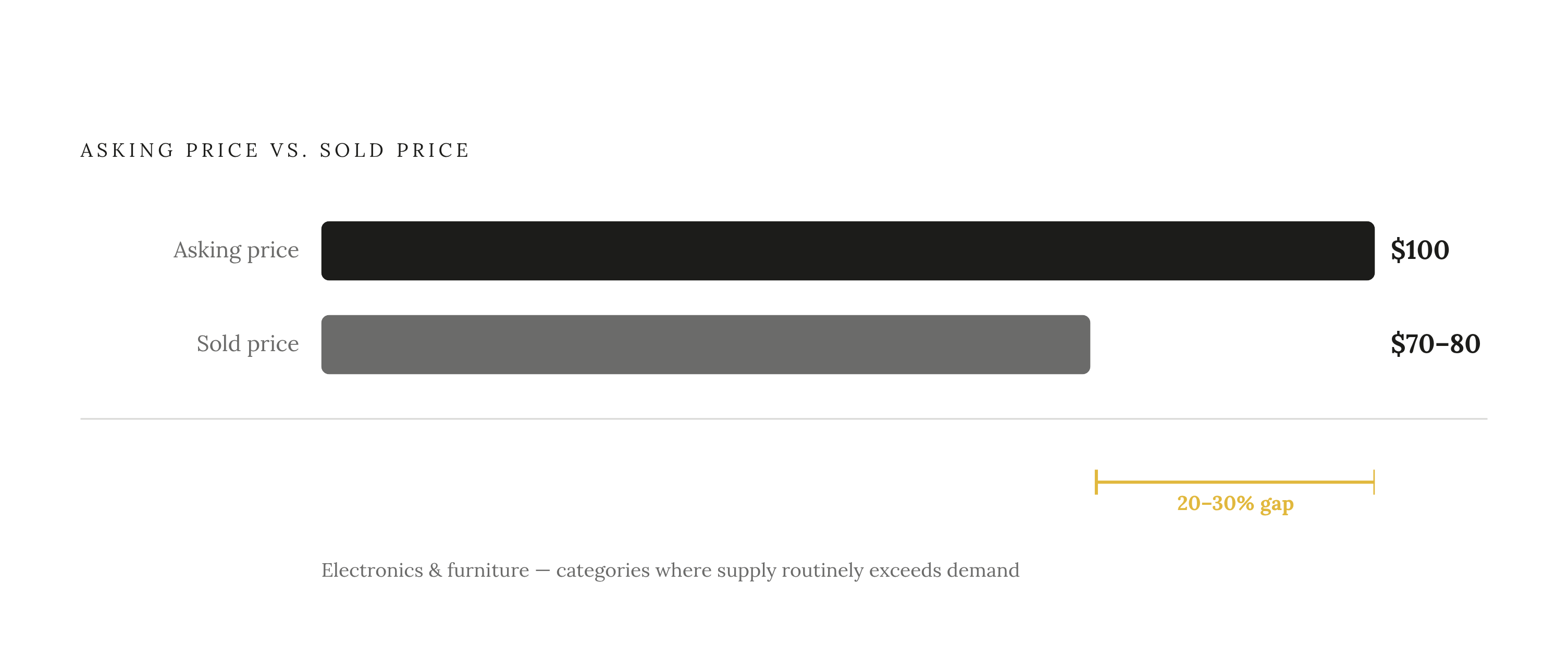
An asking price is a seller’s hope. A sold price records a transaction that closed. The gap can reach 20 to 30 percent in categories such as electronics and furniture, where supply routinely exceeds demand. That difference can leave a listing that seems fairly priced well above what buyers will pay.
Facebook Marketplace makes this distinction especially easy to miss because it shows no sold prices at all. Sellers looking only at its listings compare asking prices with more asking prices, creating a closed loop without a completed-sale signal. There may be plenty of numbers on the screen, but none answers the crucial question of what a buyer paid. The price tags are talking to one another.
What photo-first AI valuation actually does under the hood
A photo-to-price tool starts with image recognition, moves through item identification, and then retrieves market data. These are separate jobs. The identification layer works out what the object is, while the pricing layer attaches a value using whatever data the tool draws from. Two apps can recognize the same item correctly and still return very different prices because they consult different kinds of listings.
Visual cues help identify the brand, model, era, category, and distinguishing features. A logo on a tag, a model number on a sticker, a collectible’s design, or a ceramic maker mark can narrow the match. Natural language processing reads visible text, including patent dates and country-of-origin stamps, to refine that identification.
Reliability then depends on both the match and the market history. It is easier to price branded, mass-produced items that have plenty of past sales than one-of-a-kind antiques or goods with heavy wear. Poor photos also make the results less accurate, and those harder cases need to be checked by hand against sold comparisons, usually called sold comps. Recognizing a model does not, by itself, establish its condition.
Anyone looking for automatic AI condition grading and real-data pricing needs proof that the tool can do each job. A scanner may identify an object without showing how its estimate accounts for wear. Only some photo-scanner apps say they use sold prices, and fewer show the sales behind their estimates. Can you see the sales behind it?
How do you get a resale price based on sold items, not listings?
Google Lens is a free first-look identification tool on web, iOS, and Android. It finds visually similar products quickly, but the prices it surfaces are current retail asking prices. That makes it useful for answering “What is this?” before moving to a dedicated pricing source.
FlipAI identifies resale items from a photo or barcode on iOS and shows current eBay asking prices with an AI estimate. Its free allowance is 10 lifetime scans, followed by a monthly Pro subscription. The important distinction is the evidence underneath the estimate. Live listings show current competition, but they do not establish what buyers have paid, so they are not a substitute for sold comps in a final pricing decision.
Curio specializes in antique identification on iOS and Android, with attention to maker marks, era, and backstory. It is free to download with paid tiers. Curio does not specify on its site whether its price estimates use asking prices or sold prices. Its values can therefore help with identification and backstory, but a final price needs more proof. A compelling backstory still needs a buyer.
Tools that focus on one category are another option when their database is a better fit for the item than a general scanner. PriceCharting covers video games, trading cards, and comics through price guide data, with free web, iOS, and Android options and a Photo Appraiser feature. Price guide data should still be distinguished from visible individual transactions. Discogs is free and provides real sales data from its marketplace for vinyl records, CDs, and other physical music formats.
For a wider range of resale items, eBay sold data shows completed sales to compare with the item that has been identified. The practical workflow is to use an identification tool where needed, then consult the relevant sold records rather than treating every app-generated estimate as equivalent. These tools perform different jobs.
The condition adjustment that turns a sold comp into your actual price
A sold comp shows what someone else’s item sold for. The median of several recent sold prices for the same item, adjusted against the condition those listings describe, provides a practical starting point. Condition provides the next adjustment. A barely used example with its original box or tags has a stronger position than one with visible wear, even when the model number matches.
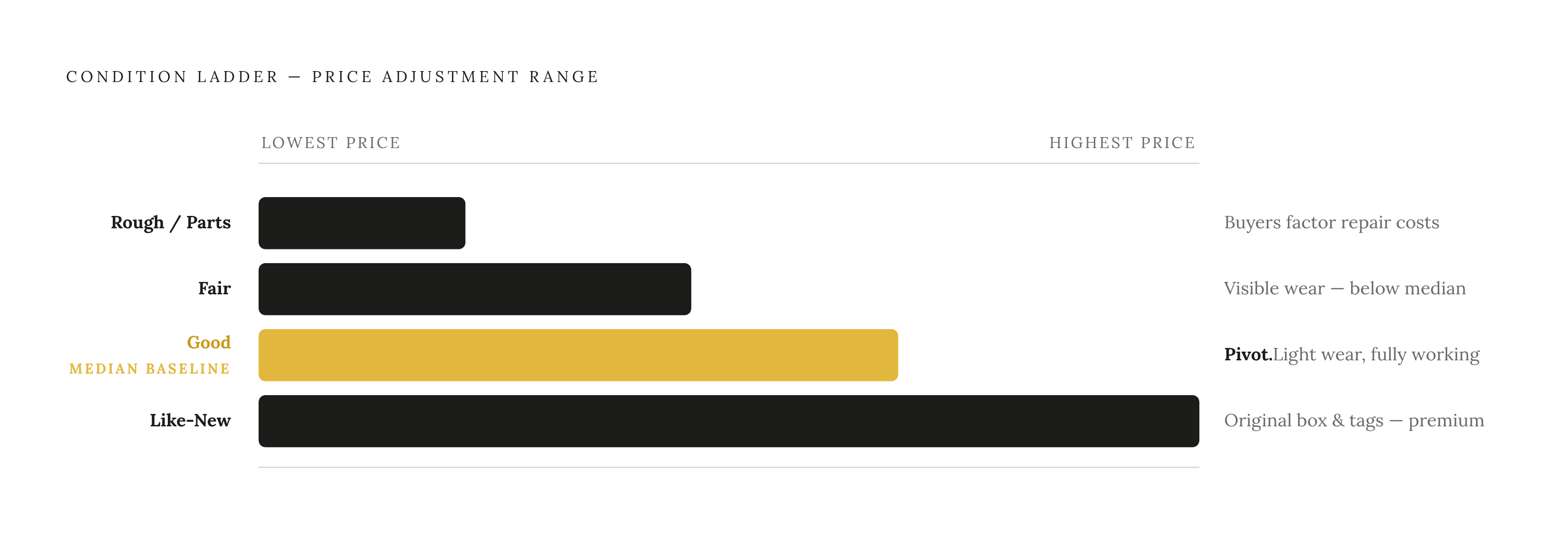
The rough condition ladder runs from like-new through good, fair, and rough or parts-only. Good means the item has light wear and works fully, which is the usual used condition in many comps. Fair means the item has visible wear but still works, so a price below the median can help it sell. Rough or parts-only goods need pricing that recognizes buyers are calculating repair costs.
For Facebook Marketplace, the workable substitute for missing sold records is eBay’s sold data for the same item. A used phone or couch can provide a rough cross-market reference, followed by a slightly lower local price to account for the local-sale dynamic and expected negotiation.
On platforms where offers are normal, modestly pricing above the median can leave negotiating room. The trade-off is a longer wait and more lowball offers. A simple markdown schedule, with a drop after one unsold week and another after two, keeps that cushion from becoming permanent upholstery. After the price has been adjusted for condition and negotiation, platform fees still have to come off to show how much the seller takes home.
How platform fees change the real value of the same sold comp
A sale price and a payout are different numbers. The same item sold for the same amount can leave a different balance depending on the marketplace and transaction type. A sold comp establishes what the buyer paid, but it does not establish what the seller kept.
Facebook Marketplace local pickup paid in person has no selling fee. Meta’s seller policy as of October 2026 applies a fee to shipped orders through Facebook checkout, with that shipped fee doubled from its prior level. That works for furniture, appliances, and exercise equipment when shipping would eat up the profit, though their prices still need to be checked against sold data from elsewhere.
Poshmark’s October 2026 fee structure takes a flat fee below a sales threshold and a percentage at or above it. The flat charge makes it especially expensive for cheap items. As the sale price falls, a fixed deduction consumes more of the proceeds, so a low sold comp can look much less appealing after fees. Depop’s zero-commission structure provides a different fee basis for fashion, though zero commission should not be read as a statement about every possible selling cost.
The resulting routing logic follows the item and the deductions. Facebook Marketplace fits bulky local goods, eBay fits shipped goods with a real secondary market, and Poshmark fits brand-name fashion where its buyers are concentrated. Depop fits fashion items where zero commission is important to the proceeds. None of those routes makes a platform best overall.
What real sold data shows about which categories are worth listing
Is the item worth listing at all? A plausible selling price is useful only if the likely proceeds justify the work of photographing, describing, answering questions, and completing the sale. That is where a quick valuation can save more time than a faster description generator.
Working, tested electronics often hold enough value to justify that effort, including phones, retro game consoles, cameras, and AV gear. eBay’s pre-owned sales data for Jul–Oct 2026 puts a vintage Marantz receiver at a median sold price of $605. That is a concrete reason not to price unfamiliar equipment by its age or appearance alone. Serial numbers and all accessories belong in the photos, while untested gear brings return risk.
Other high-value examples in that period’s sold data include a Herman Miller Aeron chair, a PlayStation 5, and a Nintendo Switch OLED. Those named products illustrate where casual guesses can diverge sharply from market value. The exact identity does real work here. “Old chair” and “Herman Miller Aeron” are not equally useful inputs to a pricing search, even if they describe the same object in the spare room.
Branded clothing also has steady demand, including Patagonia, Carhartt, Levi’s, Lululemon, and Nike. Buyers search for those names, so the brand helps connect the item to its audience. Generic no-name clothing rarely clears, while fast-fashion pieces from H&M, Forever 21, and Shein face low resale values and thousands of similar listings. Competition makes differentiation difficult before the seller has written a word.
A photo-to-price check takes seconds and can separate promising listings from goods that do not repay the effort. Items without a visible brand or model number and without comp history are especially difficult to identify and price. For those items, the recommendation is to donate rather than spend time manufacturing a listing out of uncertainty.
Turning a photo and a price into a listing that sells
Once the price is grounded, the listing needs to explain what supports it. The brand or model number belongs in the title because buyers search using specific terms. The listing must describe the same condition that was used to set the price. A “good/gently used” comparison does not justify hiding visible wear, and that mismatch invites returns and disputes.
Clear views against a plain background reduce uncertainty and return requests, while visible serial numbers and accessories help establish what is included. For electronics, that also connects the listing to the identification work already done.
Underpriced AI can close the loop between photo identification and listing creation by generating the title and description in the same step. That makes a photo-first workflow useful beyond the estimate, removing the blank-page friction that stops casual sellers from starting. The generated wording still needs to reflect the identified item and the condition behind its price.
A description that answers likely questions reduces the need for messages, and fast replies to the questions that remain shorten time-to-sale. The finished listing should make the model, condition, completeness, and price easy to understand. At that point, the photo has done more than produce an impressive-looking number. It has helped turn evidence of value into something a buyer can act on.