Shipping Basics for First-Time Online Sellers
A step-by-step cost breakdown to keep your first sale profitable.
Shipping costs the average first-time seller more than they think, and almost none of that extra cost is the carrier rate. It's the box, the tape, the bubble wrap, the label fee, and the fact that nobody added those up before setting a price. This guide walks through each cost in order, from the box you pick to the price you post, so you don't quietly lose money on the first sale while you're too busy celebrating that it sold.
Why first-time sellers lose money on shipping
Picture a seller who lists a used blender for a modest price, slaps on a flat shipping charge because that number felt fair, and packs up the sale feeling good about it. Then the box costs a little, the bubble wrap adds a little more, and the label, bought at full retail, runs much higher than either. The flat rate charged to the buyer didn't come close to covering it. That's the normal first-sale experience for anyone who counted postage and called it done.
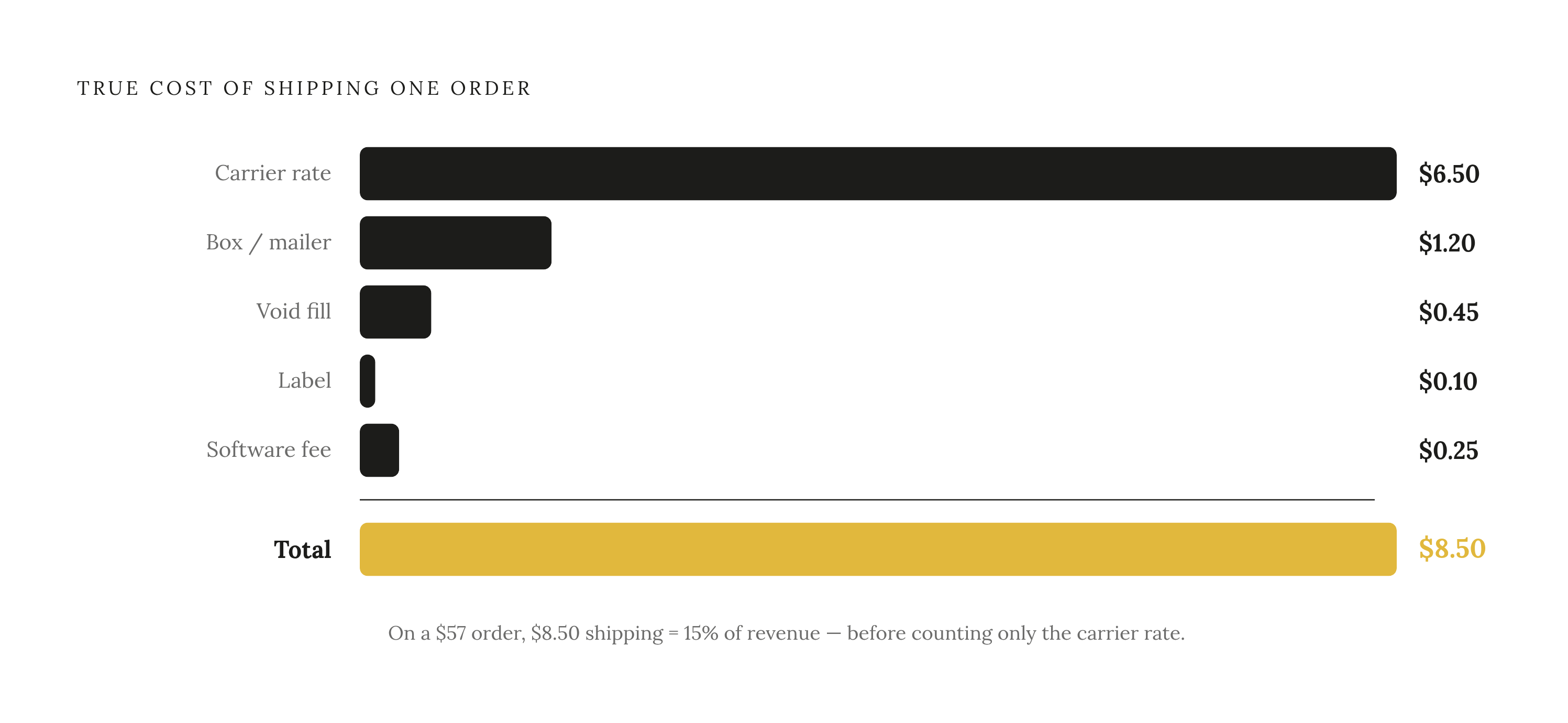
The real cost of shipping an order is the carrier rate plus the box or mailer, plus void fill, plus the label itself, plus any software fee tied to printing that label. Add all five before pricing anything. Skip that step and shipping costs can run past 15% of total revenue, quietly eating the profit on every single order; plenty of small sellers are already well past that line without knowing it, because they set a shipping price to look competitive instead of working backward from what the shipment actually costs.
Someone selling two things a year might wonder if any of this is worth tracking. It is, because a sale that costs more to ship than it earns doesn't teach a new seller anything except to quit. Getting the math right on sale number one is the whole game. It's a lot easier to build good habits before the first loss than to unlearn bad ones after the tenth.
Dimensional weight
Carriers don't always bill by what something weighs. For packages that are light but take up a lot of room, they bill by dimensional weight, a number calculated from the box's size. That means a big empty box with a small light item inside can cost a lot more to ship than the item's actual weight would suggest. The box itself becomes a cost input, not just packaging.
Box size is the one lever a seller controls directly here. A box that's too roomy gets charged by the carrier for all that empty air, whether or not anything is in it. Distance also affects the price: carriers price by zone, so the same oversized box costs more shipped cross-country than shipped two states over, even though the label looks identical at a glance.
Weighing the package correctly avoids a second trap. Always weigh it after it's packed, not before, so the box and padding are part of the number. And carriers round up: a package that weighs 9.14 pounds gets billed as a 10-pound package, full stop on the decimal. The practical rule is simple. Pick a box that fits the item snugly. Too large, and the seller pays twice: once through the dimensional weight surcharge, and again for the extra bubble wrap needed to keep the item from rattling around in all that dead space.
Choosing packaging that protects the item without inflating the carrier bill
With the dimensional weight factor clear, you can base the packaging decision on a straightforward call about what's being shipped. Light items need light packaging. Heavy or breakable items need sturdier packaging. Get that match right, and costs stay predictable order to order.
For anything light, apparel, accessories, printed material, a poly mailer or padded bubble mailer beats a cardboard box on every count. They weigh less, they ship flat, and they can cost just a few cents apiece, which adds up to real savings across a few dozen orders compared to boxing everything by default.
For anything heavier or fragile, electronics, ceramics, anything that can shift around in a truck full of other packages, corrugated cardboard with real cushioning is worth the extra cost. A quick shake test before sealing tells the story: if something rattles, add more padding before the box goes anywhere. That extra padding costs a few dollars at most. A damaged-item refund and a dispute over it costs a lot more, in both money and hassle.
Free supplies are sitting there unused by most beginners. USPS, FedEx, and UPS all give away boxes at no charge. USPS Priority Mail boxes can be ordered free from store.usps.com and delivered right to the door, as long as they're used with Priority Mail service. A digital postal scale (weigh after packing, never before), a tape measure (round every dimension up to the next full inch), and a small set of standard box sizes are worth owning early on, so measuring from scratch isn't necessary every time something sells. You don't need a thermal label printer on day one, but it earns its keep fast. It prints with heat instead of ink, runs faster than an inkjet, and costs a fraction as much per label, which matters the moment shipping stops being occasional.
Once a seller works out what a given item actually costs to ship, packaging turns into one of the easiest places to protect margin: poly mailers for anything light, corrugated board and real cushioning for anything fragile, and free carrier-supplied boxes wherever they fit, each one a small decision that adds up across a season of sales.
Matching the carrier to the shipment rather than defaulting to one for everything
No single carrier wins every time. Sticking with one out of habit, or because its drop-off box happens to be closer, means overpaying on some share of every batch of shipments. The right carrier follows from what's inside the box, not from which counter is easiest to reach.
USPS generally wins on light parcels. But if a shipment gets heavy or needs to arrive by a specific day, UPS and FedEx generally win. USPS Ground Advantage is usually the cheapest standard option for anything under a pound, with one exception: USPS Media Mail, which beats it for eligible media like books and records. But once a package gets heavier and speed starts to matter, UPS and FedEx ground services close the gap, and they often come out ahead.
USPS offers free home pickup, so there's no need to drive to a counter and stand in line just to hand off a package. For a casual seller shipping once or twice a week, that one feature often decides whether an order ships on time or sits on the counter for three extra days.
Where to buy labels
The exact same label, same carrier, same service, costs different amounts depending on where it's bought. Buying at the post office counter is the most expensive route available. Buying through eBay or through third-party shipping software gets the same label for roughly 10 to 30% less, with the exact savings shifting by service, weight, and zone.
Pirate Ship is a free piece of web-based shipping software. There's no monthly fee; sellers pay for postage and nothing else. It gives small, occasional sellers access to USPS Commercial Pricing, and sometimes even pricing below Commercial through USPS's Connect eCommerce program, so they get the same discounted rates that high-volume shippers use. Shippo runs a similar free Starter plan: no monthly fee, no per-label charge on Shippo's own carrier rates (a 5-cent fee only kicks in if a seller connects their own carrier account), and it opens up multiple carriers along with USPS commercial rates, which makes it a solid pick for anyone who wants options beyond USPS and UPS. ShipStation sits further up the ladder. You only need its subscription once your order volume climbs high enough to justify it, so if you're shipping a handful of orders a month, you're usually better off with one of the free tools instead.
eBay's own built-in label tool also charges commercial rates, and it has one advantage the standalone tools don't automatically offer: it attaches the label straight to the order record.
How tracking and signature confirmation protect sellers from disputes
Tracking isn't a nice-to-have on eBay. You need it to actually get paid and stay protected if something goes wrong. A seller without tracking on a package has no path to winning an "Item Not Received" case, no way to qualify for Top Rated Seller status, and no coverage under eBay's money-back guarantee if a buyer disputes the order.
High-value items raise the bar further: if you sell something for $750 or more, eBay requires signature confirmation. Skipping it leaves zero protection against an "Item Not Received" claim, even if the tracking record shows the package was delivered to the door.
Buying the label through eBay solves this automatically: the tracking number attaches to the order the moment the label is generated. Pirate Ship can do the same thing, but only after the seller links their Pirate Ship account to eBay through its integration settings first. That one setup step is exactly where beginners tend to miss the requirement, shipping a package with tracking that technically exists but was never attached to the order where it counts.
eBay's search algorithm rewards fast handling and fast delivery, which adds a second layer to how shipping decisions pay off. Shipping fast and shipping tracked isn't just about staying safe from disputes. It also sells more.
Pricing shipping into a listing before the item sells
Everything up to this point, true cost, box size, carrier choice, label source, all funnels into one moment: typing a price and a shipping charge into a listing before anyone has bought anything. Figuring that number out after the sale is how the margin disappears.
Work out the true shipping cost for the specific item before you list it. Weigh it packed, measure the box, estimate the likely destination zone, and look up the actual rate through Pirate Ship or eBay's label tool. Add the box, the mailer, and the void fill on top of that rate to get the real number, not an estimate.
From there, two approaches both work. You can charge the buyer calculated shipping, which stays transparent and adjusts automatically based on where the package is headed. Or fold the shipping cost into the item's price and advertise "free shipping." Free shipping is never actually free: it's either baked into what the buyer pays for the item or quietly eaten out of the seller's margin, and a seller needs to know which one is happening before advertising it that way. "Free shipping" tends to boost both conversion and search placement on eBay, but only pays off when the listed price already covers the real shipping cost calculated earlier. Calculated shipping tends to protect you better on heavy items or long cross-country hauls, because zone pricing swings widely there, but flat-rate or free shipping works fine for small, light items where the rate barely moves no matter where it's headed.
The item's own price matters here too. Used goods typically sell for a fraction of their original retail price depending on condition, and the shipping cost has to fit inside whatever margin that leaves. A cheap item with a shipping cost far higher than its price isn't a listing worth making, no matter how good the item is.
If you set an accurate shipping price before the listing goes live, you separate a profitable first sale from a silent loss, and that starts with knowing the true per-order cost ahead of time. Reclaim: Sell with AI, which prices items using real market data, can build custom shipping policies directly into the listing at the moment it's created, turning what used to be a guess into a deliberate decision from the start. Because these tools calculate item value and shipping cost together from a single photo, they remove the manual math that trips up most first-time sellers before they even realize they're doing it wrong.
Get this part right on the first listing, and the second one takes a fraction of the effort. That's the whole payoff.